
MSC: Bridging Engagement and Similarity for Stable Community Discovery
Finding Maximal Stable Cores in Social Networks
This paper introduces the Maximal Stable Core (MSC), a novel cohesive subgraph model for social networks that integrates structural engagement (k-core) and attribute similarity (clique). The authors propose an efficient Core Decomposition algorithm to identify all MSCs containing a query user, achieving superior performance over baseline binary search methods.
TL;DR
Finding stable groups in social networks requires more than just counting connections—it requires shared interests. This paper introduces Maximal Stable Cores (MSC), a subgraph model that identifies the most tightly connected group a user belongs to, where every member is also highly similar. The authors tackle the NP-Hard nature of this problem using a clever Core Decomposition Approach that outperforms standard binary search search techniques.
Problem & Motivation: Why Structure is Not Enough
Modern social network analysis often relies on the k-core (where everyone has at least neighbors). While mathematically elegant, a -core can be fragile; if users don't share common interests, the group is likely to dissolve (unravel).
The (k, r)-core model was previously proposed to fix this by adding a similarity threshold . However, two major problems remained:
- NP-Hardness: Checking the similarity constraint is equivalent to finding a clique on a similarity graph, which is computationally expensive.
- The "Optimal k" Problem: Users don't just want to be in any group; they want to be in the most engaged group possible. Finding this maximum (the MSC) for a specific query user is the core challenge.
Methodology: The Core Decomposition Insight
The baseline approach to finding the maximum is Binary Search, which repeatedly calls an expensive enumeration algorithm. The authors' breakthrough is based on a Nested Property: a -core is always contained within a -core.
The Algorithm Strategy
Instead of searching for values blindly, the Core Decomposition Method follows these steps:
- Pruning: Remove all users dissimilar to the query user .
- Base Enumeration: Find a -core for a starting value of .
- Local Decomposition: Since all members of this core are already similar, the similarity constraint is satisfied for all sub-populations. We can now run a standard, linear-time k-core decomposition on this small subgraph to find the highest possible for user .
 Figure 1: Comparison between Engagement (left) and Similarity (right) graphs to identify the MSC.
Experiments & Results
The authors tested their methods on two real-world datasets: Brightkite and Gowalla.
Key Findings:
- Bottleneck Identification: The "First Enumeration" (finding the first valid group) accounts for up to 90% of the runtime as similarity increases.
- Efficiency: Once the first core is found, the Core Decomposition (CD) approach is significantly faster than Binary Search (BS) because it avoids re-running the NP-Hard similarity checks.
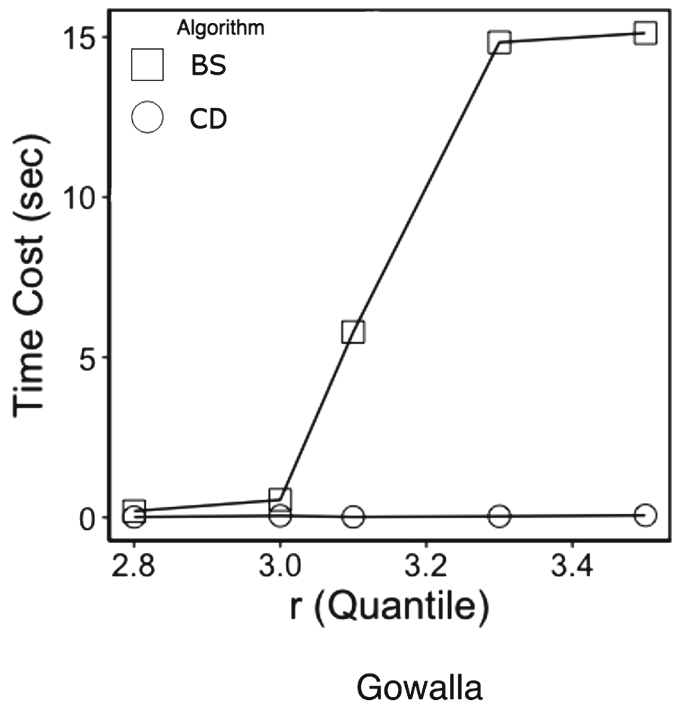 Figure 2: Performance gains of Core Decomposition over Binary Search in subsequent iterations.
Critical Analysis & Conclusion
The Maximal Stable Core provides a robust framework for applications like friend recommendations and targeted marketing. By ensuring both high engagement and high similarity, it identifies "sticky" communities.
Takeaway: The real value of this paper lies in the theoretical proof that once a similarity-constrained subgraph is identified, further structural optimization can be done in linear time.
Limitations: The algorithm's total speed is still tethered to the efficiency of the initial maximal clique enumeration. Future research into approximating the first (k, r)-core could unlock even greater performance for massive-scale datasets.