
Game-Based Diffusion: Why Your Seeding Strategy for Social Networks Might Be Wrong
16901_On maximizing diffusion speed in social networks impact of random seeding and clustering.
The paper investigates the "Diffusion Speed Maximization" problem within game-based social network models. It proposes polynomial-time approximation algorithms for Erdős-Rényi, Planted Partition, and Geometrically Structured graphs, achieving nearly optimal diffusion speeds by strategic seed placement.
TL;DR
While most researchers focus on "how many people" an innovation reaches (Influence Maximization), this paper tackles "how fast" it reaches everyone (Diffusion Speed Maximization). By moving away from epidemic-based models to game-based Logit dynamics, the authors prove that traditional high-degree seeding often fails. Instead, they provide a toolkit of algorithms that adapt to network topology—ranging from random seeding in dense graphs to border-node targeting in structured ones.
The Core Motivation: From Infection to Strategic Choice
Most social influence research treats information like a virus: if you touch an infected person, you might get sick. But real-world adoption—like choosing a new smartphone or joining a social platform—is a coordination game. You only switch if enough of your friends do, because there's a payoff to being on the same system.
The problem? Even if everyone eventually switches, it could take a lifetime. This paper asks: How can we spend a small budget to make the whole network switch as fast as possible?
The Mathematical Intuition: Crossing the Energy Barrier
The authors model user behavior using Logit Dynamics. Users aren't perfectly rational; they make "noisy" best responses. The network state is a Markov Chain, and the hitting time (time to total adoption) is dictated by an Energy Function .

The term represents the "Energy Barrier." Think of the network adoption as a ball trying to roll over a mountain range. Seeding individuals is like lowering the height of the peaks. The goal is to find the set of seeds that minimizes the highest peak the adoption process must climb.
Methodology: Topology-Aware Seeding
The paper identifies that "one size fits all" does not apply to social networks.
1. The Global Connectivity Paradox (Erdős-Rényi)
In a globally well-connected, dense graph, the symmetry is so high that no single node is significantly more influential than another for speed. Surprisingly, the authors prove that arbitrary (random) seeding is nearly optimal.
2. The Power of Proportion (Planted Partition)
In networks with large, distinct communities, the intra-cluster diffusion is the bottleneck. The optimal strategy is to allocate seeds proportionally to the size of the clusters.
3. The Border-First Strategy (Structured Graphs)
For planar or d-dimensional graphs (common in geographic social networks), the authors propose the PaS (Partitioning and Seeding) algorithm.
- Phase 1: Partition the graph into small, manageable clusters.
- Phase 2: Seed the "border nodes" (the separator cluster ) first to break the correlation between clusters.
- Phase 3: Use a greedy approach to fill the remaining budget within clusters.
(Note: Refer to Algorithm 1 in the paper for the step-by-step logic of Partitioning and Seeding.)
Experimental Results: Real-World Evidence
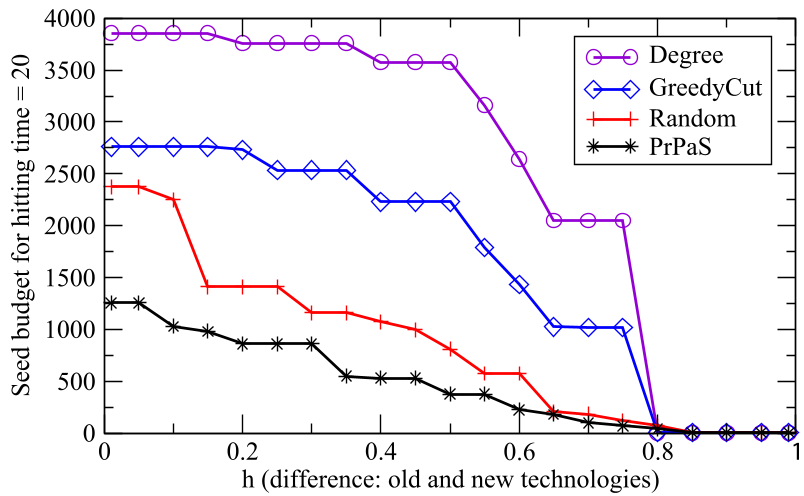
Using Facebook ego networks, the authors demonstrated a "Phase Transition" in hitting times. If the seed budget is too low, the network takes forever to adopt. Once the budget hits a "threshold," speed increases dramatically.
Key Findings:
- Degree and GreedyCut (Epidemic SOTA): Performed poorly. Targeting high-degree nodes doesn't necessarily help cross the energy barriers in game-based models.
- PrPaS (The Paper's Method): Achieved the threshold with 50% fewer seeds than random selection and significantly outperformed degree-based heuristics.
Critical Insight & Conclusion
The fundamental takeaway is that in game-based diffusion, localization matters more than centrality. While high-degree "influencers" are great for spreading a virus, "cluster-aware" seeding is the key to accelerating strategic adoption. This work opens a new frontier in viral marketing: don't just look for the most connected people; look for the structural bottlenecks of the network.
Limitations: The model assumes a static graph and fixed payoffs. Future research could explore dynamic topologies or cases where payoffs evolve as the innovation matures.