
Maximizing Earned Benefit: A Precision Strike Approach to Social Influence
Maximizing the Earned Benefit in an Incentivized Social Networking Environment: An Integer Programming-Based Approach
This paper introduces an Integer Programming (IP) approach for the "Benefit Maximization in Incentivized Social Networking Environment" problem. By incorporating node-specific selection costs and target-specific benefit values, the method optimizes seed node selection under a fixed budget to maximize the expected earned benefit among predesignated target users using the Independent Cascade (IC) model.
TL;DR
In the world of viral marketing, not all users are created equal. This paper shifts the focus from "how many people can we reach" to "how much value can we extract from specific targets." By formulating the problem as an Integer Program (IP), the authors provide a mathematical framework to select influential seed nodes that maximize financial or strategic benefit within a strict budget, outperforming traditional heuristics by over 12%.
The Strategic Shift: Beyond Simple Popularity
The classic Social Influence Maximization (SIM) problem is often criticized for being too "academic." It treats every user as a unit of one. In reality:
- Costs are Variable: Influencing a celebrity costs more than a local student.
- Targets are Specific: A brand might only care about users interested in "High Energy Physics" or "Tech Gadgets."
- Benefits are Uneven: Converting a high-net-worth individual might be worth 100x more than a casual browser.
The authors identify that previous SOTA methods failed to synthesize these three practical constraints into a single optimization objective.
Methodology: From Probability to Optimization
The core challenge of applying Integer Programming to social networks is the probabilistic nature of influence. You don't know if User A will influence User B; you only know there's a 10% chance.
The IP Formulation
To bridge this gap, the authors use a Sampling Technique. They generate multiple "deterministic" versions of the network (realizations) where edges are either "active" or "inactive" based on their probabilities.
The objective function maximizes the average benefit across these realizations:
Key Constraints Explained:
- Budget Constraint: Ensure the sum of costs for selected seed nodes does not exceed budget .
- Diffusion Logic: A node can only be influenced at time if one of its neighbors was influenced at . This captures the "cascade" effect of the Independent Cascade model within a linear system.

Performance: Quantitative Superiority
The researchers tested their IP approach (implemented via Python's PuLP module) against common heuristics:
- MAX_DEG: Picking people with the most friends.
- MAX_CLUS: Picking people in tight-knit communities.
- MIA/PMIA: High-end tree-based influence approximations.
Key Finding: The "High Budget" Advantage
The experiments on the Facebook Ego Network and HEP Collaboration Network revealed a clear trend: as the budget increases, the IP approach's ability to "see" the global network structure allows it to pick seed sets that heuristics miss.
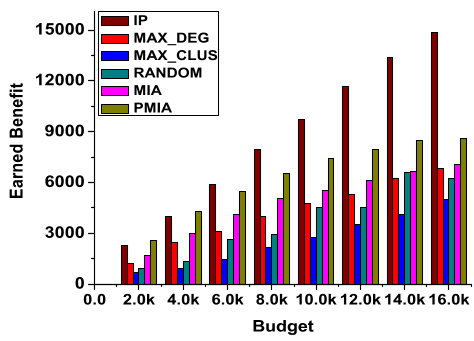 Figure: On the Facebook dataset, the IP approach (highest line) significantly pulls away from heuristics as the budget grows, proving its efficiency in identifying optimal "benefit-to-cost" pathways.
Critical Analysis & Conclusion
The primary takeaway is that exact mathematical modeling (IP), even when simplified through sampling, provides a more robust foundation for targeted marketing than decentralized heuristics.
Limitations & Future Work
While the IP approach is more accurate, it is computationally intensive (-Hard). While it beat MIA in speed in some tests, it is vastly slower than simple MAX_DEG. The authors satisfy the need for precision, but the next frontier is scalability. Future research will likely focus on "Heuristic IP" or GNN-based (Graph Neural Network) approximations that can provide the same "Benefit Maximization" logic at the speed of light for billion-scale networks.
Takeaway: If you have a specific target list and a limited budget, stop counting followers and start solving equations.