
MGC Algorithm: Precision Seeding for Collective Action in Social Networks
Maximizing Group Coverage in Social Networks
The paper introduces the Maximizing Group Coverage (MGC) algorithm for the Group Influence Maximization (GIM) problem. It aims to select seed nodes to maximize the expected number of activated groups under the Independent Cascade (IC) model, outperforming the baseline Maximum Coverage (MC) approach.
TL;DR
In social networks, decisions are rarely individual—they are group-based (e.g., a class buying a specific textbook). This paper tackles the Group Influence Maximization (GIM) problem. Unlike standard Influence Maximization, GIM requires a percentage () of a group to be active for the group itself to be "activated." The authors propose MGC (Maximizing Group Coverage), a heuristic that identifies seed nodes not just by how many groups they "touch," but by how effectively they can influence their peers within those groups.
The "Group Decision" Bottleneck
Traditional Influence Maximization (IM) is a well-studied field, but it has a fundamental flaw when applied to real-world marketing or social engineering: the lack of group logic. In many scenarios, an individual won't adopt a behavior unless a significant portion of their circle does the same.
Mathematically, this changes the game. While individual IM often deals with submodular functions (where "diminishing returns" allow for greedy approximations), GIM's objective function is neither submodular nor supermodular. This renders standard greedy algorithms theoretically insufficient and practically weak.
Methodology: Beyond Simple Coverage
The authors identify a critical insight: Coverage Influence. A node might belong to 10 groups (High Coverage), but if it has zero connections to other members in those groups, it is a "dead end" for cascades.
The MGC Algorithm solves this by calculating a contribution score for each node:
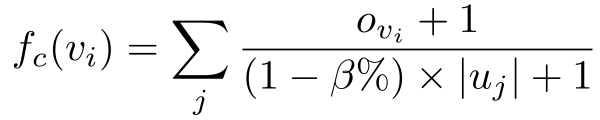
Why this formula works:
- The Numerator (): This accounts for the node itself plus its neighbors/target nodes within the same group. It prioritizes "localized influencers."
- The Denominator (): This represents the "resistance" of the group. Smaller groups or groups with lower activation thresholds are easier to flip, giving nodes in those groups a higher weight.
The algorithm then sorts nodes by this score and selects the top , resulting in a complexity of , making it highly scalable for large social graphs.
Experimental Validation
The authors compared MGC against the Maximum Coverage (MC) baseline—a strategy that simply picks nodes belonging to the most groups.
Key Findings from Dataset 1 (Gnutella) and Dataset 2 (Deezer):
- The β-Threshold Gap: As the group activation threshold increases, group activation becomes exponentially harder.
- MGC vs. MC: As seen in the performance charts, MGC consistently stays above MC. In scenarios where , the MC algorithm fails to activate almost any groups because it doesn't account for the internal "social pressure" needed to trigger the threshold, whereas MGC continues to succeed.
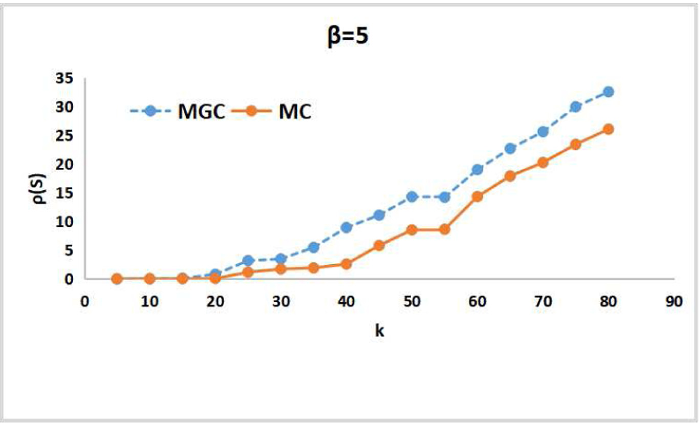 Fig 1: MGC consistently outperforms MC across different seed sizes (k).
Critical Insight & Future Outlook
While MGC is powerful, the authors honestly note a limitation: its effectiveness wanes when groups are very large and thresholds are very low, as the "local influence" becomes diluted.
From a high-level perspective, this work shifts the focus of network influence from "Structural Centrality" (where you sit in the network) to "Group-specific Utility" (how much leverage you have over a specific collective). For future researchers, the next frontier lies in defining an approximation ratio for this non-submodular objective to provide better theoretical guarantees.
Conclusion
If you are building a viral marketing campaign for a product that requires "community buy-in" (like a multiplayer game or a corporate tool), MGC suggests you stop looking for the person with the most followers, and start looking for the person who is most "entrenched" within their specific cliques.