
Maximizing Leader Influence: Scaling Opinion Dynamics through Smart Link Addition
Maximizing Influence of Leaders in Social Networks
This paper investigates the "Opinion Maximization" problem using the DeGroot model, aiming to maximize a crowd's average opinion by strategically adding edges between 1-valued leaders and followers. The authors propose two greedy algorithms, including a fast approximation version that achieves near-linear time complexity and scales to networks with millions of nodes.
TL;DR
How do you win a "war of opinions" in a massive social network? While most research focuses on who you choose as leaders, this paper proves that how you connect those leaders to followers is equally critical. By combining social science's DeGroot model with cutting-edge graph theory (Laplacian solvers), the authors provide a toolkit to maximize influence in networks with over a million nodes.
Perspective: Beyond Leader Selection
In the landscape of social influence research, the "Leader Selection" problem is well-trodden ground. However, identifying a charismatic influencer is only half the battle; the real-world challenge often lies in link recommendation—suggesting the right friends or follows to bridge ideological gaps.
The technical hurdle? Calculating the equilibrium opinion of a network requires inverting a Laplacian matrix. For a network of a million nodes, a traditional approach would take centuries. This paper addresses this bottleneck by treating graph topology as a dynamic optimization problem.
The Core Mechanism: Monotonicity and Submodularity
The authors model the network using a variant of the DeGroot model, where "stubborn" leaders hold binary opinions (0 or 1) and followers update their views based on the weighted average of their neighbors.
Two mathematical properties make this problem solvable:
- Monotonicity: Adding a link between a "positive" leader and a follower never decreases the overall network opinion.
- Submodularity: The "law of diminishing returns" applies. Connecting a leader to a follower who is already surrounded by positive influences yields less marginal gain than connecting to a "neutral" or "negative" follower.
By proving these, the researchers justify using a Greedy Algorithm, which provides a guaranteed approximation of the optimal solution.
Methodology: From to Near-Linear Time
The paper’s "Secret Sauce" lies in two sophisticated approximation techniques:
1. SDD Linear System Solvers
Instead of calculating (the inverse Laplacian), the authors use fast solvers to find in . This reduces the problem of finding equilibrium opinions to a series of linear equation solves, which is significantly faster for sparse graphs.
2. Johnson-Lindenstrauss (JL) Projections
To estimate the impact of a new edge without updating the whole system, the researchers project the network's influence vectors into a lower-dimensional space. This allows them to "guess" the marginal gain of an edge with high accuracy and very low cost.
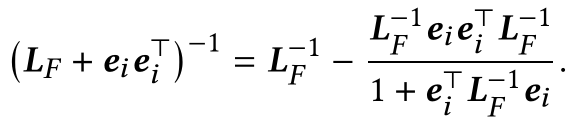 The Sherman-Morrison trick: How the authors calculate the impact of a single edge addition without re-calculating the entire network state.
Experimental Triumphs
The researchers tested their algorithms on datasets ranging from small groups (Karate club) to massive ones (YoutubeSnap).
Key Findings:
- Accuracy: Their "Approx" algorithm yields results virtually identical to the exact greedy solution.
- Baseline Superiority: It consistently outperforms standard metrics like PageRank, Degree Centrality, and Betweenness when deciding where to add edges.
- Scalability: The "Exact" greedy method fails on networks larger than 50,000 nodes due to memory limits, whereas the "Approx" version handles 1,000,000+ nodes with ease.
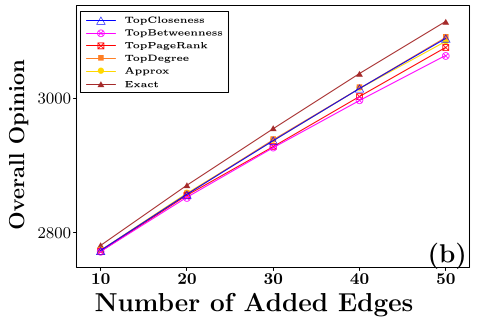 Performance across different types of networks (Reality, PagesGovernment, etc.) showing the greedy method (red/blue lines) consistently beating all other heuristics.
Critical Insight & Future Outlook
The primary takeaway is that global influence is a structural property. We often think of "virality" as a product of content, but this work shows it is heavily dependent on the "Laplacian" structure of the graph—how information flows through the nodes.
Limitations: The model assumes agents are passive averages of their neighbors. It doesn't account for "backfire effects" where aggressive prodding causes people to become more stubborn.
Future Work: The authors suggest applying these fast Laplacian techniques to minimize controversy or reduce polarization—effectively using the same math to "heal" social networks rather than just "maximize" a single viewpoint.
Conclusion
Zhou and Zhang have successfully bridged the gap between theoretical sociology and high-performance graph computing. Their work proves that with the right mathematical approximations, we can analyze and influence the digital town square at a scale previously thought impossible.