
Maximizing Long-term Integral Influence: Beyond the "One-Hit Wonder" in Social Networks
Maximizing the long-term integral influence in social networks under the voter model
This paper investigates the Long-term Integral Influence Maximization (LIIM) problem under the Voter Model in social networks. The authors propose an exact matrix-based solution to identify the most influential nodes that maximize the expected total number of activations over an infinite time horizon.
TL;DR
In social networks, opinions are rarely permanent. Users switch back and forth, influenced by their peers. This paper tackles the Long-term Integral Influence Maximization (LIIM) problem under the Voter Model. Instead of just looking at how many people are influenced at a single snapshot in time, the authors provide an exact mathematical solution to maximize the total cumulative activations over the long run using matrix analysis.
Background: The Fluidity of Opinions
Most classic influence models (like IC or LT) assume that once a node is "activated" (e.g., buys a product), it stays activated. However, the Voter Model reflects a more volatile reality: users change their minds repeatedly.
The core challenge here is moving from Instant Influence (how many people have the opinion at time ) to Integral Influence (the sum of all activations across all time steps to ). This is crucial for brands that care about total brand exposure or cumulative sales rather than a single viral moment.
Methodology: The Matrix Inversion Insight
The researchers prove that the propagation of influence in the Voter Model is a Markovian process. If we represent the network as a weight matrix , the total influence can be calculated as a geometric series of matrices.
The Exact Solution
The paper reveals that as long as the weights are properly normalized (ensuring the series converges), the long-term influence can be calculated via: Where:
- is the initial seed vector.
- is the identity matrix.
- is the transition weight matrix.
This is a powerful result: it means the "best" seeds are simply the nodes corresponding to the largest entries in the column sums of the matrix.

Experiments: Performance vs. Heuristics
The authors tested their exact solution against common industry heuristics like PageRank, Degree Centrality, and DegreeDiscount on datasets like Facebook and Twitter.
Key Findings:
- Superiority: The "ExactSolution" (based on matrix inversion) predictably outperformed all heuristics.
- The PageRank Connection: PageRank was found to be the closest approximation to the exact solution, confirming its value as a robust heuristic for social influence.
- Efficiency: While matrix inversion is more intensive than simple degree counting, the authors demonstrated that it is still highly practical, taking only seconds or minutes to process graphs with thousands of nodes.
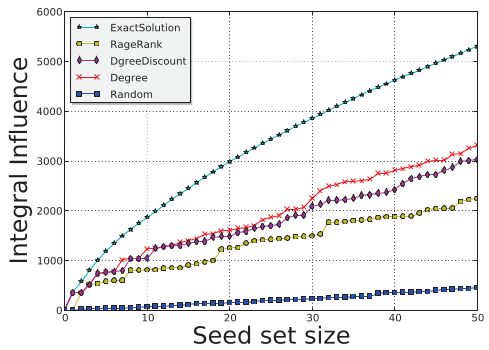 Figure: The ExactSolution (Blue line) consistently maintains the highest integral influence as the number of seeds () increases.
Critical Analysis & Future Outlook
Takeaway: This work shifts the focus from "viral marketing" (short-term) to "sustainable influence" (long-term). By providing an exact solution, it sets a theoretical ceiling for what heuristic algorithms should aim for.
Limitations:
- Scalability: For networks with millions of nodes, calculating directly becomes computationally prohibitive (). Future work needs to explore sparse matrix approximations or distributed inversion techniques.
- Weight Estimation: The model assumes edge weights are known, but in the real world, these "influence probabilities" are difficult to estimate accurately.
Future Prospect: Integrating this "Integral" view into Multi-Agent Reinforcement Learning (MARL) could allow AI agents to navigate social dynamics by understanding how their actions accumulate value over time, rather than seeking immediate rewards.