
PM2AM: Scaling Multi-Product Profit Maximization in Social Networks via Martingales
Maximizing profit of multiple adoptions in social networks with a martingale approach
The paper introduces the PM2AM algorithm, which addresses the Profit Maximization with Multiple Adoptions (PM2A) problem in social networks. By leveraging a martingale approach to estimate profit spread across multiple products, the algorithm achieves a approximation ratio of in near-linear time relative to the network size and product count.
TL;DR
Most "Influence Maximization" research assumes a single product and a simple node count goal. In the real world, companies have portfolios of products, disparate profit margins, and strict marketing budgets. This paper presents PM2AM, a near-linear time algorithm that maximizes total expected profit for multiple products. By applying martingale theory to statistical sampling, the authors break the scalability bottleneck that plagued previous multi-adoption models.
Problem & Motivation: Beyond the Single-Product Silo
The classic Influence Maximization (IM) problem asks: "Which users should I seed to maximize the number of people who hear about my product?" However, this is an oversimplification.
- Product Diversity: Companies like Apple or Samsung promote many products simultaneously.
- Cost-Profit Asymmetry: Activating a "seed" for a luxury item costs more but yields higher profit than a mass-market accessory.
- The Complexity Trap: Previous attempts at the "Profit Maximization with Multiple Adoptions" (PM2A) problem resulted in algorithms with complexity—totally impractical for modern social graphs with millions of nodes.
The authors' insight was to treat the multi-product spread as a submodular maximization problem on a "disjoint union graph," where each product propagates in its own layer, yet all share a common budget.
Methodology: The Martingale Magic
The core of the paper is the transition from Independent Cascade (IC) models to Reverse Reachable (RR) sets, optimized via Martingale analysis.
1. Reverse Reachable (RR) Sets
Instead of simulating a "forward" spread (which is slow), the algorithm picks a random node and looks backward to see who could have influenced it. If a seed node falls into this "RR set," then is influenced. This turns influence estimation into a Maximum Coverage problem.
2. Martingale Sampling
How many RR sets do we need to be "sure" about our profit estimate? Too many samples waste time; too few lead to bad decisions. The authors use a martingale sequence—a mathematical concept where the expected future value is equal to the current value.
They design a two-phase process:
- Sampling Phase: Iteratively generates RR sets until a stopping condition based on a lower-bound estimate of the optimal profit is met.
- Node Selection Phase: A cost-effective greedy selection that picks nodes with the best "bang for the buck" (Profit Increase / Cost).
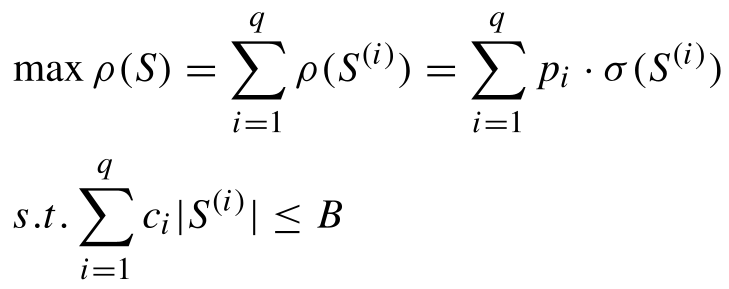 The objective function: Maximizing the sum of product profits subject to a total budget constraint.
Algorithms: PM2AM and Sampling
The paper introduces two critical algorithms to bridge the gap between theory and efficiency.
- Algorithm 3 (PMCE): The "Profit Maximization with Cost Effectiveness" greedy strategy. It maintains two candidate sets—one focused on cost-efficiency (ratio of profit to cost) and one focused on pure profit—to handle the "knapsack" nature of the budget.
- Algorithm 4 (Sampling): The innovative part of this work. It uses statistical tests to guess the optimal profit range, ensuring that (the number of RR sets) is large enough to satisfy the approximation guarantee without over-sampling.
Experiments & Results: Trading Accuracy for Speed
The authors provide a rigorous theoretical analysis comparing their PM2AM to the existing RMG algorithm.
- Efficiency: PM2AM operates in near-linear time . In contrast, the prior RMG algorithm's complexity includes high-degree polynomials of , making it unusable for large-scale data.
- Approximation: PM2AM guarantees a ratio of . While RMG technically provides a ratio, the massive speedup of PM2AM allows it to be applied to networks where RMG simply fails to run.
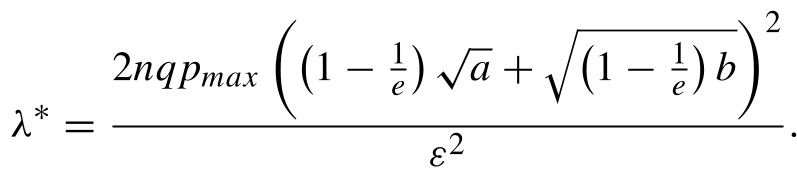 The threshold , derived through martingale concentration inequalities, defines the sample size required for the approximation guarantee.
Critical Insight & Future Outlook
The real value of this paper isn't just the guarantee; it is the application of Martingale Concentration Inequalities (like Corollary 2 in the paper) to handle the variance of multi-product spreads. This provides a "safety net" for the greedy choice, ensuring that the estimated profit doesn't deviate wildly from the real expected profit.
Limitations: The algorithm assumes products spread independently. In reality, products might be complementary (buying a phone makes you likely to buy a case) or competitive. Incorporating these inter-product dependencies remains an open challenge for the next generation of marketing AI.
Conclusion: PM2AM successfully bridges the gap between academic influence models and practical business constraints, proving that even complex multi-product optimization can be solved efficiently with the right mathematical tools.