
Maximizing Recommender’s Influence: An Information-Theoretic Perspective
Maximizing Recommender’s Influence in a Social Network: An Information Theoretic Perspective
This paper introduces an information-theoretic framework to quantify the influence of a recommender in a social network. By modeling the recommendation process as a finite-state communication channel with causal feedback, the authors prove that the recommender's influence is equivalent to the Directed Information between suggestions and user actions, representing the maximum rate of information flow.
TL;DR
Is a recommendation system just a predictor, or is it a communication channel? This paper argues for the latter. By treating a social network as a Finite State Channel with causal feedback, the authors quantify the "Influence" of a recommender using Directed Information. They provide a closed-form solution for the capacity of this channel, revealing that a recommender's power is fundamentally limited by the social dynamics and trustworthiness of its user base.
Background & Positioning
In the landscape of recommendation systems (RS), most work targets Accuracy (e.g., RMSE in Matrix Factorization). However, this paper sits in the intersection of Social Network Analysis and Information Theory. It moves beyond "what the user might like" to "how much the recommender can control the flow of decisions." It is a theoretical probe into the fundamental limits of persuasion in a digital social ecosystem.
Problem & Motivation: The Feedback Loop
Current social networks are not static. When a streaming service recommends a video, your decision to watch it is influenced by:
- The specific suggestion (The Recommender).
- Your own previous history (Individual Bias).
- What your friends just watched (Social Context).
The authors identify a gap: How do we quantify the "competitive advantage" a recommender gain by knowing and controlling these suggestions? They utilize the Gambling Intuition: just as side information increases a gambler's wealth growth rate, a recommender's suggestions increase its ability to "predict" (and thus influence) the network's state.
Methodology: The Recommendation Channel
The core innovation is viewing the recommendation process as a Feedback Channel.
1. The Finite State Model
The user's previous decision acts as the State () of the channel. The recommendation is the input, and the decision is the output.
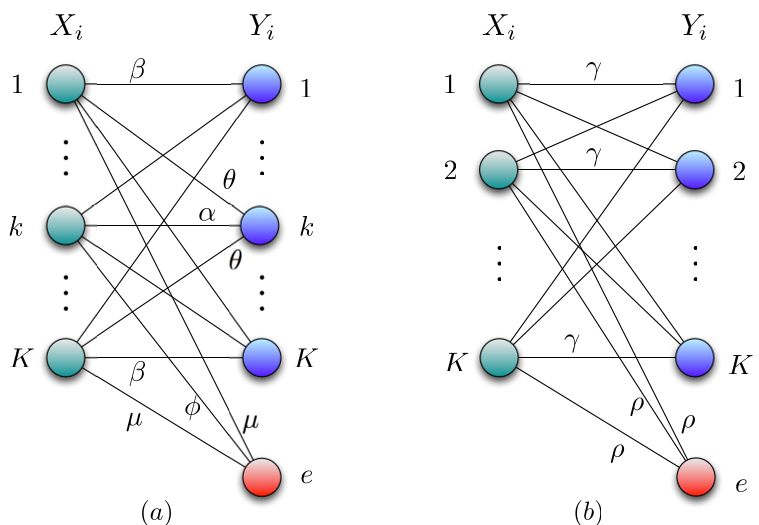
The authors define transition probabilities that account for three states:
- Trust/Agreement: User accepts the recommendation.
- Persistence: User repeats their last action regardless of recommendation.
- Indifference: User takes no action (state ).
2. Quantifying Influence via Directed Information
The "Influence" () is defined as the difference in the growth rate of knowledge about the network between an informed recommender and an uninformed observer. Mathematically, this collapses into Directed Information :
This formula captures the causal flow of information from suggestions to actions, accounting for the fact that suggestions are made based on past decisions.
Experiments & Results: What Drives Influence?
Through numerical simulations, the authors explore two primary drivers of influence:
1. The Trust Factor
By increasing the "trustworthiness" parameter (), which represents the probability of a user following a recommendation that differs from their previous action, the recommender's influence grows significantly.
2. The Choice Complexity ()
Counter-intuitively, as the number of possible actions increases, the recommender's influence actually increases. Why? Because in a world with more choices, the user's behavior is naturally less predictable (higher entropy). The recommender’s specific suggestion provides more "information" to the system, thus exerting more control.
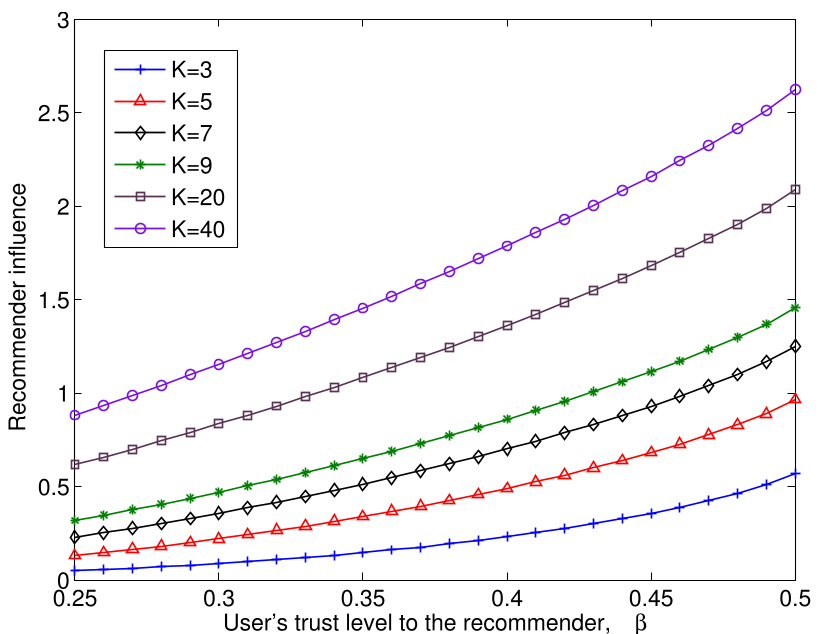 Fig 4: As trustworthiness and choice increase, the capacity of the influence channel rises.
3. Network Indifference
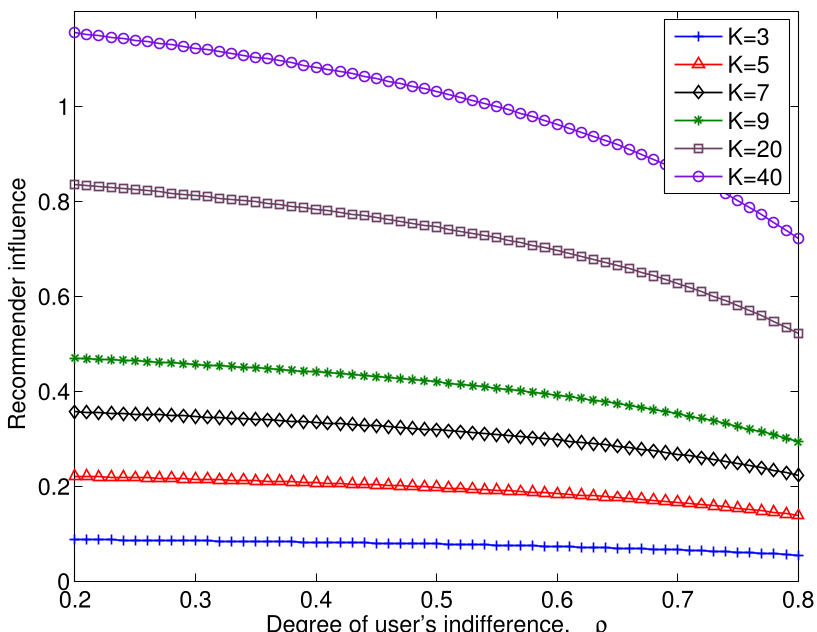
The paper also examines "Indifference" (). In a "responsive" network where users rarely choose "no action," the recommender is more influential. However, the data suggests that Trust is a much more potent lever than Responsiveness.
Critical Analysis & Conclusion
Takeaway
The paper successfully bridges the gap between social behavior and communication theory. It proves that the "optimal" recommendation strategy in a social context is a Stationary Markov Strategy—meaning the best next suggestion depends primarily on the current state of the network.
Limitations
- Simplicity of State: The model assumes a single-user focus with social influence simplified to the last users. Real-world social graphs are far more topological (scale-free, small-world).
- Parameter Sensitivity: The "Trust" parameters are assumed to be static, whereas, in reality, trust is dynamic and can be lost if suggestions are poor.
Future Outlook
This work lays the groundwork for "Information-Theoretic RL" in recommendations, where the reward function isn't just a click, but the maximized Directed Information flow between the platform and its community.