
Maximizing Time-discounted Influential Sustainability: Balancing Speed and Longevity in Social Marketing
Maximizing time-discounted influential sustainability in social networks
The paper introduces the "Time-discounted Influential Sustainability" problem, a novel framework that balances rapid information spread with long-term marketing impact in social networks. It proposes a greedy algorithm to optimize the timing of seed activation across various network topologies, achieving superior utility compared to synchronous and random baseline methods.
TL;DR
In the world of social marketing, being a "one-hit wonder" is a failure. While advertisers want their products to spread fast to beat competitors, they also need sustained engagement. This paper proposes a new mathematical model—Time-discounted Influential Sustainability—and a greedy algorithm to determine exactly who to target and when to activate them to ensure a marketing campaign stays relevant over time without losing the "first-mover" advantage.
Problem & Motivation: The "Flash-in-the-Pan" Paradox
Traditional Social Marketing research focuses on Influence Maximization (IM): finding a set of nodes to reach the maximum number of people. However, researchers have observed a critical flaw: a topic can go viral and reach millions but disappear from public attention almost instantly.
The authors identify two conflicting needs:
- Influential Sustainability: Maintaining a long-term impact where each "wave" of the campaign reaches at least new users.
- Time-Discounting: Recognizing that information loses value over time; spreading early builds competitive barriers.
Most prior work treats these in isolation. Furthermore, they often assume seeds are activated simultaneously at , which is rarely optimal for maintaining a long-burning flame of influence.
Methodology: The Math of Strategic Timing
The paper defines a utility function that rewards the campaign only when the number of newly activated nodes exceeds a threshold . This reward is then multiplied by a discount factor (where ).
The Complexity Challenge
The authors prove that this objective function is:
- NP-Hard: Computing the exact spread is computationally intensive.
- Non-Monotonic: Adding more seeds doesn't always increase sustainability (it might "burn out" the network too fast).
- Non-Submodular: The "diminishing returns" rule doesn't strictly apply here, making standard IM algorithms ineffective.
The Greedy Hill-Climbing Approach
To solve this, they propose a Greedy Algorithm that doesn't just pick a node, but picks a (node, time) pair. It looks for the seed that provides the best "marginal sustainability" at the best possible starting time.
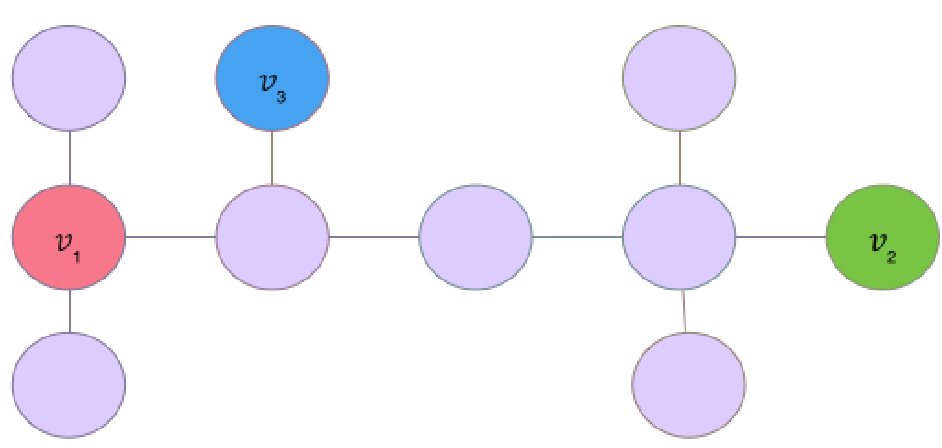 Fig 1: A conceptual example showing how staggered activation timings can prevent the "exhaustion" of reachable nodes.
Experiments: Topology Matters
The researchers tested their method on three classic network types using real-world census data from Beijing:
- ER (Random): Uniform connection probabilities.
- WS (Small World): High local clustering (like local friend groups).
- BA (Scale-Free): "Rich-get-richer" dynamics (like Twitter/X followers).
Key Findings:
- Algorithm Superiority: The Greedy algorithm consistently beat "Synchronous" activation. In WS networks, the utility was nearly 30% higher than activating all seeds at once.
- Seeding Strategies: Selecting High-Degree nodes (hubs) remains the "gold standard" for most scenarios. However, in Small World networks, Low-Degree nodes (the fringes) occasionally perform better because they don't exhaust the local clusters too quickly, allowing for a slower, more sustainable spread.
- The Failure of Betweenness: Interestingly, "Bridge" nodes (High-Betweenness) performed poorly under Linear Threshold (LT) models, sometimes yielding zero utility because they couldn't trigger the threshold across different network components.
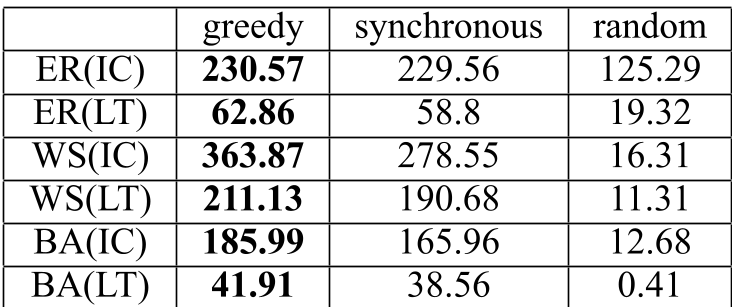 Table 1: Performance comparison showing the clear advantage of the proposed Greedy algorithm across different network models (IC and LT).
Critical Insight & Conclusion
The core takeaway is that timing is a resource as valuable as the seeds themselves. By staggering the activation of influencers, advertisers can "pulse" the network, ensuring the campaign remains above the visibility threshold for as long as possible.
Limitations & Future Work
- Heuristic Nature: Because the function is non-submodular, the greedy approach lacks the 63% (1-1/e) optimality guarantee familiar to IM researchers.
- Model Expansion: Future research will likely move toward the SIR (Susceptible-Infected-Recovered) model to better simulate how people "recover" from an ad and become immune to further influence.
This work provides a robust foundation for modern digital marketing strategies where the goal isn't just to "go viral," but to "stay viral."