
MRT: Prioritizing Social Reliability Over Global Efficiency in Network Search
16829_Maximum Reliable Tree for Social Network Search.
This paper introduces the Maximum Reliable Tree (MRT) algorithm, a graph-based method designed to enhance social network search. Unlike traditional search engines, MRT prioritizes the reliability of relationships between a searcher and results, outperforming the standard Optimum Branching Tree (OBT) in social navigation tasks.
TL;DR
Search in the social era isn't just about what you find, but who it comes from. This paper introduces the Maximum Reliable Tree (MRT) algorithm, a method that transforms complex social graphs into efficient search trees. By prioritizing the most trusted paths between a user and their network, MRT ensures that relevant information is closer "at hand," significantly reducing the navigation effort compared to traditional graph algorithms like Optimum Branching Trees (OBT).
The "Reliability" Gap in Modern Search
When you search for "Avatar" on Facebook or Twitter, the algorithms often return a flat list of posts containing the keyword. But in a social context, a recommendation from a close friend is infinitely more "reliable" than a post from a stranger.
Current graph-based search methods typically use Minimum Spanning Trees (MST) or Optimum Branching Trees (OBT) to simplify network connections. The flaw? These algorithms are designed to minimize the total cost of the entire network structure. While this is great for building a cheap power grid, it is terrible for a user who needs the shortest, most reliable path to a specific friend.
Methodology: Engineering Social Trust
The authors define social reliability through Arc Similarity, calculated based on the reciprocal flow of messages between two users ().
1. Arc Cost Calculation
The similarity is derived from the message volume relative to the total degree of the nodes. The "Arc Cost" is then the inverse of this similarity. High interaction leads to low cost, placing that person "closer" to you in the search hierarchy.
2. MRT vs. OBT: The Structural Shift
- OBT (Optimum Branching Tree): Focuses on the global sum of all paths. It might take you on a long, winding "detour" through several people just to save the network a bit of total weight.
- MRT (Maximum Reliable Tree): Focuses on the Rooted Shortest Path. It ensures that for every node, the path from you (the root) to that node is the shortest possible within the tree.
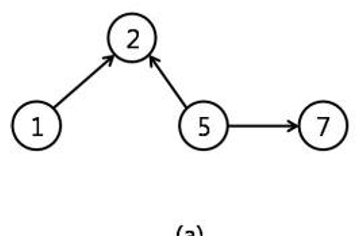 Figure: Comparison between OBT (a) and MRT (b). Note how MRT prioritizes direct paths to minimize "clicks".
Experimental Results: Faster Discovery
The researchers tested MRT against OBT using real-world data from Facebook and Twitter.
- Click Depth: In OBT, reaching a specific "reliable" node sometimes required 4 clicks because the algorithm optimized for the whole network. In MRT, that same node was reachable in only 1 click.
- Mobile Efficiency: On mobile devices where CPU and battery are limited, reducing the number of nodes visited is critical. MRT demonstrated a much lower Cumulative Cost as the user explores more results (Top-k nodes).
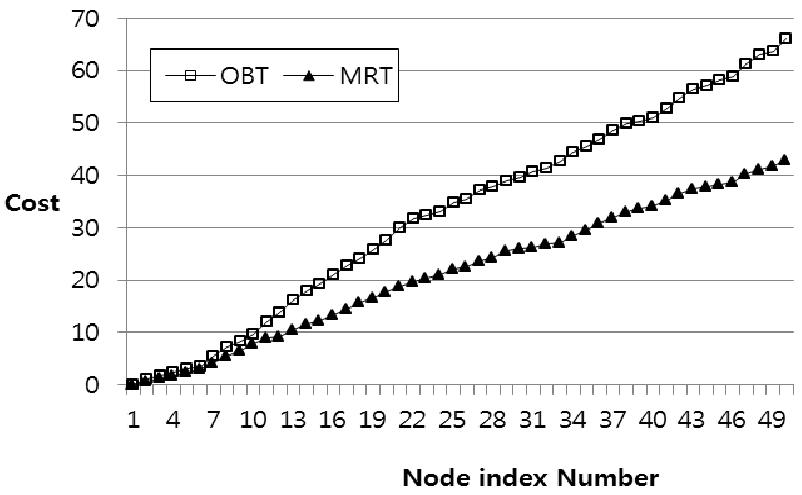 Figure: MRT provides a lower cumulative cost for discovering nodes, making it ideal for "Top-k" search results.
Critical Insight: The Future of Consilience
The true value of this work lies in its acknowledgment of Information Fusion. By combining textual similarity (keywords) with structural reliability (message frequency), MRT moves search closer to how humans naturally process information: through a lens of trust.
Limitations & Future Work
While MRT is efficient for navigation, the paper notes that it does not yet utilize an advanced index for massive-scale graphs. Future iterations will likely integrate Graph Indexing techniques (like those used in BLINKS or STAR) to handle the multi-billion node scales of modern social platforms.
Conclusion
The Maximum Reliable Tree algorithm offers a vital shift in perspective. In a world of information overload, the "best" result isn't the one that is mathematically cheapest for the network to provide—it's the one that is socially closest to the user.