
Inside the Social Graph: How Flickr, YouTube, and Orkut Redefined Network Theory
Measurement and Analysis of Online Social Networks
This seminal paper presents a large-scale measurement study of four major online social networks (Flickr, YouTube, LiveJournal, and Orkut), analyzing a dataset of 11.3 million users and 328 million links. The authors characterize these networks' topological properties, confirming they exhibit power-law, small-world, and scale-free characteristics while achieving SOTA insights into link reciprocity and core-fringe structures.
Executive Summary
TL;DR: This landmark study by Mislove et al. provides the first large-scale empirical evidence that online social networks (OSNs) are structurally distinct from the Web. By crawling over 11 million users, the researchers discovered that OSNs are defined by high reciprocity, a "supernode" core that maintains connectivity, and localized "fringe" cliques that facilitate content discovery.
Background Positioning: This paper is a foundational "systematic measurement" work in the field of Computer Science and Sociology. It moved the discourse beyond theoretical models (like Erdős-Rényi) into the messy, empirical reality of the early social web, setting the stage for modern trust-based algorithms and decentralized systems.
Motivation: The Web is Not a Social Network
Before 2007, researchers often treated all online graphs as variations of the Web's "bow-tie" structure. However, the authors sensed an intuitive difference: the Web is organized around content (links are bookmarks), while OSNs are organized around people (links are relationships).
The primary friction was the lack of open data. While Web links are public, social links were often siloed. By crawling Flickr, YouTube, LiveJournal, and Orkut, the authors aimed to see if the "Small World" phenomenon observed in physical society by Milgram (six degrees of separation) translated to the digital realm.
Methodology: Mining the WCC
The authors used a cluster of 58 machines to perform a Breadth-First Search (BFS) crawl of the Weakly Connected Component (WCC).
Key Challenge: The "Forward Link" Limitation
Unlike the Web, where you only see where a page points to, social networks like LiveJournal began offering APIs for both forward and reverse links. This allowed the authors to validate that their "forward-only" crawls (on Flickr/YouTube) were still capturing the vast majority of the "interesting" graph—the densely connected center.
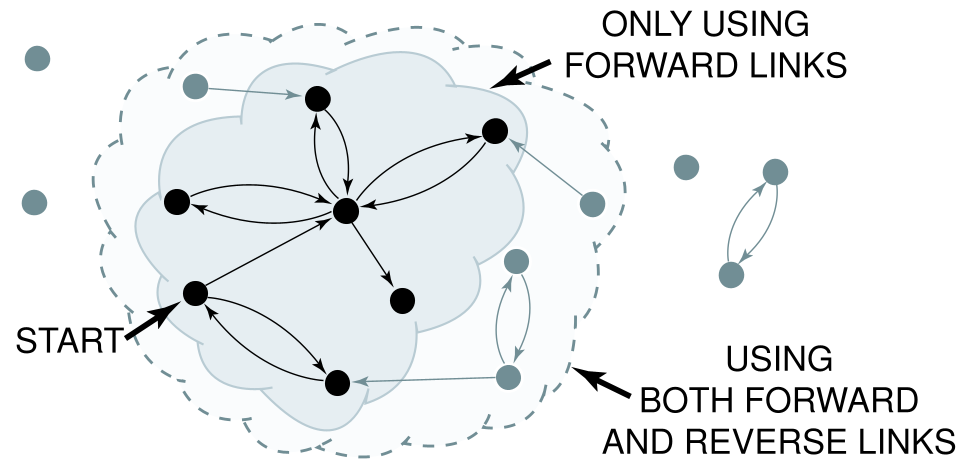 Figure 1: Visual representation of how crawling forward vs. reverse links captures the WCC.
Methodology & Structural Insights
1. Reciprocity: The "Follow-Back" Phenomenon
In the Web graph, popular pages (authorities) rarely link back to the obscure pages (hubs) that cite them. In OSNs, the authors found high symmetry (up to 79%). If you link to a friend, they likely link back. This creates a massive correlation between Indegree and Outdegree—active users are almost always popular users.
2. The Power-Law and Scale-Free Core
The data confirmed that OSNs are "Power-Law" networks. Most users have few friends, but a few "superstars" have thousands.
| Network | Avg Path Length | Diameter |
|---|---|---|
| Web | 16.12 | 905 |
| Flickr | 5.67 | 27 |
| Orkut | 4.25 | 9 |
Table 1: Comparison of path lengths showing social networks are "smaller" than the Web.
3. The Core-Fringe Architecture
The methodology's most profound insight was the existence of a densely connected core containing the top 1-10% of high-degree nodes.
- The Core: Acts as the network's backbone. Almost all shortest paths between any two random users pass through this core.
- The Fringe: Consists of small, isolated groups (cliques) of low-degree nodes. These users are tightly clustered with each other but rely on the core to reach the rest of the world.
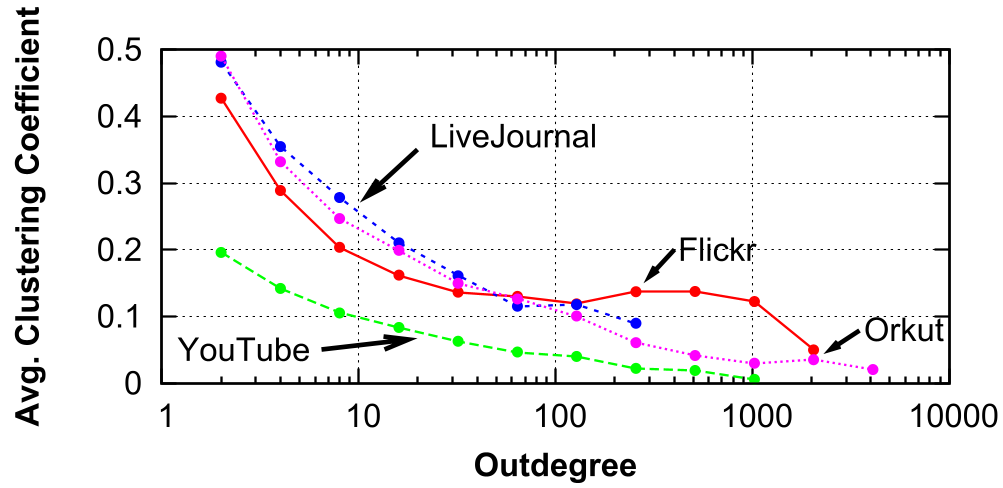 Figure 2: Clustering coefficient vs. outdegree. Low-degree nodes (the fringe) are highly clustered into local "friend circles."
The Impact: Why This Matters Today
Information Dissemination
Because the core is so tight (logarithmic growth in path length), information seeded in the core spreads nearly instantly. This explains why certain content "goes viral" within minutes—it hits the high-degree backbone and floods the fringe.
Trust and Security
The high reciprocity and core structure suggest that "Trust" can be calculated via path redundancy. If you have five different short paths to a user through the core, they are likely legitimate. This finding directly influenced the development of SybilGuard and other decentralized identity verification systems.
Critical Analysis & Conclusion
Takeaway: This paper proved that social networks are "Assortative"—popular people hang out with other popular people. This is the opposite of the "Disassortative" Internet (where high-degree routers connect to many low-degree endpoints).
Limitations: The study is a "snapshot" and does not fully capture the temporal evolution of how these links form. Additionally, the Orkut data was a partial crawl (11%), which the authors admit may oversample high-degree nodes.
Future Outlook: As we move toward the "Fediverse" and decentralized social media (Web3), the "Core-Fringe" model remains a vital blueprint. Designers must decide: do we want to replicate this "backbone" core, or can we build a truly distributed network without the "supernode" bottleneck?