
Unveiling the Hidden Fabric of Offline Sharing: A Large-Scale Analysis of Xender's D2D Networks
Measurement and analytics on social groups of device-to-device sharing in mobile social networks
This paper presents the first large-scale measurement study of Device-to-Device (D2D) content sharing in Mobile Social Networks (MSNs) using a massive dataset from Xender. Analyzing 30 million users and 443 million transmissions, it uncovers the structural properties, motif dynamics, and propagation patterns of offline social sharing groups to optimize cellular data offloading.
TL;DR
Researchers have conducted the world's first large-scale measurement of Device-to-Device (D2D) content sharing by analyzing data from Xender, covering 30 million users and 443 million transmissions. The study proves that offline social sharing follows small-world properties but suffers from low reciprocity, providing a roadmap for optimizing cellular traffic offloading through social-aware algorithms.
Context: Why D2D Sharing Matters
With the explosion of mobile multimedia, cellular networks are hitting a capacity ceiling. Interestingly, much of this traffic is redundant—popular videos and apps are downloaded repeatedly by nearby users. D2D sharing (via Wi-Fi Direct or Bluetooth) allows users to grab content from peers, bypassing the expensive cellular backbone. However, until now, we didn't truly understand how these "offline" social networks behave at scale.
The "Xender" Dataset: A Goldmine of Offline Behavior
The authors analyzed 843 GB of data from Xender, primarily focusing on the Indian market. The scale is unprecedented:
- 30.4 Million Users
- 443 Million Transmissions
- 884 Thousand Social Groups
One striking early finding: Duplicate traffic accounts for up to 40% of the total volume, and for mobile apps, this figure reaches 60%. This confirms that D2D sharing is not just a niche feature but a critical infrastructure for content dissemination in bandwidth-constrained regions.
Methodology: Mapping Social Structures
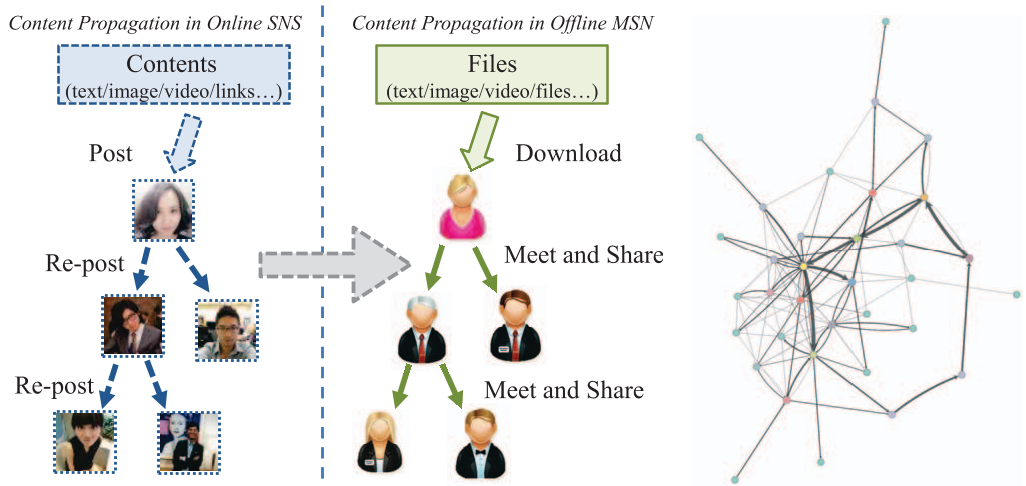
The paper treats D2D interactions as a Social Graph , where vertices are users and edges represent file transfers.
1. The Small-World Phenomenon
By analyzing the Average Shortest Path Length (ASLP) and Diameter, the authors found that these offline groups satisfy the "six degrees of separation" theory. Most users are reachable within 6 hops, suggesting that content can potentially spread very quickly if the right "hubs" are targeted.
2. Motifs: The Missing Links
Using Triad Census (analyzing 13 distinct 3-node patterns), the study found that "open triads" (where User A shares with B and C, but B and C don't interact) are incredibly common. The low reciprocity (91% of groups < 0.5) indicates that most sharing is one-way. This represents a massive opportunity for "friend recommendation" systems to close these loops and increase network density.
Cascade Trees: Tall vs. Fat
To understand how influence and files travel, the researchers defined two tree structures:
- Friendship Extension Tree (FET): Represents the growth of social bonds.
- Content Propagation Tree (CPT): Represents the actual flow of data.
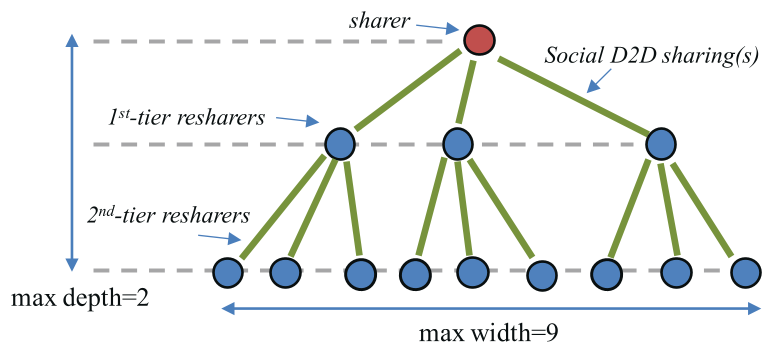
The results show a prevalence of "Tall Trees" (large depth, small width). This implies that in offline scenarios, users prefer to share content across a long chain of individuals rather than broadcasting to a large local crowd. This "linear" propagation is likely due to the physical proximity required for D2D—you share with who is next to you, and they share with the next person they meet.
Results & Performance Insights
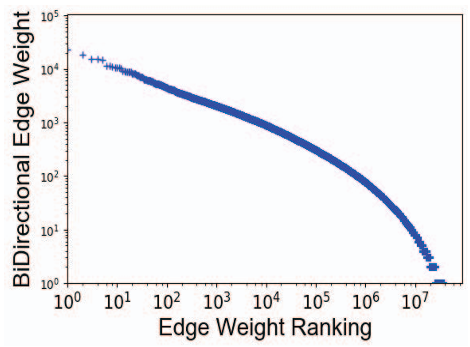
The analysis suggests that the D2D ecosystem is highly skewed:
- Power Law Distribution: a small number of "heavy users" and "heavy groups" handle the vast majority of traffic.
- Temporal Regularity: Traffic spikes by 5x to 10x on Sundays, highlighting the social nature of sharing—families and friends meet in person and exchange files.
Critical Analysis & Takeaways
This paper moves the needle from "theoretical D2D models" to "empirical evidence." The discovery of low reciprocity and tall propagation trees provides a clear signal to developers:
- Trust is the bottleneck: The lack of closed triangles suggests users are hesitant to share with "friends of friends." Reliable, privacy-preserving sharing protocols are needed.
- Incentivization: Since reciprocity is low, the system needs to reward "seeders" who provide content without immediately receiving anything in return.
- App Marketing: Given that 60% of APP traffic is redundant, D2D is the most efficient channel for app growth in emerging markets.
Conclusion: By understanding the social "motifs" of offline networks, we can design D2D systems that are not just faster, but more aligned with how humans naturally interact.