
TII: Quantifying Trust in the Age of Social Information Overload
A measurement model for trustworthiness of information on social network services
The paper introduces TII (Trust Index for Information on SNS), a systematic measurement model designed to quantify the trustworthiness of information on social networks. By utilizing graph theory and activity-based metrics, the model provides an objective score to help users distinguish reliable content from misinformation.
TL;DR
As misinformation proliferates on Social Network Services (SNS), manual verification by users has become an impossible task. This paper proposes the Trust Index for Information (TII), a graph-based measurement model that quantifies trust by analyzing user interactions—specifically sharing and responding behaviors—combined with authority scores to provide an objective metric for information reliability.
The Problem: The Subjectivity of Digital Trust
In the current SNS landscape, users are often connected to individuals they do not know physically. Determining the veracity of a post requires subjective judgment, which is prone to bias and manipulation. Existing trust models often operate in the context of e-commerce (loyalty/honesty) or P2P networks (technical robustness), but they lack a specialized framework to evaluate the information propagation path itself within a social graph.
The authors identify that trust isn't just about "who you know," but "how you interact" with the information you receive.
Methodology: The TII Framework
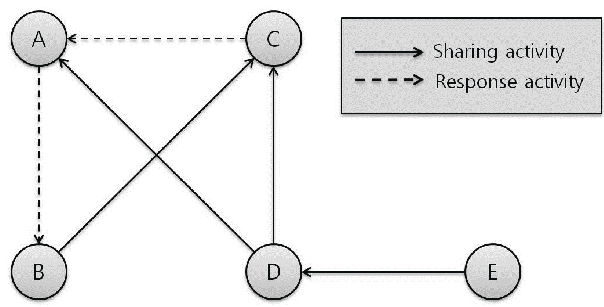
The authors model the SNS as a directed graph , where represents participants and represents interactions. They break down "trust" into four mathematically defined components:
- Activity Ratio (): The balance between incoming and outgoing edges, identifying if a node is an information sink or source.
- Sharing Ratio (): Measures how much of the incoming interaction involves the dissemination of information.
- Response Ratio (): Measures the level of feedback or interaction triggered by a node.
- Authority Score (): A normalized score derived from the HITS (Hyperlink-Induced Topic Search) algorithm, which identifies nodes that act as "hubs" of high-value information.
Model Architecture
The final TII score is a weighted sum of these four factors:
Experimental Insights
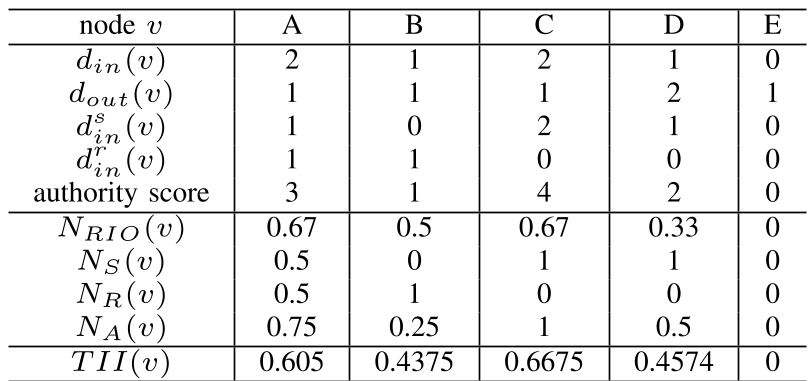
The researchers tested the model on a sample graph to see if it could distinguish between different types of influential nodes.
| Node | In-degree | Sharing Ratio | Authority | TII Score |
|---|---|---|---|---|
| Node C | 2 | 1.0 | 1.0 | 0.6675 |
| Node A | 2 | 0.5 | 0.75 | 0.6050 |
The results (shown in the table above) reveal a critical insight: Node C and Node A have the same number of incoming links, yet Node C is ranked higher. Why? Because Node C is more active in "Sharing" and holds a higher "Authority" score. This proves that TII moves beyond simple popularity (in-degree) to evaluate the quality and intent of the interaction.
Critical Analysis & Conclusion
The TII model represents a significant step toward objective trust measurement. It successfully moves the needle from "I trust this person" to "the network validates this information path."
Limitations
As the authors candidly note, the current model assumes that sharing and responding activities are inherently trustworthy. It does not yet account for malicious "sharing" (e.g., botnets spreading fake news to boost a TII score).
Future Outlook
To become a production-level tool, TII should be paired with Content Analysis (NLP). While the graph structure tells us how information moves, sentiment and fact-checking algorithms are needed to ensure the content being shared isn't "trustworthy" in structure but "toxic" in substance. This work provides the structural foundation upon which future multi-modal trust frameworks will be built.