
Digital Shadows: Do Our Social Media Posts Actually Reveal How We Feel?
Measuring Adolescents’ Well-Being: Correspondence of Naïve Digital Traces to Survey Data
This study investigates the validity of using "naïve digital traces" from social media (VK) to measure adolescent well-being including depression, anxiety, mood, social integration, and sleep. By cross-referencing digital activity with longitudinal survey data and experience sampling, the researchers evaluate whether online behaviors can serve as reliable proxies for psychological states in high school students.
TL;DR
Can we replace boring, expensive surveys with automated analysis of social media? This study tracks Russian high schoolers for four months to find out. While late-night posting and negative sentiments do signal sleep deprivation and depression, the connection is weaker than you might think. Digital traces are a great "extra" lens, but they aren't ready to replace the psychologist's survey just yet.
Background Positioning
In the hierarchy of mental health research, this paper acts as a critical validity check. While the industry often rushes toward "Big Data" solutions for mental health monitoring, Sivak and Smirnov pause to ask a fundamental question: Does the digital map actually match the territory of the adolescent mind?
Problem & Motivation: The "Black Box" of Youth
Adolescents are notoriously difficult to study. Their self-reports can be inconsistent, and frequent surveys suffer from "participant fatigue." Digital traces—data from platforms like VK (the Russian Facebook)—offer a "non-intrusive" high-resolution alternative. However, the authors argue that we cannot simply assume a "like" or a "post" means the same thing for a 16-year-old as it does for a 30-year-old.
Methodology: A Multilayer Deep Dive
The researchers didn't just look at one data source. They created a tripartite data structure:
- Clinical Surveys: Standardized scales like the PHQ-9 (Depression).
- Experience Sampling (ESM): A mobile app pinging students 3 times a day for real-time mood and sleep data.
- Digital Logs: Scraping VK for post timestamps, text sentiment, and school-specific "likes."
Model Architecture: Data Correlation
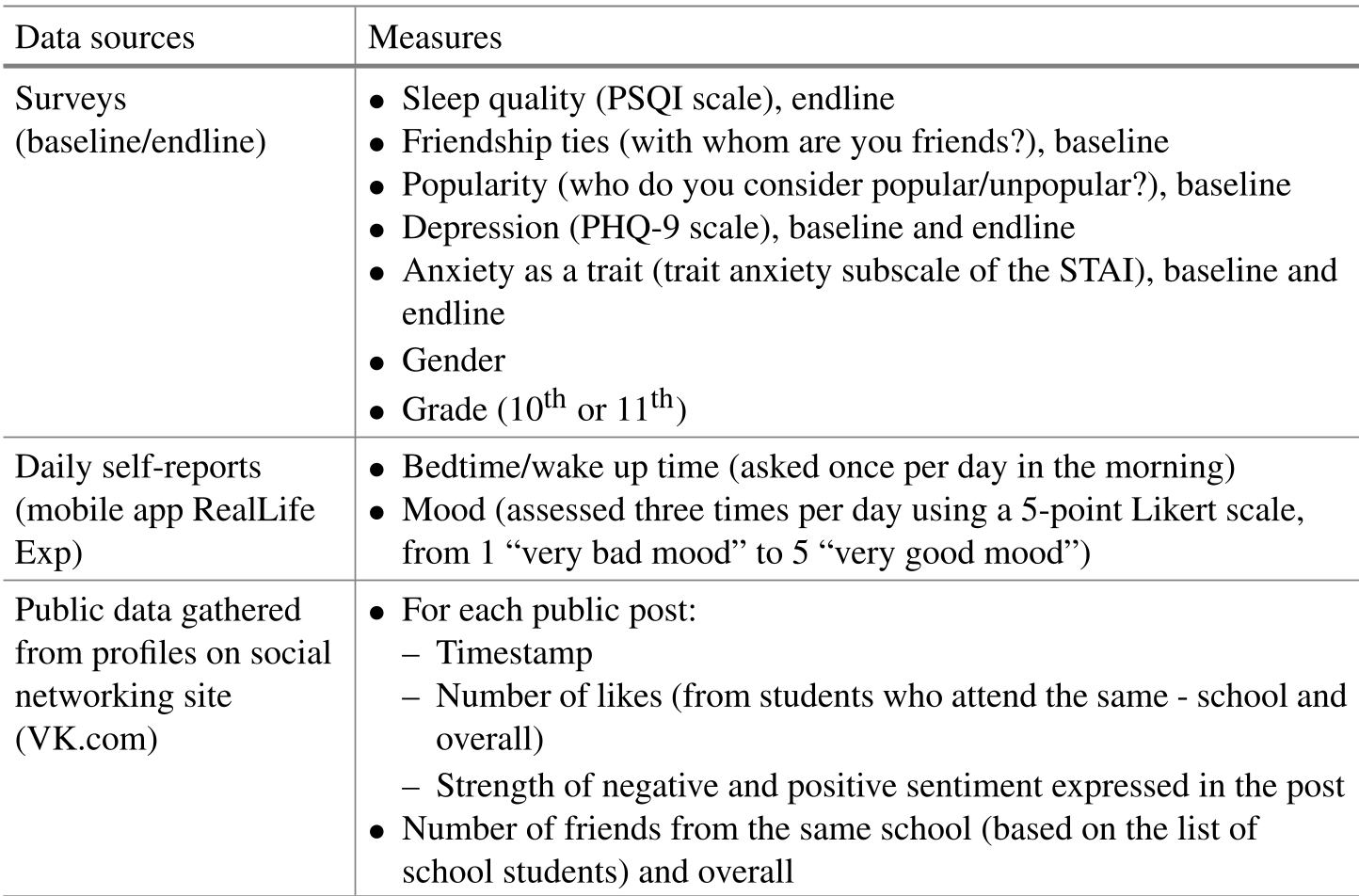
The core insight here is the use of SentiStrength to quantify emotions in short, informal Russian text, and the calculation of "Late-Night Posting" as a proxy for social jet lag.
Experiments & Results: The Reality vs. The Hype
The results provide a grounded, sober look at "Digital Phenotyping":
- Depression vs. Sentiment: There is a visible link. Students with severe depression wrote negative posts 10 times more often than those with no symptoms. However, the correlation (r=0.24) suggests that sentiment analysis misses much of the nuance.
- The Sleep Sentinel: This was the strongest finding. Posting between 1 AM and 5 AM is a robust indicator of poor sleep quality. Those who posted late slept an average of 30 minutes less than their peers.
- Social Status: Being "popular" in the real school hallways translates to "likes" from schoolmates, but not necessarily a higher total friend count on VK.
Mood Dynamics Visualization
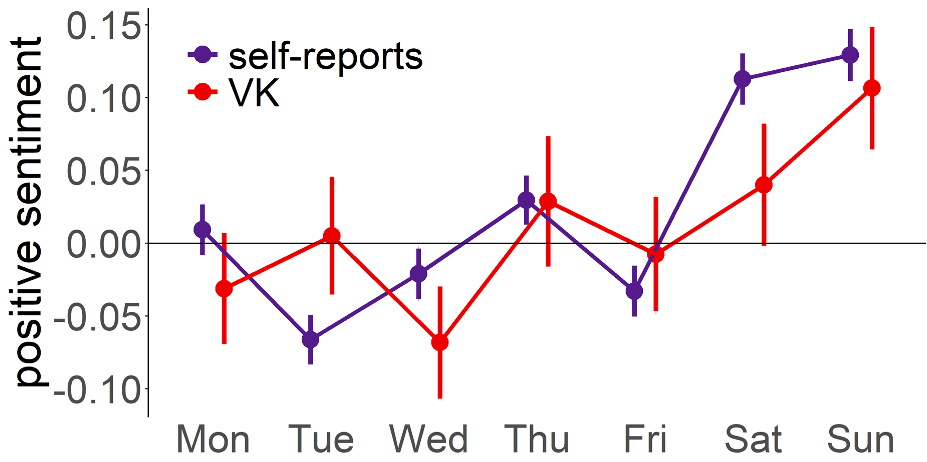
As shown in the data, both self-reported mood and social media sentiment tend to peak on weekends and "classes of choice" days (Thursdays), suggesting that digital traces can capture broad temporal patterns in affect.
Critical Analysis & Conclusion
Takeaway
The paper confirms that digital traces are complementary, not substitutive. They act as a "smoke detector"—they can tell you something might be wrong (like a negative post or a 3 AM login), but they don't provide the "why" that a survey or interview can.
Limitations
- Sample Size: With only 144 students (mostly female), the statistical power is limited.
- The "Performative" Nature of Social Media: Adolescents often curate their online personas. A depressed student might post "happy" content to fit in, masking the digital signal.
Future Outlook
This work sets the stage for "Hybrid Monitoring" systems. Future mental health tools in schools might combine background digital sensing with targeted, "smart" pings when the algorithm detects a deviation from a student's normal posting cadence.
Final Verdict: Nature vs. Digital Nurture. Our digital traces are useful footprints, but they are often distorted by the "beach" (the platform) we walk on.