
Reconciling Probability and Logic: A Betting Perspective on Inconsistency
Measuring inconsistency in probabilistic logic: rationality postulates and Dutch book interpretation
The paper investigates inconsistency measures in probabilistic logic, focusing on reconciling rationality postulates with computational feasibility. It proposes the "innocuous conditional" and "inescapable conflict" concepts to replace traditional MIS-based postulates and introduces measures computable via linear programming that align with the "Dutch book" interpretation of incoherence.
TL;DR
Knowledge bases often contain conflicting information, especially when dealing with uncertainty. This paper addresses a critical theoretical flaw: the traditional rules we use to measure "how wrong" a database is don't work when we add probabilities. The authors fix these rules and prove that the best way to measure inconsistency is to look at how much money an agent would lose in a "Dutch Book" (a set of bets with a guaranteed loss).
The Problem: The Continuity-Independence Paradox
In classical logic, a "Free Formula" is one that isn't part of any conflict. Deleting it shouldn't change the inconsistency level. In probabilistic logic, we want Continuity: a tiny change in a probability (e.g., from 0.8 to 0.801) should only lead to a tiny change in the inconsistency measure.
The authors prove a startling Impossibility Theorem: You cannot have Consistency, Independence, and Continuity at the same time.
- Why? Because in probability, resolving a local conflict (a Minimal Inconsistent Set) doesn't always resolve the global conflict. Probabilistic constraints "leak" across variables in ways classical logic doesn't.
Methodology: Innocuous Conditionals and Inescapable Conflicts
To solve the paradox, the authors move away from "deleting formulas" (abrupt repair) to "widening intervals" (consolidation).
1. The Innocuous Conditional
Instead of a "Free Formula," they propose the Innocuous Conditional. This is a statement that remains consistent even as you stretch and widen all other probability intervals in the base to fix the conflicts.
2. Inescapable Conflicts (IC)
They replace the Minimal Inconsistent Set (MIS) with Inescapable Conflicts. An IC is a set where no matter how you try to widen things, the conflict remains until you hit a specific boundary.
 Note: The paper uses complex linear partitions to define these conflict regions.
Bridging AI and Philosophy: The Dutch Book Interpretation
The most profound contribution is the bridge between AI (distance minimization) and Philosophy (Dutch Books).
- The AI View: We measure inconsistency by calculating the distance between our broken base and the nearest consistent one.
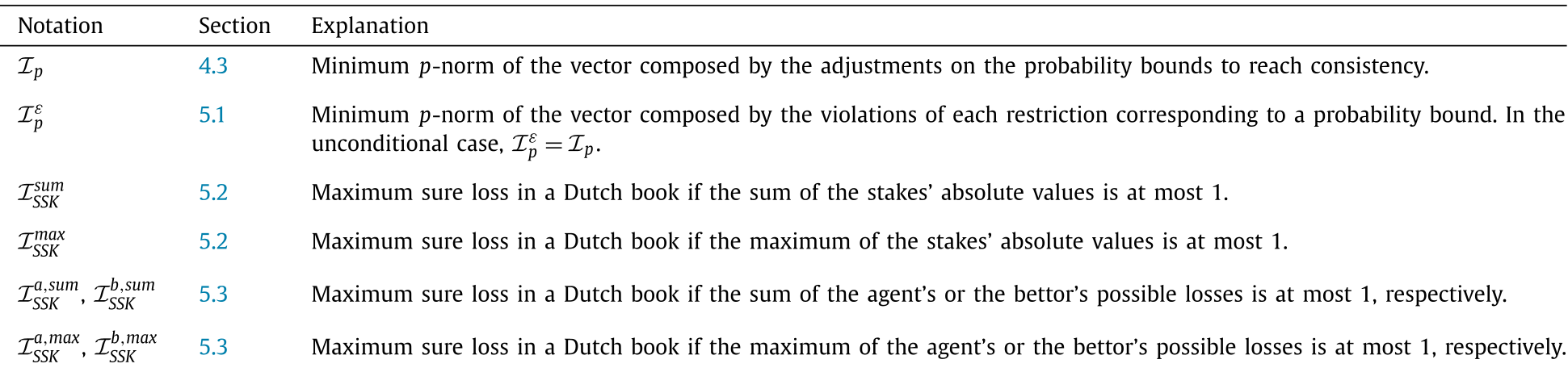
- The Epistemology View: We measure "incoherence" by asking: "If an agent bets on these beliefs, what is the maximum guaranteed loss a bettor can take from them?"
The authors prove that these are mathematically dual!
- The Manhattan distance () is equivalent to a Dutch Book where individual stakes are limited.
- The Chebyshev distance () is equivalent to a Dutch Book where the total stakes are limited.
Computational Efficiency
By framing these measures as Linear Programs, the authors ensure they are "Feasible." Using techniques like Column Generation, we can calculate the inconsistency of knowledge bases with thousands of rules in seconds, rather than hours.
Critical Insight: Why This Matters
Most AI systems fail when they encounter a contradiction. This work suggests that we shouldn't just "detect and delete." Instead, we should quantify the severity of the conflict using the Dutch Book loss and then "soften" our beliefs (widen probability intervals) until the "sure loss" disappears. This is a much more robust way to handle the messy, conflicting data of the real world.
Conclusion
Glauber De Bona and Marcelo Finger have successfully unified two separate schools of thought. By replacing outdated logical postulates with ones that respect the fluid nature of probability, they've provided a toolkit for the next generation of robust, probabilistic AI.