
Instagram Influence Decoded: Moving Beyond the Follower Count
Measuring Influence on Instagram: a Network-oblivious Approach
This paper introduces a network-oblivious approach to scoring Instagram influencers by defining influence as the expected number of views per post. Utilizing a dataset of over 940k posts, the authors employ regression models (Ridge and Random Forest) to achieve high ranking accuracy (Spearman's rs of 0.84+) without requiring expensive social graph reconstruction.
TL;DR
In the world of influencer marketing, "followers" are often a deceptive currency. This SIGIR '18 paper by Segev et al. argues that social graphs are ineffective for Instagram. Instead, they propose a network-oblivious approach that defines influence as expected exposure (views). Their model uses regression on engagement data to rank users more accurately than traditional graph-based methods, proving that "reach" is a better barometer for influence than "connections."
The "Million Follower Fallacy"
For years, brands have chased influencers with the highest follower counts. However, this study highlights a critical structural reality: Instagram is a pull-network. Unlike Twitter or Facebook, where content is "pushed" through cascades of resharing, Instagram content requires active engagement and algorithmic "pulling."
The authors identify two major pain points:
- Graph Scarcity: Reconstructing the Instagram follower graph is computationally prohibitive and resource-intensive for small researchers or marketing firms.
- Noise and Fraud: "Followers" and "Likes" are susceptible to automation, fake accounts, and the "Like You, Like Me" reciprocity phenomenon, which inflates vanity metrics without increasing actual content exposure.
Methodology: The Power of Expected Exposure
The authors redefine influence () as the average number of views () per post:
By focusing on video views (which were publicly accessible at the time of the study), they bypass the ambiguity of likes. They extracted features including:
- Geometric Mean: A hybrid of likes and followers to balance audience size with active engagement.
- Focus: The ratio between a user's most and least engaged posts to measure the stability of their influence.
- Engagement Ratios: Using comment-to-like ratios to detect "bought" engagements (since bots find it easier to like than to comment meaningfully).
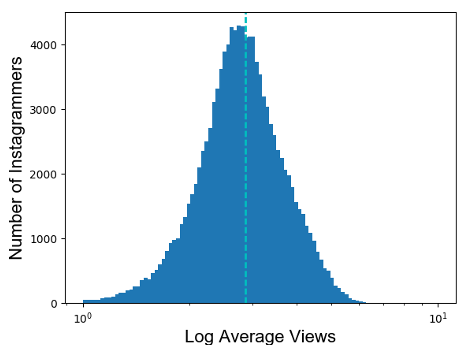 The histogram above illustrates that influence (measured by views) follows a log-normal distribution, accurately capturing everyone from micro-influencers to mega-celebrities.
Experiments and Competitive Benchmarking
The researchers tested four main approaches: Ridge Regression (RR), Random Forest (RF), Multi-Regression (using K-Means clustering), and traditional baselines.
Key Findings:
- Followers are Flawed: The follower baseline was the weakest performer (). This confirms that sheer audience size is a poor predictor of actual content reach.
- Ridge Regression Wins on Accuracy: While Random Forest was a decent ranker, Ridge Regression provided the most precise scores, effectively handling the multi-collinearity of social metrics.
- The Failure of PageRank: When testing a PageRank extension on a subset of the graph, the result was a mediocre of 0.673. This definitively shows that network topology matters less on Instagram than the individual performance of the content.
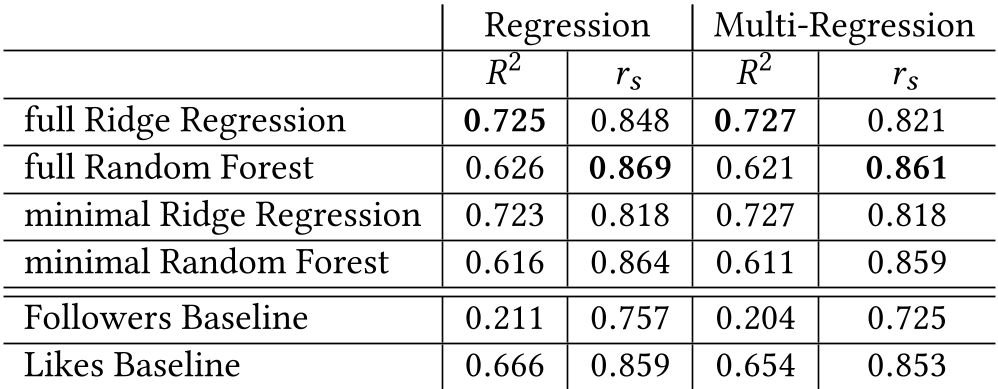 Performance metrics: Ridge Regression provides the best balance of variance reduction () and ranking correlation ().
Critical Insight: The Value of Simplicity
One of the paper's most surprising takeaways is that the Likes Baseline is an incredibly strong proxy for ranking (Spearman's of 0.859). For developers building quick ranking tools, utilizing average likes is almost as effective as complex regression models, provided you don't need the exact view count prediction.
Conclusion and Limitations
This work marks a shift toward Network-Oblivious analysis. By ignoring the complex web of "who follows whom" and focusing on "who watches what," the authors created a scalable, intuitive, and highly accurate ranking system.
Future Outlook: The authors acknowledge that influence is temporal. A user who was influential in 2024 might be irrelevant in 2026. Furthermore, future models could benefit significantly from Computer Vision—analyzing whether specific image aesthetics (e.g., "contains faces" or specific color palettes) improve the reliability of these influence scores.
For the industry, the message is clear: Stop counting followers, and start measuring the consistency of exposure.