
Beyond the Follower Count: Decoding Latent Social Influence via the AWI Model
Measuring Pair-Wise Social Influence in Microblog
The paper introduces the AWI (Active level, Willingness to retweet, pairwise Influence) model to measure social influence in microblogs like Sina Weibo. It characterizes pairwise relationships into three latent factors to move beyond simple metrics like follower counts or raw retweet rates, achieving high accuracy in retweet rate prediction and more nuanced identification of influential users.
TL;DR
In the world of social media analytics, the numbers on your profile—followers, likes, retweets—are often deceptive. This paper presents the AWI Model, a tripartite mathematical framework that separates a user’s Activity and Willingness to share from the actual Influence they exert. By isolating these factors, the researchers can predict retweet rates with high precision and discover "hidden influencers" who command massive engagement despite having modest follower counts.
Background: The Structural Trap
For years, social influence was measured through structural metrics like PageRank or simple In-degree (follower counts). However, as the authors note, these are easily "spoofed" (e.g., following authority accounts to boost scores) and don't account for whether an audience actually listens. While some researchers moved toward retweet rates, these numbers are noisy—they fluctuate based on how active a user happens to be in a given week, rather than their inherent persuasive power.
The AWI Model: A Three-Dimensional Approach
The core insight of the AWI model is that a retweet is not just a sign of influence; it is an intersection of three distinct probabilities:
- Active Level (A): Did the user even see the post? (Proportional to login frequency).
- Willingness to Retweet (W): Is the user a "serial sharer" or a passive consumer?
- Pairwise Influence (I): The specific power user has over user .
By modeling the retweet behavior as a binary variable that only triggers when all three conditions are met, the authors can use Maximum Likelihood Estimation (MLE) to strip away the "noise" of activity and willingness, leaving behind a "pure" influence score.
Architectural Intuition
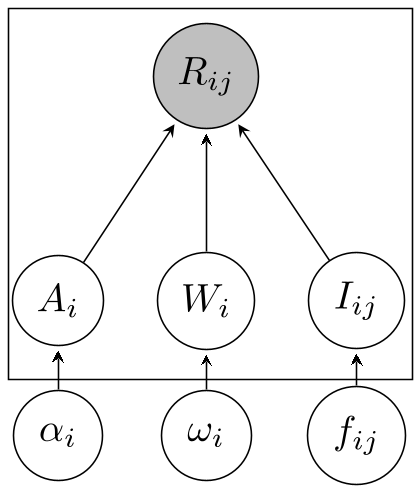
The beauty of this model lies in its local fittability. Unlike PageRank, which requires knowledge of the entire global graph, the AWI influence of user on can be calculated just by looking at the interaction history between them and their immediate neighbors. This makes it highly scalable for massive networks like Sina Weibo.
Proving the Predictability
The authors validated the model on a massive dataset from Sina Weibo consisting of over 23 million messages. They split the data into a 870-day training segment and a 68-day testing segment.
Key Findings
- Stability: The "Influence Score" () proved significantly more stable over time than the raw retweet rate. While retweet rates had a Pearson correlation of only 0.0857, the AWI influence score held a correlation of 0.2383, suggesting it captures a more permanent characteristic of the social relationship.
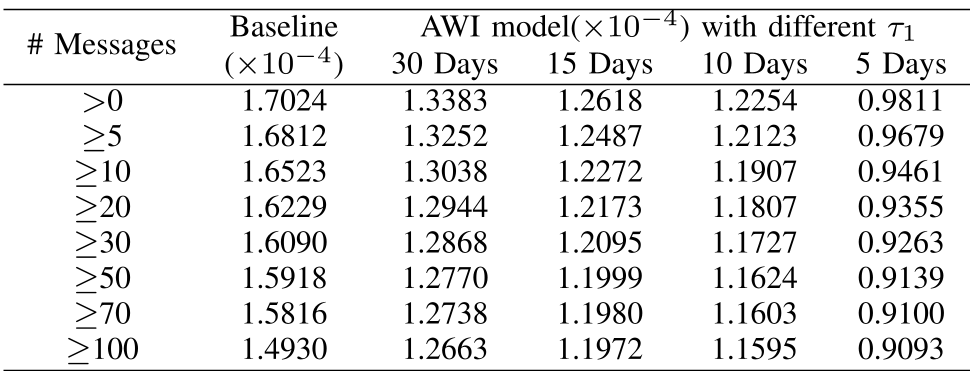
- Accuracy: The model's Mean Square Error (MSE) in predicting future retweets decreased as the time granularity () became finer, proving that accounting for temporal activity spikes is crucial.
Uncovering Hidden Influencers: The Maldives Case
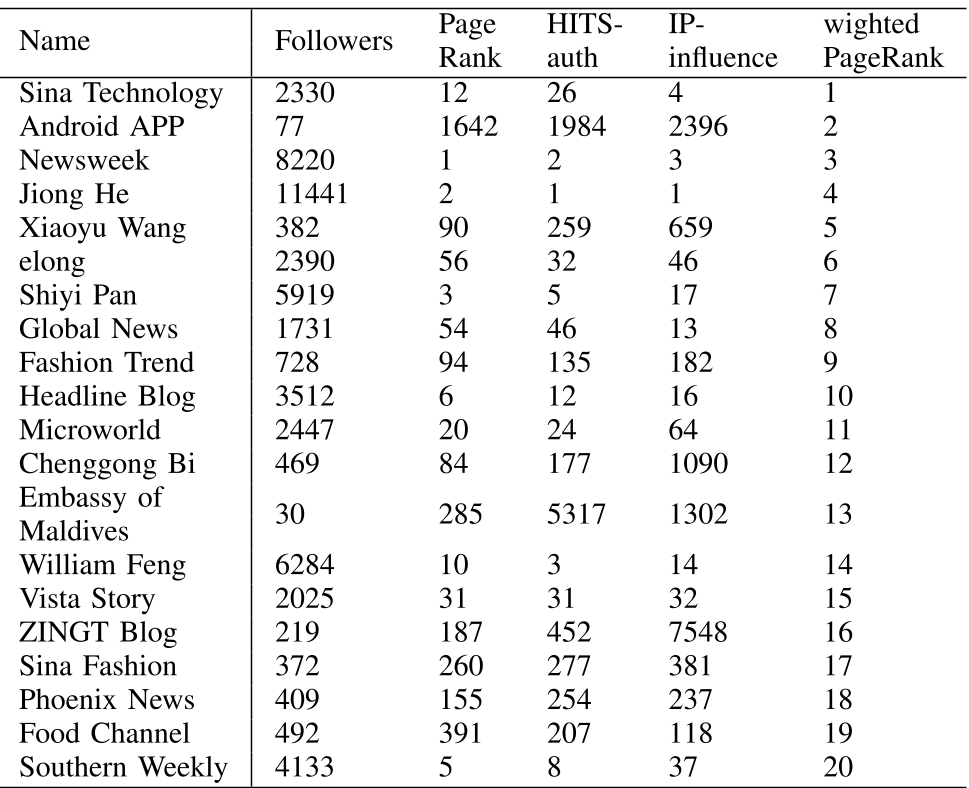
The most striking result of the paper is found in its ranking of influential users. Traditional algorithms and follower counts often highlight celebrities or major news outlets.
The AWI Model, however, identified accounts like the "Embassy of Maldives" and "Android APP". Despite having only 30-70 followers, these accounts ranked in the Top 20 for Weighted PageRank. Their content (travel attractions or popular app shares) was so compelling that it propagated wildly through retweets, even though the structural graph suggested they were "nobodies."
Critical Analysis & Takeaways
The AWI model successfully deconstructs "Social Influence" into a measurable, latent variable.
- Value: It provides a mathematical basis for Viral Marketing to find high-impact, low-cost users for campaigns.
- Limitations: Currently, the model ignores the content of the message. Influence is often topic-specific (e.g., someone influential in tech might have zero influence in cooking).
- The Future: Integrating Natural Language Processing (NLP) to make the Influence Score () topic-sensitive would be the logical next step for this framework.
Conclusion: Influence is not about how many people see you; it's about how many people act because of you. The AWI model gives us the tools to finally measure that distinction.