
Beyond the IDE: A Large-Scale Field Study on how Professionals Actually Comprehend Code
Measuring Program Comprehension: A Large-Scale Field Study with Professionals
This paper presents a large-scale field study measuring program comprehension among 78 professional developers across 7 industrial projects (3,148 working hours). Using the ActivitySpace framework to track HCI data across IDEs, browsers, and editors, it reveals that developers spend ~58% of their time on comprehension, establishing a new empirical benchmark for the industry.
TL;DR
For decades, the software engineering community has assumed that "program comprehension" is the dominant activity in a developer's day. This paper finally proves it at scale: ~58% of a professional's time is dedicated to understanding code. Unlike previous lab-based studies, this research tracks 78 professionals across 3,148 hours of real work, revealing that comprehension isn't just an IDE activity—it heavily involves web browsers and document editors, highlighting a massive "context-switching tax" in modern development.
The "IDE-Only" Blind Spot
Most prior research into program comprehension was conducted in controlled laboratory settings with students or very small groups of professionals. Crucially, these studies focused almost entirely on the Integrated Development Environment (IDE).
The authors of this paper argue that this is a fundamental flaw. In reality, a developer trying to fix a bug doesn't just stare at source code; they search Stack Overflow, read internal documentation, and browse API tutorials. To capture this, the team used the ActivitySpace framework to monitor interaction data across all desktop applications.
Methodology: Tracking the "Spree"
The core of the study relies on the concept of a Spree—a sequence of HCI events (clicks, scrolls, keystrokes) separated by a "Reaction Time" (RT) of 1 second.
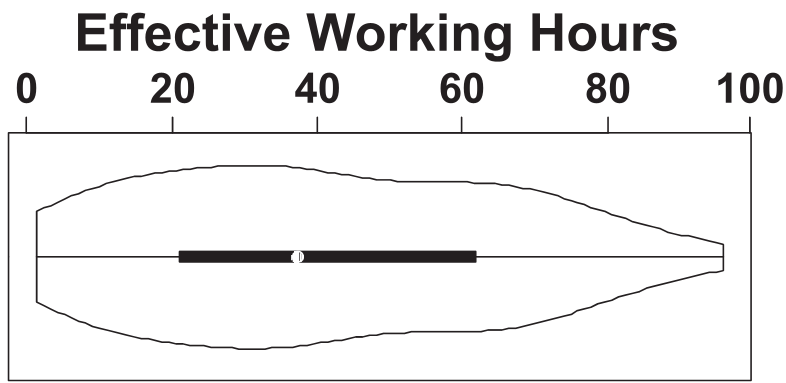
The researchers categorized activities into:
- Navigation: Searching, clicking links, browsing files.
- Editing: Writing and modifying code.
- Comprehension: Inspecting consoles, reading code, or understanding web tutorials.
- Other: Non-work related or idle time.
Key Results: Where Does the Time Go?
The study quantified what many of us felt: we spend way more time reading than writing.
- The 58% Benchmark: Across 7 projects, comprehension averaged 57.62% of work time.
- The Web Browser Factor: Developers spent 27.26% of their comprehension time in browsers compared to 19.95% in the IDE. This is a groundbreaking shift in how we view "understanding" code.
- Java vs. C#: Interestingly, Java developers spent significantly more time on comprehension (~63%) than C# developers (~53%). The authors trace this to Java's heavy reliance on diverse third-party libraries and differences in IDE (Visual Studio vs. Eclipse) efficiency.

Why is Understanding So Hard?
The authors identified 9 root causes for high comprehension time through 200 analyzed sessions and interviews:
- Poor Code Quality: Meaningless naming, god classes, and lack of comments.
- The Browser Trap: Query refinement and sifting through irrelevant search results.
- The Maintenance Tax: Projects in the maintenance phase required significantly more comprehension time due to developer turnover and legacy technical debt.
Deep Insights: The Experience Gap
One of the most striking findings involves Professional Experience. Senior developers (5+ years) spent significantly less time on comprehension (~44%) compared to juniors (~66%).
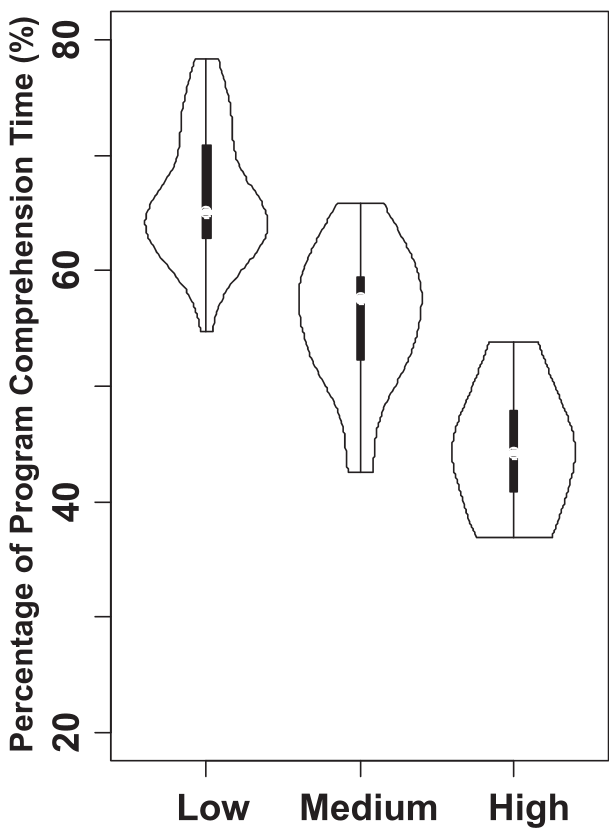
The authors observed that seniors have better "Information Foraging" strategies. For example, a senior developer might copy snippet code into their IDE to compare side-by-side, whereas a junior might switch back and forth between the browser and IDE dozens of times, losing "mental state" with every switch.
Conclusions and Future Work
The study concludes that the industry needs a paradigm shift:
- Unified Environments: We must integrate search and documentation directly into the IDE to stop the "context-switching" leakage.
- Automated Quality Control: Better tools for detecting "low-quality" code/comments are needed to lower the entry barrier for new developers.
- Learning from Experts: We should build tools that mirror the "navigation patterns" of senior developers to help juniors find relevant information faster.
By providing a realistic, data-driven foundation, this paper serves as a wake-up call for tool builders: the browser is just as much a "developer tool" as the IDE, and it's time we treated it as such.