
Mechanical Turk as an Ontology Engineer: Bridging the Expert-Crowd Gap
Mechanical Turk as an Ontology Engineer? Using Microtasks as a Component of an Ontology-Engineering Workflow
This paper investigates the feasibility of using Amazon Mechanical Turk (MTurk) for ontology evaluation, specifically focusing on hierarchy verification (subclass-superclass relationships). The authors compare the performance of "turkers" against undergraduate students and domain experts, showing that microtask crowdsourcing can achieve SOTA-level reliability (up to 90% accuracy) for common-sense knowledge.
Executive Summary
TL;DR: This seminal work from Stanford University questions whether the "crowd" can replace Ph.D. experts in the tedious task of ontology verification. By breaking down complex hierarchies into simple yes/no microtasks, the researchers prove that Amazon Mechanical Turk workers can match the performance of university students and, with the right context, approach the accuracy of biomedical domain experts.
Positioning: Published in the early 2010s, this paper is a foundational exploration of Human Computation for the Semantic Web. It serves as a bridge between rigid, expert-led ontology development and the scalable, data-driven approaches common in modern AI.
The Scalability Problem: Why Experts Don't Scale
Ontologies like the Gene Ontology (GO) or WordNet are the backbones of organized knowledge. However, as these graphs grow to tens of thousands of classes, they face a "Passive Participation" problem. Expert users are happy to consume the data but rarely have the time to curate it.
The authors identify a critical insight: Hierarchy verification (checking if B is a subclass of A) constitutes over 80% of the relationships in most public ontologies. If we can outsource this "backbone" verification to a paid crowd, we can free up experts for high-level conceptual modeling.
Methodology: Engineering the Microtask
The researchers didn't just throw questions at MTurk; they engineered a workflow to ensure quality. The core of their approach involved:
- Decomposition: Breaking hierarchies into triples (Z < Y < X) to generate true/false statements.
- Qualification: Using "Free" training questions to filter out spammers.
- Contextual Priming: Providing textual definitions to non-experts to see if they could perform at an expert level.
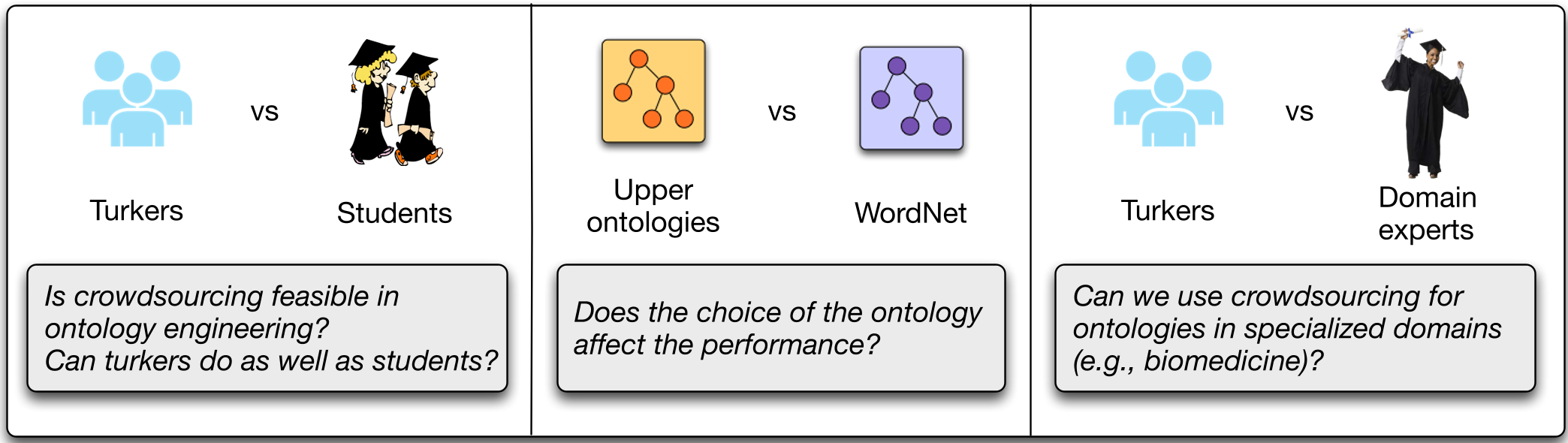 Figure 1: The structured approach used to compare turkers against students and experts across various ontology types.
Experiments & Results: Crowd vs. Expert
The study utilized three distinct "difficulty settings":
- Upper Ontologies (BWW/SUMO): Highly abstract and difficult for everyone (including students).
- Common Sense (WordNet): Easy for the general public.
- Specialized Domain (CARO - Anatomy): Originally thought to require medical degrees.
Key Findings:
- The Bonus Effect: Offering a financial incentive for >75% accuracy significantly improved reliability.
- Common Sense Dominance: On WordNet tasks, Turkers achieved a staggering 89% accuracy.
- Closing the Expert Gap: In the biomedical domain, the gap between Turkers and Experts was significant (66% vs 81%) unless the Turkers were given definitions. Once definitions were provided, Turkers jumped to 82%, making their performance statistically comparable to experts (89%).
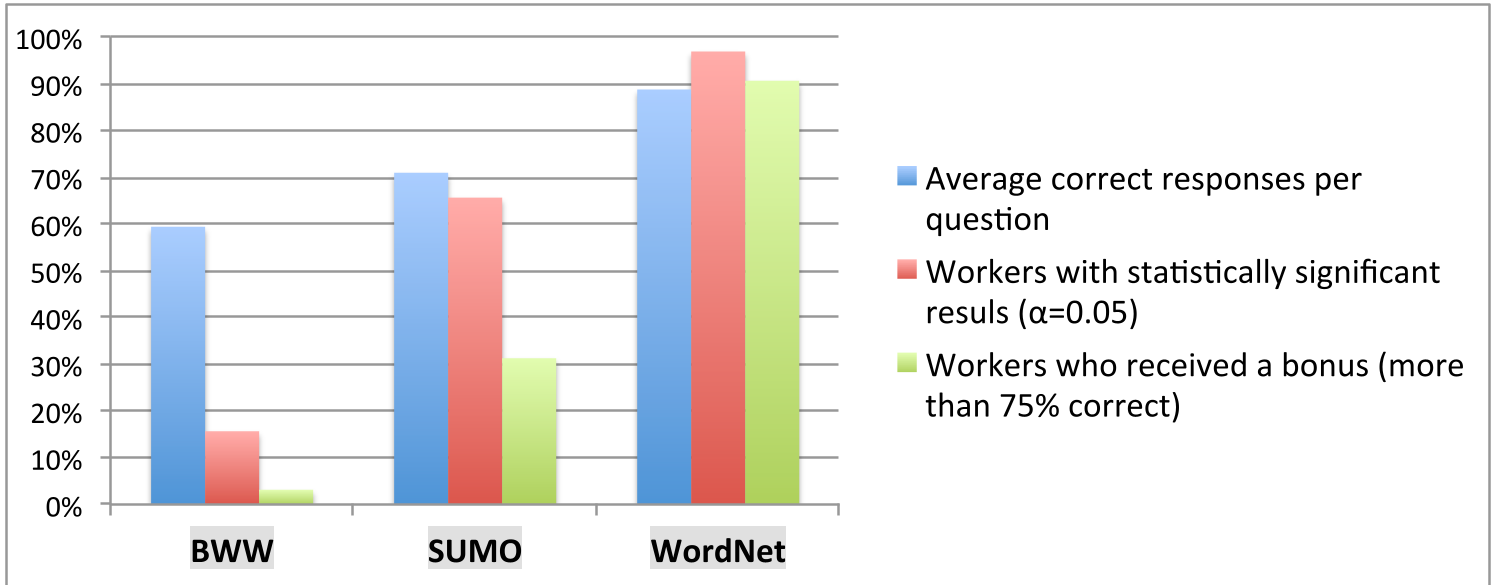 Figure 2: Statistical summary showing that while performance varies by ontology type, the crowd remains a robust resource.
Critical Insight: The "Context" Factor
The most profound takeaway is that domain expertise is often just "context in disguise." When non-experts (turkers) were given the same definitions as experts, they reached parity. This suggests that the barrier to entry for many "expert-only" tasks is actually a documentation/UI problem rather than a lack of innate cognitive ability.
Conclusion & Future Outlook
While this research predates the modern LLM era, its logic holds today:
- Scalability: Crowdsourcing is 10x cheaper than formal user studies.
- Hybrid Workflows: The authors envision tools like Protégé having a "Send to MTurk" button for instant hierarchy validation.
Limitations: The study notes that 12-31% of the crowd acts as "spammers" (providing identical answers), requiring robust filtering mechanisms like "Golden Questions." Additionally, while the crowd is great at verifying existing structures, they are less suited for proposing new, high-level abstractions.
The Takeaway for Today's AI: This work reminds us that human evaluation remains the "ground truth." Whether you are building an ontology or fine-tuning an LLM, the quality of your human-in-the-loop workflow determines the quality of your knowledge graph.