
Beyond the Virus: How Reputation Governs Information Wars in Social Networks
Mechanism Analysis of Competitive Information Synchronous Dissemination in Social Networks
This paper introduces a Social Evolutionary Game (SEG) framework incorporating coordination game strategies to model the synchronous dissemination of competitive information on social networks. By integrating individual reputation and communication frequency into the utility function, the study achieves a high degree of correlation with real-world Sina Weibo data.
TL;DR
Information doesn't just spread like a virus; it competes like a game of strategy. This paper moves beyond traditional epidemiological models by proposing a Social Evolutionary Game (SEG) framework. It reveals that the decision to "forward" or "switch" information is governed by a delicate balance between immediate reward and long-term social reputation.
The Missing Link: Human Agency in Information Flow
Most classical models (like SIR or Independent Cascade) view social network users as static nodes that simply "catch" and "pass" information. However, in the real world—especially in competitive marketing—users are active decision-makers. They ask: If I share this new ad, will it hurt my credibility? Is the reward worth the risk of looking like a flip-flopper?
The authors argue that existing models ignore individual characteristics, specifically:
- Reputation: The long-term trust built with one's peers.
- Coordination: The tendency to adopt what neighbors are using to maximize mutual utility.
Methodology: Coordination Games and SEG
The study utilizes a Coordination Game matrix (A/B strategies) where the highest payoffs occur when both players choose the same strategy. This mirrors social reality: information is more valuable when you and your friends use the same platform or discuss the same topic.
The SEG Framework
The model operates on a directed graph where two dynamics co-evolve:
- Strategy Updating: Using the Fermi update rule, users imitate neighbors with higher utility, but with a degree of "noise" representing irrationality.
- Partnership Adjusting: Users selectively cut ties with low-reputation neighbors and seek out high-reputation ones.

The 1.2x Rule: The Resilience of the "Status Quo"
The most striking find from the simulations is the extension of the critical point. While pure game theory suggests a rational agent might switch at a 1:1 utility ratio, the presence of Reputation creates a barrier.
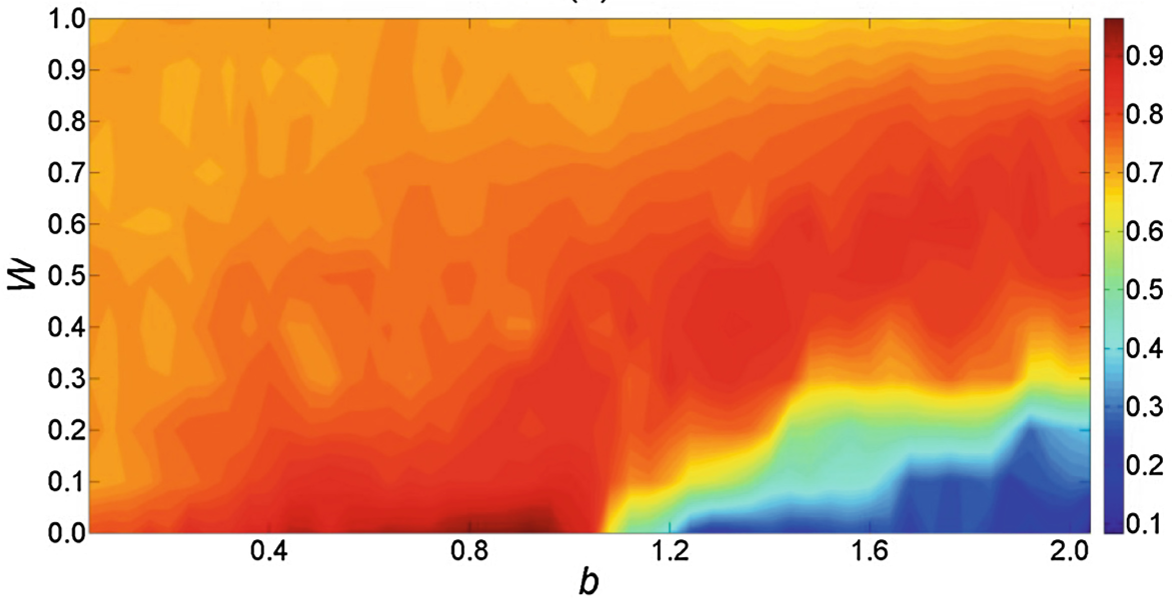
As shown in Fig. 2, when users communicate frequently (), they become more cautious. A competing information source needs to be roughly 1.2 times more attractive than the current one to trigger a mass shift in the network. If the utility is lower, the "loss of reputation" caused by abandoning the original community outweighs the gains.
Real-World Validation: Sina Weibo "Red Packet" Wars
To prove the model's validity, the authors analyzed the 2015 Spring Festival competition between two electronics giants, Micoe and Midea, on Sina Weibo.
By tracking search volumes and forwarding amounts, they mapped the "Utility" (incentives like red packets) to the "Strategy" (user engagement).
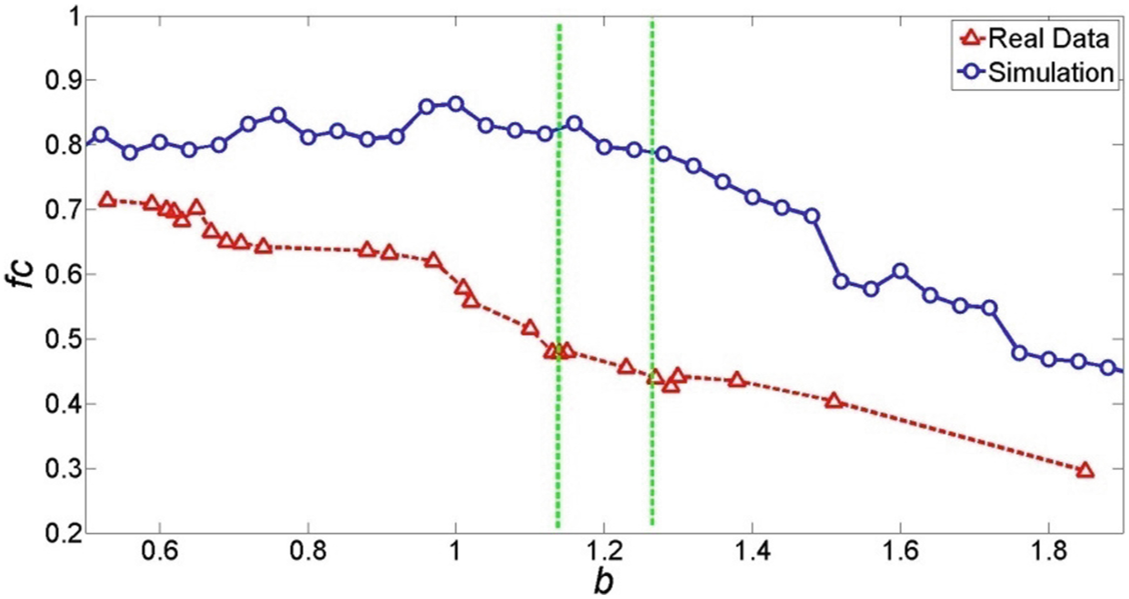
Fig. 5 demonstrates that the real-world data curve for user "defection" (switching from one topic to another) falls toward the 0.5 threshold exactly when the utility of the newcomer reaches the predicted ~1.2x mark. This confirms that reputation acts as a stabilizer in social networks, preventing erratic jumping between information sources.
Critical Insight & Conclusion
This research provides a rigorous mathematical basis for what marketers have long intuited: Brand loyalty is a function of social reputation.
Key Takeaways:
- Network Inertia: High-density networks with frequent communication are harder to "invade" with new information because the social cost of switching is higher.
- The Incentive Threshold: If you are launching a competing product in a saturated market, your "Red Packet" (incentive) must be at least 20% better than the incumbent's to even begin shifting the needle.
Limitations: The study assumes a relatively homegeneous network (regular random graph). Future work should explore how Influencers (high-degree nodes) with massive reputation capital can accelerate or decelerate this 1.2x threshold.