
Incentive-Compatible Clustering: When Game Theory Meets Distributed Data Mining
Mechanism Design for Clustering Aggregation by Selfish Systems
This paper introduces a game-theoretic market mechanism for clustering aggregation among selfish distributed systems. By incorporating transferable utility (penalties and rewards), the authors propose a framework that incentivizes decentralized nodes to report their true local cluster labels rather than lying to protect private interests.
TL;DR
Most clustering aggregation algorithms assume participants are "good citizens" who report data honestly. This paper challenges that assumption, introducing a Mechanism Design framework that uses financial penalties to force "selfish" systems (like competing banks) to tell the truth, ensuring the global cluster consensus remains accurate even when agents are tempted to lie.
The "Selfish" Reality of Distributed Mining
In distributed data mining, we often need to aggregate local results from multiple sources to find a global pattern. The status quo assumes that if systems share their labels, we just need to find the "minimum disagreement."
The Problem: What if a bank doesn't want its competitors to know the true classification of high-value customers? A rational, selfish system might lie about its labels to skew the global result. If even a few systems cheat, traditional algorithms like K-means ensembles fail because the "ground truth" they converge toward becomes a "liar's consensus."
The Solution: Mechanism Design
The authors argue that we should stop trying to minimize disagreement and start maximizing social welfare. They treat the clustering problem as a market game.
1. The Utility Function
Each system has a utility for a record , defined by:
- : Confidence that record belongs to cluster .
- : The "profit" or value derived from that clustering.
2. The Incentive Mechanism
To prevent lying, the authors propose a five-step mechanism including a Penalty System:
- Bidding: Systems bid on a penalty that "liars" (those in the minority) must pay.
- Voting: Systems report labels.
- Aggregation: Plurality voting determines the majority consensus.
- Settlement: If your reported label differs from the majority , you pay a penalty that is distributed to the majority winners.

Theoretical Breakthrough: Bayesian Nash Equilibrium
The core achievement is proving that a Bayesian Nash Equilibrium exists. This means that if the penalty is set correctly (Theorem 1 & 2), the "best" strategy for a rational agent is to tell the truth, provided they believe others are doing the same.
The paper defines a "Consistent Belief" property—where a system's confidence in a cluster is proportional to how many other systems they believe will agree with them. If you think you're right and others will agree, lying becomes an expensive risk.
Experimental Insights
The authors simulated seven selfish systems to test the relationship between penalty size () and accuracy.
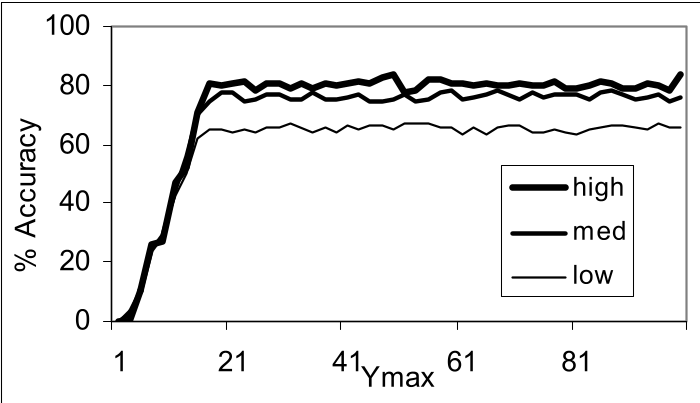
Key Findings:
- Diminishing Returns of Punishment: Increasing the penalty helps initially, but eventually, accuracy plateaus. You can't "punish" your way to 100% accuracy if the systems' local data is inherently noisy.
- Prior Confidence is King: The ultimate accuracy of the aggregation is bounded by the systems' prior confidence (). If the systems are unsure of their own data, no amount of economic incentive can create a perfect global result.
Critical Analysis & Future Outlook
While this work is a pioneered "preliminary step," it has limitations:
- Homogeneous Cluster Counts: It assumes all systems seek the same number of clusters ().
- Transferable Utility: It relies on "monetary payments," which might be difficult to implement in non-financial software environments.
- The Majority Bias: It assumes the majority is likely to be "correct." If a majority of systems are equally biased, the mechanism will reinforce that bias rather than the truth.
Future Work: The authors point toward negotiating penalties and exploring "soft clustering" where systems report probabilities rather than hard labels. As we move toward a world of Decentralized AI, merging Game Theory with Data Mining is no longer optional—it's the only way to build robust systems.