
Beyond Graphs: Analyzing Social Interactions as Behavioral Contingencies
A media-based social interactions analysis procedure
This paper proposes a formal procedure for analyzing media-based social interactions using "Mechner Language" to codify behavioral contingencies. By mapping Facebook user actions (posts, likes, comments) into if-then rules and applying data mining metrics, it establishes a human-readable framework for evaluating how different media types (video, status, links) drive social engagement.
TL;DR
While most researchers treat social networks as static graphs of "friends," this paper treats them as a series of behavioral experiments. By using a specialized symbolic language (Mechner Language), the authors transform Facebook actions like "liking a status" into measurable logic rules. Their findings reveal a startling truth: native "Share" buttons are often ignored in favor of manual reposting, highlighting a major gap between UI design and user psychology.
Problem & Motivation: The Limits of Topology
Most social network analysis (SNA) is obsessed with topology—who is connected to whom. However, a "link" on Facebook doesn't tell you the strength or the nature of an interaction. The authors argue that we need to understand the behavioral contingencies: "If User A does X, how likely is User B to do Y?"
The challenge is that human behavior is messy. To solve this, the authors bridge the gap between Experimental Social Psychology and Data Mining, providing a human-readable way to "code" and rank these interactions.
Methodology: Coding Human Behavior
The core of the methodology is the Mechner Language. In this system, every social interaction is an if-then rule:
- Action (A): The trigger (e.g., posting a video).
- Agent (a, b, k): The users involved.
- Consequence (C): The result (e.g., a notification or a comment).
Architecture of the Analysis Procedure
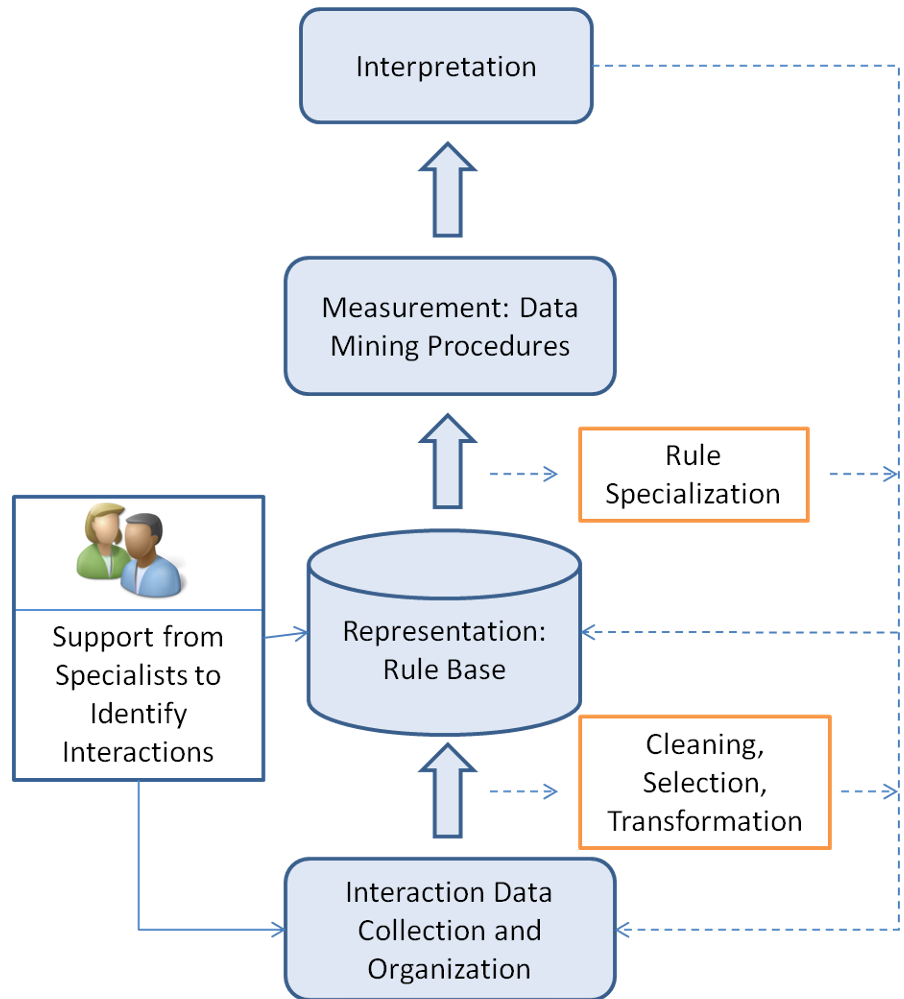
The authors propose a four-step iterative loop:
- Collection: Automated crawling (e.g., Python scripts).
- Representation: Translating actions into Mechner rules (e.g., ).
- Measurement: Calculating "Interestingness" using measures like Support (frequency) and Correlation (strength).
- Interpretation: Designers look at the rules to see if their UI is actually working.
Deep Dive: The Facebook Case Study
The authors analyzed over 600,000 actions from 1,400 Facebook profiles. They categorized posts into types: Check-ins, Photos, Statuses, Videos, Links, etc.
The Interaction Ranking
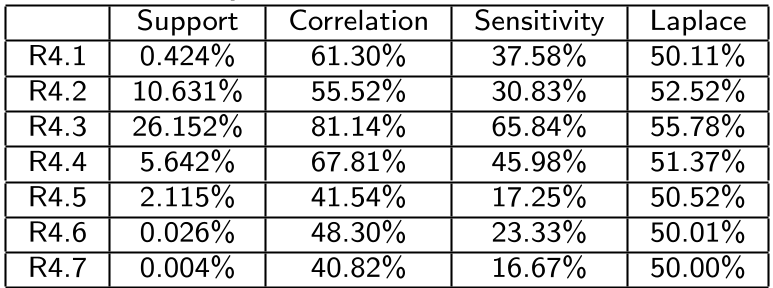
By ranking rules, they found that Rule R4 (Post + Comment + Like) was the most representative of active engagement.
- Status updates (Rule R4.3) showed the highest correlation with interaction.
- Videos (Rule R4.4) followed closely, suggesting that media-based stimuli are heavy drivers of social reciprocal behavior.
The "Sharing" Paradox
The most interesting finding involves how users share content. The authors modeled whether users use the "Facebook Share" button (Actions A8/A9) or manually copy-paste URLs (Actions A5/A7).
The Result: Support for native sharing rules (R9 and R10) was 0.00%. Users preferred to start a completely new social interaction by posting a link themselves rather than clicking "Share" on someone else's post. This suggests that the "Share" button at the time failed to satisfy the user's desire for authorship or visibility.
Critical Insight & Conclusion
Takeaway for Developers
If your "Share" button has 0% engagement, it’s not because people aren't sharing; it’s because your interface doesn't match their behavioral contingency. This paper proves that by formalizing social acts into logic rules, we can pinpoint exactly where a product's user experience fails to facilitate social "stimuli."
Limitations
The study is focused on a snapshot of Facebook in 2012. Modern social media has moved toward ephemeral content (Stories) and algorithmic feeds, which might require adding "Time" as a more explicit variable in the Mechner formulas—a direction the authors themselves suggest for future work.
Final Thought
This paper elevates Social Network Analysis from mere "counting" to "understanding," providing a rigorous mathematical framework for the psychological "if-then" of human connection.