
Who Are Your Users? Bridging the Gap Between Intuition and Data-Driven Personas
Who are your users?: comparing media professionals' preconception of users to data-driven personas
This study investigates the discrepancy between media professionals' internal preconceptions of their audience and data-driven personas at Al Jazeera English (AJE). By conducting 16 qualitative interviews and comparing insights with an Automated Persona Generation (APG) system, the researchers highlight a lack of organizational alignment regarding user mental models.
TL;DR
In the fast-paced world of digital news, editors often believe they "know" their audience. However, this study at Al Jazeera English reveals a startling fragmentation: media professionals' mental models are often built on a mix of personal anecdotes and "vague data," frequently clashing with actual social media demographics. The research underscores the need for Automated Persona Generation (APG) to reconcile these subjective biases with objective reality.
Background: The Persona Paradox
Personas are intended to be the "North Star" for product teams, aligning everyone—from developers to editors—around a common understanding of the user. Yet, in practice, these tools often face rejection. Why? Because organizations aren't blank slates; they are filled with professionals who already have deep-seated, often unconscious, preconceptions about who is "on the other side of the screen."
The Core Conflict: Intuition vs. Evidence
The research team interviewed 16 producers at Al Jazeera English (AJE) and compared their "gut feelings" about the typical user against data-driven personas extracted from Facebook analytics.
Source of Knowledge
The study found that professionals rely on two major (and often flawed) sources:
- Personal Observations: Seeing AJE on TV in hotel bars, observing family members, or projecting their own interests ("I make what I would watch").
- Vague Data: Half-remembered statistics or "brand handbooks" that they cannot specifically recall.
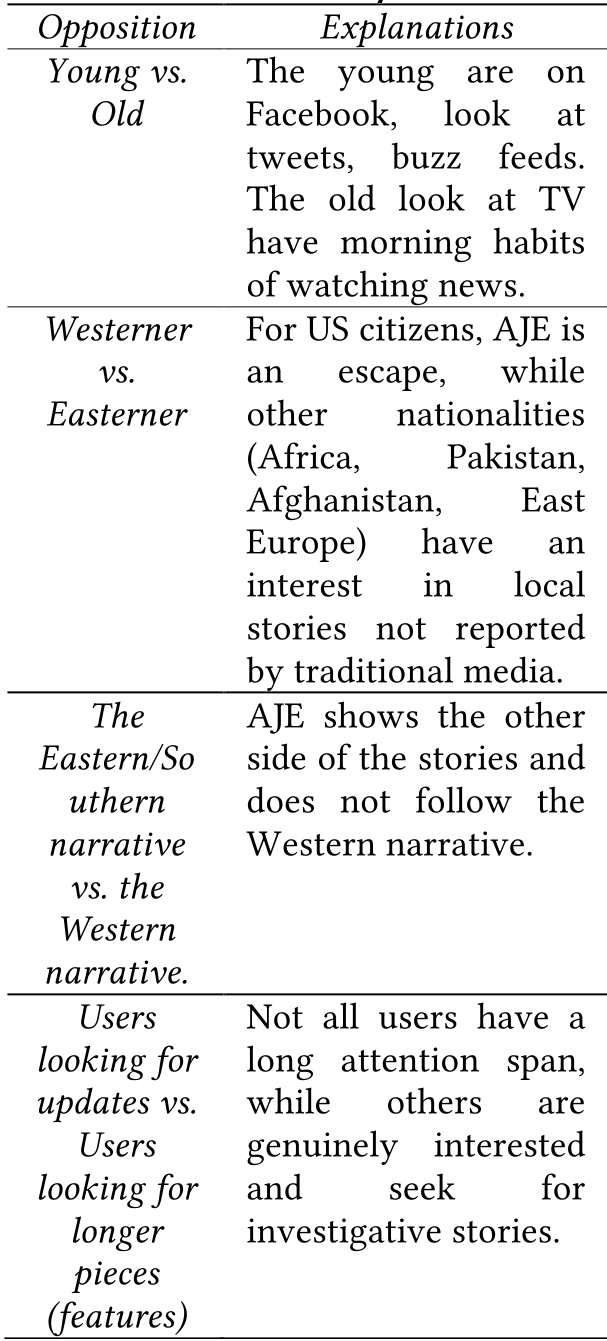 The table above illustrates the dichotomies editors use to categorize their audience, often framing them as "Westerners vs. Easterners" or "Young vs. Old."
Methodology: Automated Persona Generation (APG)
The authors utilized a system that scrapes social media data to generate "representative" individuals—giving them a name, age, and location. This turns abstract "big data" into a relatable human form.
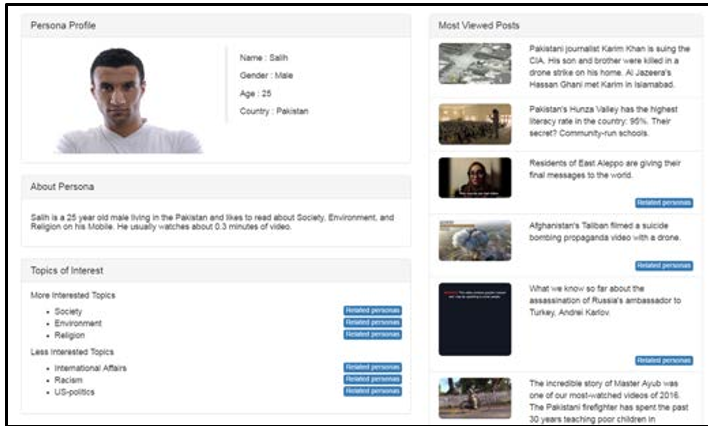 Example of an APG output used to challenge the editors' preconceptions.
Key Findings: Where They Match and Where They Miss
By comparing the professional interviews with the APG system (Table 3), the researchers identified critical gaps:
- Gender: There was strong agreement. Both producers and data confirmed a predominantly male audience.
- Age: Significant discrepancy. Producers believed the core audience was in their 30s or older. The data showed a much younger demographic, centered around age 25.
- Geography: Producers were divided. Some saw US viewers as "immigrants seeking home news," while others saw them as "Westerners seeking an alternative narrative."
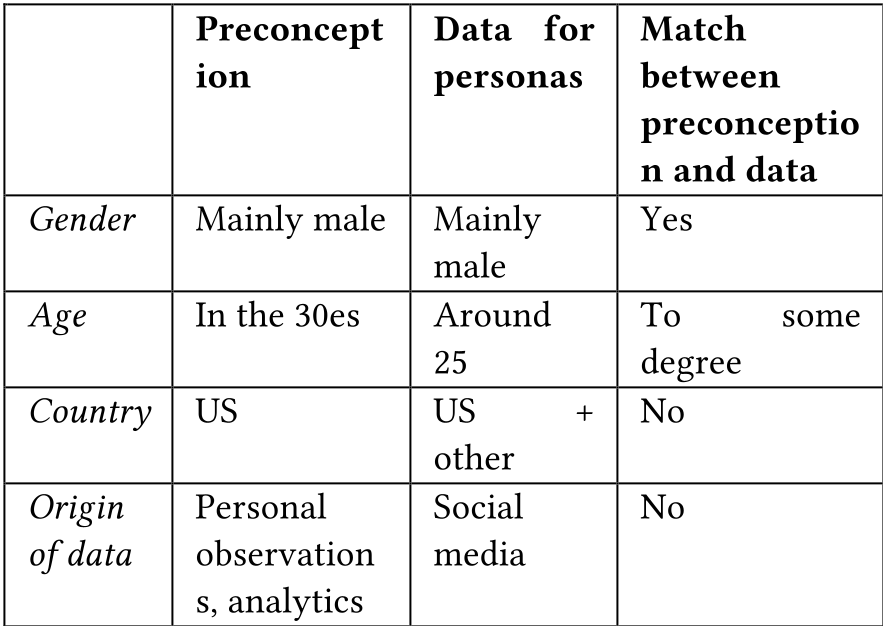 The comparison highlights that while some demographic markers align, the "Origin of Data" remains a point of friction.
Critical Insight: The Two Camps of Producers
The study highlights a cultural divide within the newsroom:
- Traditional News Producers: High resistance. They rely on "journalistic instinct" and show little interest in data-driven insights.
- Social Media Producers: High interest. They are more attuned to interaction habits and are hungry for tools that help them optimize engagement.
Conclusion: Implementing Personas in the Real World
The takeaway for any tech lead or UX researcher is clear: Data is not enough.
If a data-driven persona deviates too far from the "organizational reality" (what the stakeholders believe to be true), it will likely be ignored. To succeed, the implementation of personas must include a feedback loop. Instead of imposing names like "Andrew" or "Vihaan" on a team, researchers should ask: "Do you recognize this person? Does this feel real based on your field experience?"
Bridging the gap between a producer's "hunch" and a data scientist's "dashboard" is the only way to achieve true user-centricity in complex organizations.