
SocialConnector: Bridging the Intergenerational Gap through Active Mediation
Mediating Intergenerational Family Communication with Computer-Supported Domestic Technology
The paper introduces SocialConnector, a computer-supported domestic system designed to mediate intergenerational communication between older adults and their families. Evaluated through a 9-week "in-the-wild" study, the system utilizes touch and voice-based interfaces to bridge the digital divide, achieving a significant increase in social engagement through automated social awareness notifications.
TL;DR
Social isolation is a growing crisis for the elderly, exacerbated by a digital divide where standard social media tools don't fit their needs. SocialConnector is a domestic technology intervention that acts as a "mediator." By simplifying complex social media into voice/touch interfaces and using smart "awareness triggers" to prompt family members, the system increased family-to-senior interaction by over 60% in a 9-week field study.
Background: The Invisible Wall in Family Communication
As people age, their social circles tend to shrink, focusing primarily on close family. However, a paradox exists: while younger generations are more connected than ever via social platforms, the technology often isolates the very seniors they care for. The authors identify this as asymmetrical communication—younger family members want to use Instagram or WhatsApp, while older adults may prefer voice or simplified synchronous exchanges.
Methodology: The SocialConnector Architecture
SocialConnector doesn't ask the senior to "learn Facebook." Instead, it acts as a translation layer.
- Asynchronous Translation: It pulls Instagram photos and Facebook posts, rendering them as a simple "Photo Album" or "Incoming Message" feed on a fixed tablet.
- Voice Interaction: Seniors can dictate emails or initiate Skype calls using voice commands or single-touch "carousels" of family photos.
- The Mediation Engine: This is the "secret sauce." The system monitors the senior's activity. If a senior reads a message, the system sends an informal "social awareness" notification to the sender. It also sends periodic prompts to family members to remind them to reach out.
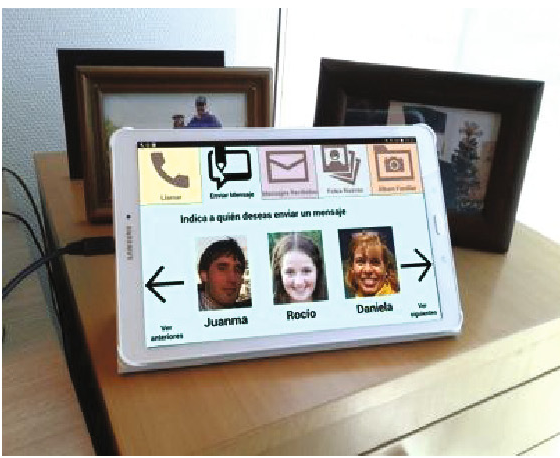 Caption: (a) Fixed wall-mounted arrangement; (b) Table-top arrangement in a domestic setting.
Experimental Results: Breaking the Silence
The researchers conducted a three-phase study (Pre-intervention, Intervention, Post-intervention) with nine families. The data showed a dramatic "U-shaped" improvement that didn't fully regress:
- Phase 1 (Baseline): Average of 91.1 interactions per 3 weeks.
- Phase 2 (With Social Triggers): Jumped to 149.8 interactions ().
- Phase 3 (Triggers Removed): Interactions stayed high at 133.1.
This suggests that the Social Awareness Triggers actually trained the family members to communicate more frequently, creating a new habit of engagement.
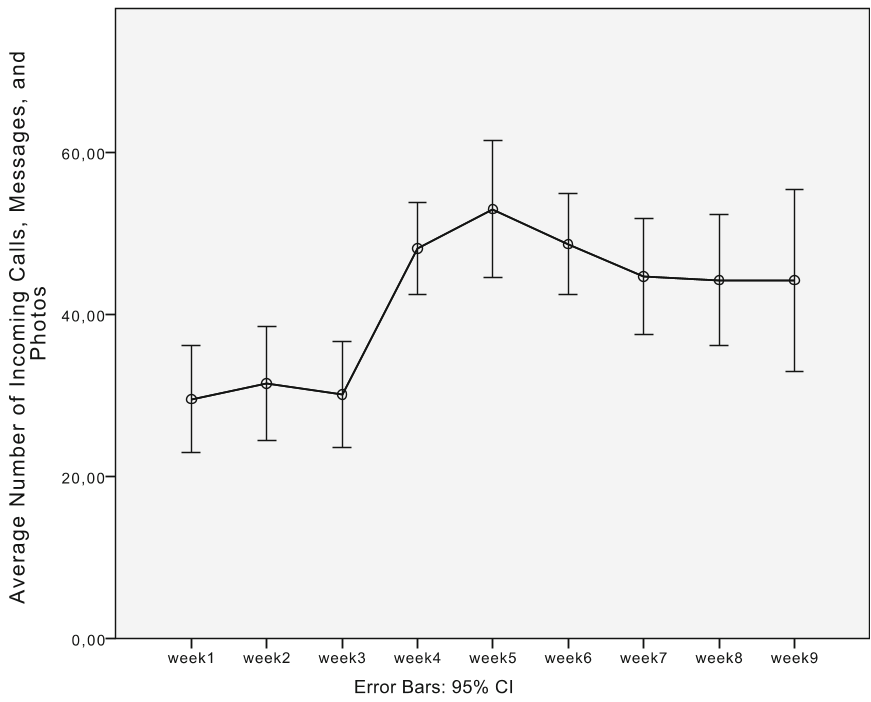 Caption: Significance of the social awareness mediation on incoming messages, calls, and photos.
Critical Insight: From Monitoring to Mediation
Most "Elder Tech" focuses on surveillance (fall detection, heart rate). This paper argues that Social Health is just as critical. The "SocialConnector" insight is that the technology should not just "watch" the senior, but "nudge" the family.
However, there are limitations. The "outgoing" interaction from seniors (them initiating calls) only saw a "slight tendency" to increase, which was not statistically significant. This implies that while seniors love receiving content, the barrier to initiating still exists, perhaps due to a fear of "burdening" their busy children—a cultural nuance heavily present in the Chilean families studied.
Summary & Future Outlook
SocialConnector proves that domestic technology can effectively mediate family bonds by respecting the different "interaction paradigms" of each generation. Future work in this space will likely involve more personalized persuasion—using AI to find the "perfect moment" to prompt a grandchild to send a photo to their grandparent, further humanizing the digital experience.
Key Takeaway: Don't just build an interface for the elderly; build a bridge for the entire family.