
Medical Diffusion: Pioneering 3D Volumetric Generation with Latent Diffusion Models
Medical Diffusion: Denoising Diffusion Probabilistic Models for 3D Medical Image Generation
2022-11-08
Summary
Problem
Method
Results
Takeaways
Abstract
This paper introduces Medical Diffusion, a novel latent diffusion probabilistic model designed for high-resolution 3D medical image generation. By combining 3D VQ-GANs with diffusion models in a compressed latent space, the authors achieve state-of-the-art results in synthesizing realistic 3D MRI and CT volumes across various anatomical regions.
## TL;DR
Medical Diffusion is a cutting-edge framework that brings the power of Latent Diffusion Probabilistic Models (LDMs) to 3D medical imaging (MRI and CT). By operating in a compressed latent space, it generates high-fidelity, diverse, and anatomically correct 3D volumes. This approach solves the "mode collapse" issues of GANs and demonstrates that synthetic data can effectively boost the performance of segmentation models when real-world labeled data is scarce.
## The Problem: The High-Dimensional Barrier of 3D Imaging
In the world of medical AI, data is often the bottleneck. Privacy regulations prevent the easy sharing of MRI/CT scans, and labeling 3D volumes is a grueling task for radiologists. While 2D image generation has seen a revolution with models like Stable Diffusion, 3D data remains a "final frontier."
Existing methods, primarily Generative Adversarial Networks (GANs), face two major hurdles:
1. **Computational Intensity**: Direct 3D generation requires massive GPU memory.
2. **Lack of Diversity**: GANs often suffer from mode collapse, generating the same "safe" patterns repeatedly rather than capturing the full biological variance of human anatomy.
## Methodology: The Two-Step Latent Approach
The authors bypass the computational trap of 3D data by using a **Latent Diffusion** strategy. Instead of diffusing the raw voxels, they work in a compressed "concept space."
### 1. 3D VQ-GAN (The Compression Engine)
The model first learns a discrete codebook using a 3D Vector Quantized GAN. This compresses a 256x256x32 volume into a manageable latent representation. The core insight here is the use of a **slice-wise discriminator** and a **3D discriminator** to ensure that both individual slices look sharp and the overall volume makes 3D sense.
### 2. Diffusion in Latent Space
Once in the latent space, a 3D U-Net based diffusion model handles the generation. To keep the math efficient, the authors used a clever trick: they applied convolutions on the high-resolution image plane while treating the depth dimension as part of the batch, then used **depth attention blocks** to link the slices together.
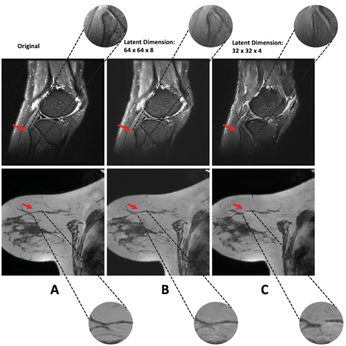
*Figure: Comparison of VQ-GAN reconstruction at different compression factors. A factor of 4 (64x64x8) preserves vital anatomical details like fibular bone and tissue continuity, whereas a factor of 8 leads to significant distortion.*
## Experimental Results: Realistic and Diverse
The model was tested across four major datasets: Knee MRI (MRNet), Brain MRI (ADNI), Breast MRI (DUKE), and Lung CT (LIDC).
### Radiologist Validation
In a reader study, professional radiologists rated the synthetic images on a Likert scale. Over **90% of the generated samples** were deemed "realistic with only minor unrealistic areas," proving that the model successfully captured complex human anatomy across different modalities.
### Diversity over GANs
Using the MS-SSIM metric, the authors proved that Medical Diffusion generates a much wider variety of samples than WGAN-GP. While the GAN basically "memorized" a few patterns (MS-SSIM ~0.99), the Diffusion model's diversity (MS-SSIM ~0.85) was remarkably close to that of real patient data (~0.80).
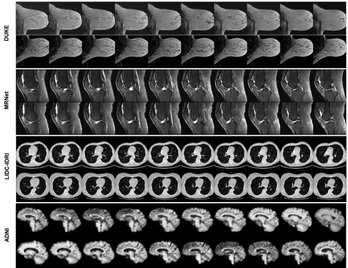
*Figure: Synthetic samples across Knee MRI, Brain MRI, Lung CT, and Breast MRI. Note the consistency across neighboring z-slices.*
## Application: Solving Data Scarcity
The true "litmus test" for synthetic data is its utility. The researchers simulated a scenario where an institution had very little labeled data (only 5% of their dataset).
- **Without Synthetic Data**: Dice Score 0.91
- **With Synthetic Pre-training**: Dice Score **0.95**
This 4% jump in accuracy is significant in medical contexts and proves that models can "learn" anatomical priors from synthetic volumes.
## Critical Analysis & Future Outlook
Medical Diffusion is a milestone because it demonstrates that diffusion models are not just for "art" but are robust enough for high-stakes medical 3D volumes.
**Limitations**:
- **Resolution**: While impressive, the resolution is not yet at the full diagnostic quality used by modern clinical scanners.
- **Latent Compression**: As shown in the paper, choosing the compression factor is a tightrope walk; too much compression loses tiny lesions or fine vessels.
**The Future**:
The code is public, and the framework is modality-agnostic. The next step will likely involve **Text-to-3D-Medical-Image** generation, where a radiologist could type "3D MRI of a 65-year-old with a 2cm tumor in the left frontal lobe" to generate high-quality training or educational data on demand.
## Conclusion
Medical Diffusion proves that latent diffusion models are currently the superior architecture for medical image synthesis. By prioritizing diversity and 3D consistency, this work paves the way for a more open, yet privacy-preserving, era of medical AI research.