
iDrug: Bridging the Gap in Mobile Social Medicine Recommendations
Medicine Rating Prediction and Recommendation in Mobile Social Networks
This paper introduces iDrug, a recommendation framework for Over-the-Counter (OTC) medicines within Mobile Social Rating Networks (MSRN). It integrates geographical, temporal, and social relationship data to provide personalized medicine rating predictions and ranked recommendations.
TL;DR
As healthcare becomes increasingly digital, the "iDrug" framework addresses the lack of specialized recommendation engines for over-the-counter (OTC) medicines. By leveraging Mobile Social Rating Networks (MSRN), the system predicts medicine ratings not just based on user preference, but by factoring in where the patient is located and how long ago a review was written.
Contextualizing the Problem: Beyond E-Commerce
While we trust algorithms to recommend movies or books, the medical field presents a higher barrier to entry. Existing systems often ignore two vital dimensions:
- Geography: A medicine recommendation is useless if the product isn't available in a local clinic or pharmacy.
- Temporality: Medical reviews lose relevance over time as new formulations or contraindications are discovered.
The authors argue that the rise of "Ubiquitous Healthcare" requires a paradigm shift: treating medicine selection as a social, location-based, and time-sensitive decision.
Methodology: The MSRN Framework
The researchers define a Mobile Social Rating Network (MSRN) to capture the complex relationships between patients (), medicines (), and locations ().
1. Temporal Weighting
One of the key innovations is the integration of a time-decay factor (). Instead of treating all ratings equally, the system considers the "average elapsed time horizon," ensuring that recent patient experiences carry more weight in the prediction than years-old reviews.
2. The Prediction Logic
The system calculates a predicted rating using a weighted average of the "Top-K" most similar patients. The similarity function is not a simple dot product; it is a mapping function that aggregates:
- Social Similarity: Ties between patients with similar symptoms ().
- Medicine Affinity: Historical rating patterns ().
- Location Relevance: Proximity to local medical facilities ().
 Figure 1: The structure of MSRN, showing the dual-clustering of patients by medicine community and local area community.
The iDrug Prototype
To prove the feasibility of the model, the authors developed iDrug, a mobile application designed for real-world scenarios.
- Scenario: A traveler in New York City catches a cold.
- Action: iDrug identifies his location, scans for nearby medicine providers, and analyzes the reviews from other patients in that specific geographic cluster who had similar symptoms.
- Outcome: The user receives a ranked list of medicines (e.g., weight-loss supplements or cold medicine) with predicted star ratings tailored to their current context.
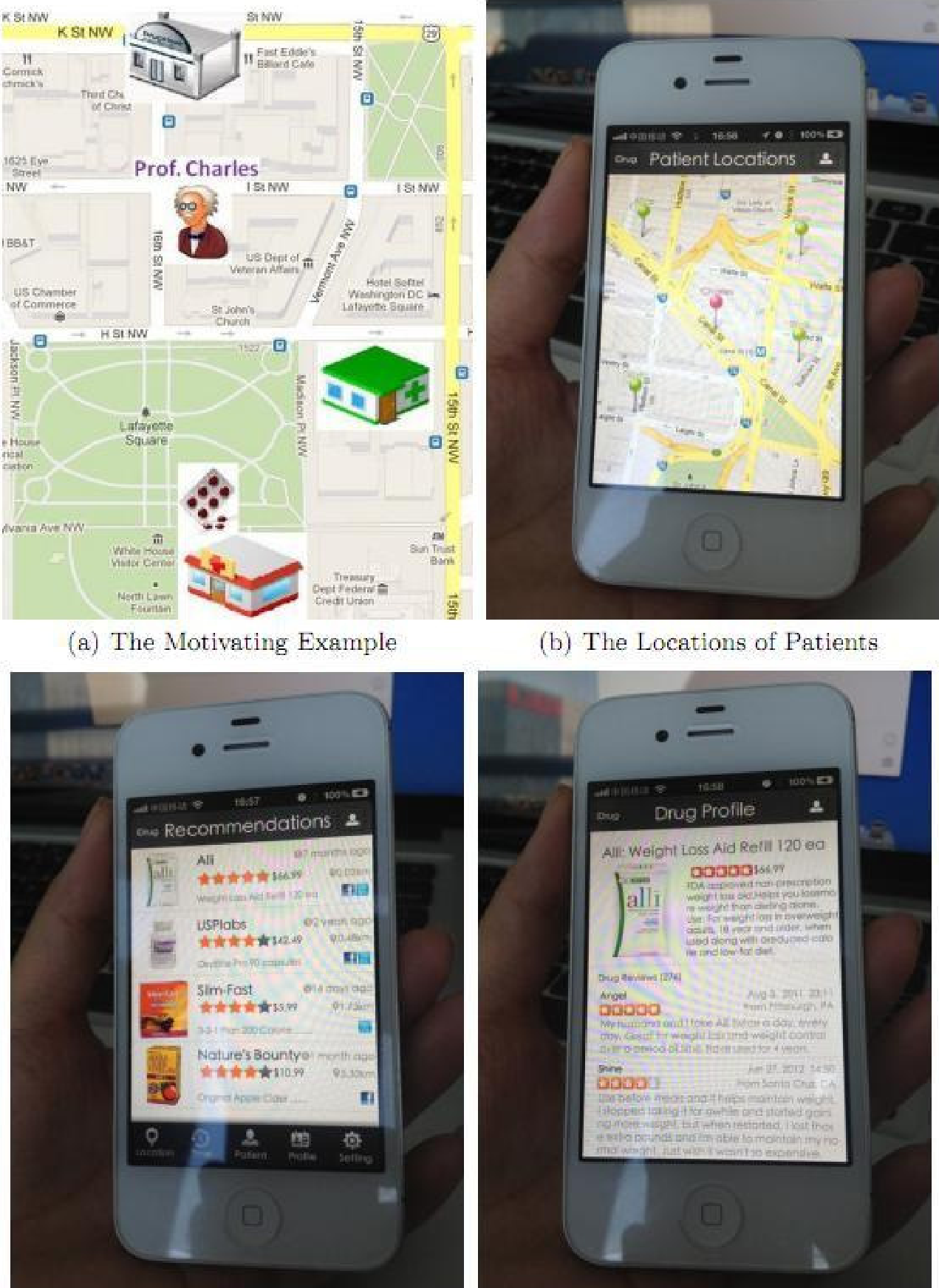 Figure 2: Prototype screens showing (b) location tracking, (c) predicted medicine rankings, and (d) deep-dive medicine reviews.
Critical Insight: Efficiency through Sparsity
The use of a Location-Medicine-Patient tri-modal approach effectively reduces the search space for the recommender. By filtering candidates based on geographical accessibility first, the system avoids the "long-tail" problem where it might recommend an effective medicine that is physically impossible for the patient to obtain.
Summary and Future Outlook
This work provides a solid foundation for Local-Aware Medical DSS (Decision Support Systems). However, as the authors note, the next evolution of this work will need to:
- Incorporate larger, standardized datasets (like the Nursing Home Compare data).
- Refine similarity measures to account for complex comorbidities.
- Address the inherent privacy risks of sharing medical symptoms over mobile social networks.
In the era of ubiquitous computing, iDrug represents an important step toward making medical information as accessible and personalized as any other social utility.