
Meet Eater: When Social Media Attention Becomes a Matter of Life and Death
Meet Eater: Affectionate Computing, Social Networks and Human–Plant Interaction
Meet Eater is a physical computing installation that explores "Affectionate Computing" by linking the survival of real plants to social media engagement. Using an Arduino-controlled irrigation system, the project transforms a garden into a tangible ambient display where Facebook interactions (likes and posts) directly trigger physical watering.
TL;DR
Meet Eater is a provocative "Affectionate Computing" installation that connects a physical garden to a Facebook page. By transforming likes, comments, and fans into physical water for the plants, the project explores the anthropomorphic qualities we assign to inanimate objects and the visceral power of social networks. It turns out, "loving" a plant too much on social media can literally drown it.
Background: Beyond Simple Sensors
In the world of Tangible Media, we often see plants used as simple output devices—Twitter-enabled pots that complain when they are thirsty. Meet Eater takes a different philosophical turn. Instead of focusing on the need of the plant (moisture levels), it focuses on the dedication of the community.
The authors, Bashkim Isai and Stephen Viller, were inspired by the idea that plants respond to human affection. They wanted to see if the "digital affection" found on social platforms could be mapped to a physical reality. This creates a bridge between "here" (the physical installation) and "there" (cyberspace).
Methodology: The Social Irrigation Loop
The heart of the system is a fusion of software and hardware designed to act as a synthetic ecosystem.
- Social Input: An Adobe AIR application polls the Meet Eater Facebook page every two hours.
- Logic Layer: It calculates the increase in "Fans" and wall posts.
- Physical Actuation: When specific thresholds are met, the application sends a signal to an Arduino microcontroller.
- Hardware Action: The Arduino activates a submerged water pump in a reservoir, trickling water through a PVC irrigation system into the pots.
 Figure 1: The internal architecture, analogous to a household sink, showing the reservoir and irrigation setup.
The "Sea of Love" Problem: Experimental Results
The most fascinating result of the Meet Eater project wasn't just that it worked, but how it failed.
The designers initially set watering thresholds based on modest social expectations. However, after the project was picked up by over 45 international news publications, the Facebook page was flooded with "fans." Because the system was hard-coded to reward every interaction with water, the plants were essentially "killed by kindness."
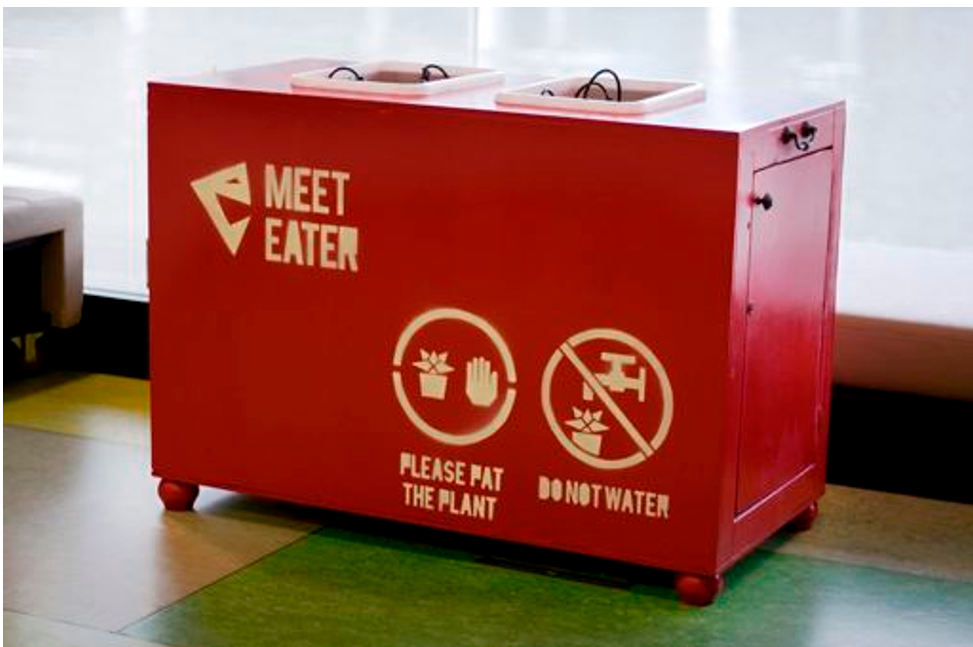 Figure 2: The physical installation at The Edge, State Library of Queensland, where the biological and digital worlds collided.
This highlights a fascinating tension in Human-Computer Pet Interaction (HCPI): the scaling issue of social media. While a person might talk to a plant once a day, a global network can "talk" to it thousands of times a minute.
Critical Insight: Plants as Ambient Displays
Meet Eater moves the needle on Ambient Displays. Normally, we think of glowing lights or moving needles. Here, the "display" is the health of a living organism. A thriving, green plant becomes a visualization of a community's active care; a wilted plant is a sign of social neglect.
Limitations and Future Work
The primary limitation identified was the lack of a "negative" feedback loop—there was no mechanism for the plant to signal "stop" when it had enough water, other than its own death. Future iterations would benefit from biological sensors (like soil moisture) acting as a safety override to the social input.
Conclusion: The Future of Affectionate Computing
The Meet Eater project serves as a reminder that the "bits" of our digital lives have real-world consequences. By anthropomorphizing a garden through a social network, the researchers proved that we could feel a sense of collective responsibility for distant, inanimate, or biological objects. As we move deeper into the era of the Internet of Things (IoT), the "Meet Eater" model suggests that emotional attachment might be the most powerful user interface of all.