
Evaluating Sea Battlefield Satisfaction: Leveraging Membership Cloud for Meteorological Intelligence
Satisfaction evaluation for meteorological environment information in sea battlefields based on membership cloud
This paper introduces a quantitative satisfaction evaluation method for Meteorological Environment Information (MEI) in sea battlefields using Membership Cloud theory. It transforms fuzzy qualitative weather descriptions into precise quantitative metrics to assess their impact on the Operational Effectiveness of Weaponry & Equipment (OEWE).
TL;DR
In modern naval warfare, weather is not just a background element—it is a decisive factor in Operational Effectiveness of Weaponry & Equipment (OEWE). This paper presents a novel framework using Membership Cloud theory to quantify the "satisfaction" of meteorological conditions. By bridging the gap between qualitative expert descriptions and quantitative data, it provides a mathematical lens to evaluate how rain, fog, and waves degrade missile and radar performance.
Context: Why "Fuzzy" Weather is a Hard Problem
High-tech weaponry is paradoxically more vulnerable to the environment than its predecessors. A surface-to-air missile's trajectory can be compromised by low-altitude winds, and radar detection ranges are often slashed by atmospheric mist.
The core challenge is that Meteorological Environment Information (MEI) is inherently "fuzzy." Terms like "moderate sea" or "bad visibility" do not have hard boundaries. Traditional fuzzy logic uses fixed membership functions (one-to-one mapping), but human experts—even specialists—rarely agree perfectly. There is randomness in their assessment and fuzziness in the criteria.
Methodology: The Membership Cloud Architecture
The authors move beyond traditional fuzzy sets by adopting the Membership Cloud, a model that can reflect the "double-sided soft marginal property."
1. Numerical Characteristics
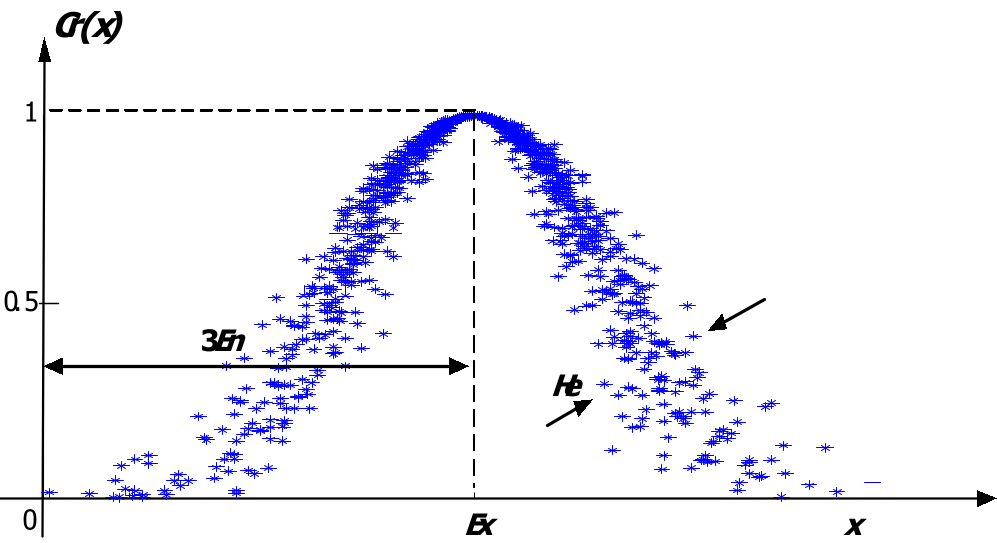
The "Cloud" is defined by three pillars:
- Expectation (): The central value of the qualitative concept.
- Entropy (): Measures the fuzziness—representing the acceptable range of the concept.
- Hyper-entropy (): The "entropy of entropy," measuring the dispersion of the cloud droplets (representing randomness).
2. The Evaluation Pipeline
The system follows a structured workflow to digitize expert knowledge:
- Categorization: Weather is divided into 6 levels (from Level 0: Sunny/Calm to Level 5: Thunderstorm/Terrible).
- Expert Polling: Experts provide satisfaction scores () for different environment levels.
- Backward Cloud Generation: Statistical tools calculate and from the expert scores to build the Cloud .
- Forward Cloud Generation: For a specific real-world weather state, the generator produces specific "cloud droplets" (), where is the satisfaction degree.
Experimental Validation: Surface-to-Air Missiles
To test the theory, the researchers evaluated a specific surface-to-air missile system against 10 experts' opinions.
Key Results & Data
The study focused on Grade 3 conditions (light rain and rough sea). By processing expert inputs through the Membership Cloud model (), the system derived:
- Satisfaction Score: ~0.437 (on a scale where 1.0 is perfect).
- Fuzzy Degree (): 0.143.
- Certainty Degree (): 0.857.
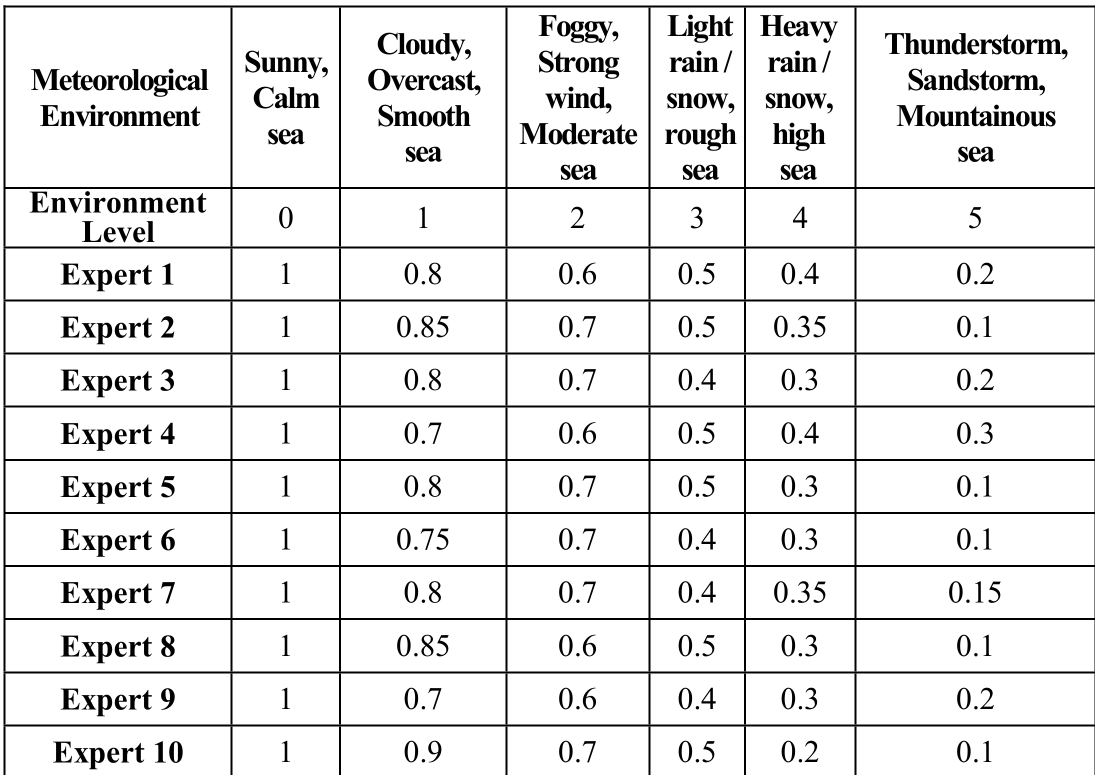
The results highlight a critical insight: as weather moves further from the "Ideal" (Expectation), the fuzzy degree increases, meaning our confidence in the satisfaction evaluation naturally decreases—a nuance that traditional linear models miss.
Critical Insight & Conclusion
This paper’s primary value lies in its treatment of uncertainty. In military logistics and operational planning, "I don't know" is not a useful answer, but "0.437 satisfaction with 85% certainty" is actionable intelligence.
Limitations: The model currently relies heavily on expert groups ( individuals in the example). In a real-time sea battlefield, integrating actual sensor data from satellites and lidars directly into the Cloud Generator without manual expert intervention would be the next logical step for this research.
Future Outlook: The Membership Cloud approach could easily be extended to other domains where subjective human judgment meets complex environmental data, such as autonomous vessel navigation or off-shore platform safety.