
MABED: Tapping into the Social "Buzz" for Precision Event Detection on Twitter
Mention-anomaly-based Event Detection and tracking in Twitter
This paper introduces MABED (Mention-Anomaly-Based Event Detection), a novel method for identifying and tracking events in Twitter by leveraging the frequency of user mentions (@username). Unlike traditional text-only approaches, MABED focuses on social interactions to handle noisy data and achieves more accurate event localization and description.
TL;DR
Researchers have developed MABED (Mention-Anomaly-Based Event Detection), a tool that identifies real-world events in the chaotic Twitter stream by monitoring how people mention each other. By focusing on social interaction "anomalies" rather than just keyword counts, MABED filters out noise more effectively and discovers how long an event truly lasts—whether it's a 2-hour shock or a week-long political debate.
Background: Why Text is Not Enough
Detecting events on Twitter is like trying to find a needle in a haystack where the hay is constantly shouting. Traditional methods focus on Textual Content (n-grams, word frequencies) or Topic Modeling (LDA). However, these suffer from:
- Noise: Most tweets are personal chatter (e.g., "I'm eating a sandwich").
- Fixed Windows: Most algorithms assume events happen in neat 24-hour blocks, which is rarely true in the real world.
- External Bias: Some methods rely on Wikipedia to "verify" events, meaning they might miss emerging or controversial topics not yet documented.
The Core Insight: Mentions as "Social Thermometers"
The authors of the MABED paper argue that when something truly important happens, users don't just tweet about it; they mention others to discuss it. These @username links are dynamic and topic-specific.
By measuring the Mention Anomaly—the gap between how often a word is mentioned in a specific time-slice versus its average historical frequency—the system can isolate the signal from the noise.
Methodology: How MABED Works
MABED operates in a sophisticated two-phase workflow:
1. Detection of Mention Anomalies
The system treats the arrival of mentions containing a word as a probabilistic process. If the observed number of mentions significantly exceeds the statistical expectation (modeled via a normal distribution), an anomaly is flagged. To determine the exact duration, the paper uses the Maximum Contiguous Subsequence Sum (MCSS). This allows the event to bridge "lulls" in activity (like night-time in a specific geography) without breaking the event into multiple fragments.
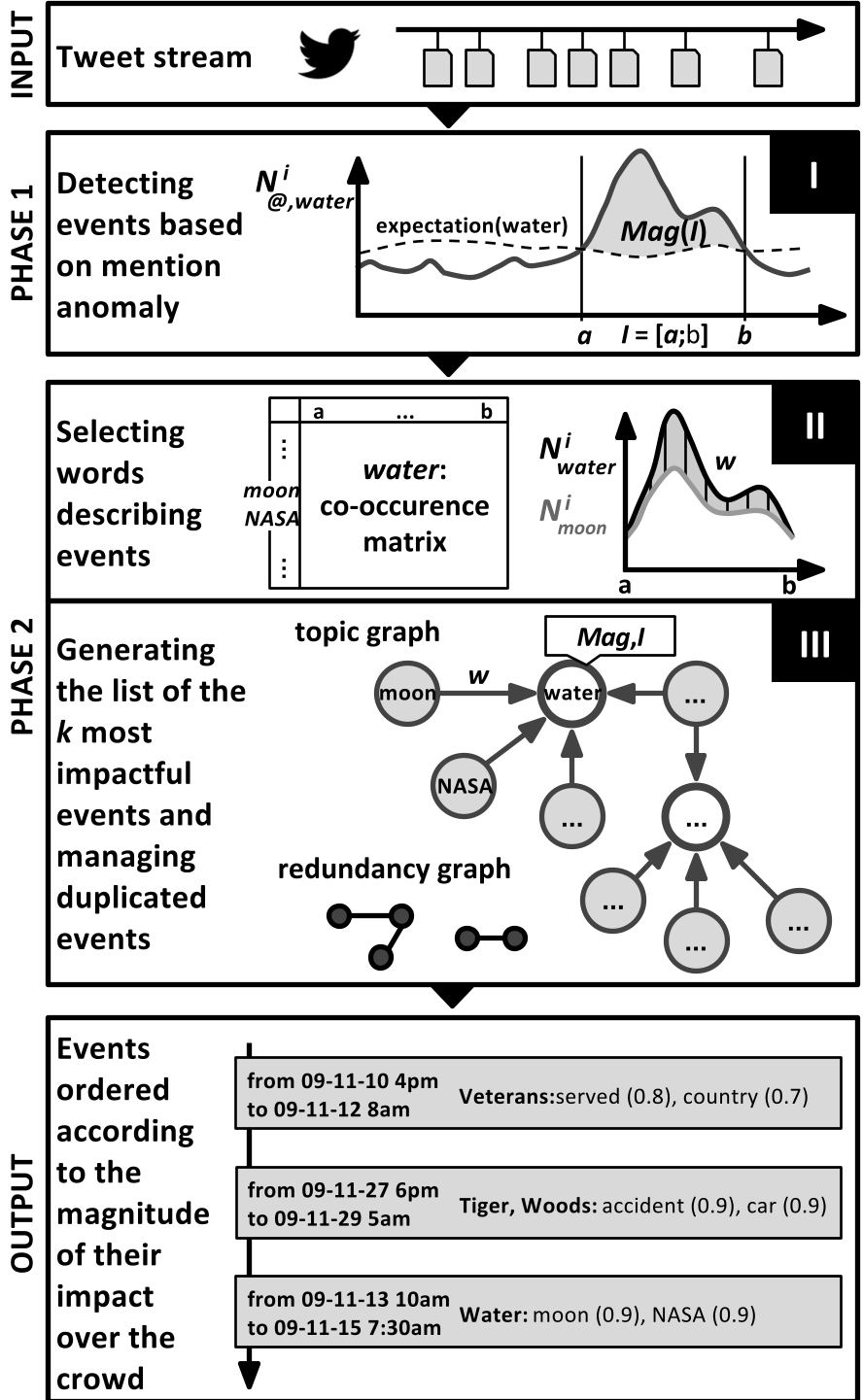 Figure 1: The MABED workflow, from tweet stream to the final list of impactful events.
2. Refined Description Selection
Rather than grouping words through expensive clustering, MABED looks at the temporal correlation between the main "bursty" word and potential descriptors. If the word "shooting" spikes at the exact same sub-hour intervals as the word "hood," they are linked to describe the "Fort Hood shooting."
Experimental Results & SOTA Comparison
The authors tested MABED on 3.5 million tweets across English and French datasets.
- Precision vs. Noise: In the English corpus (Cen), which contained up to 50% non-event chatter, MABED maintained high precision (0.775), while n-gram methods (TS3) plummeted to 0.375.
- Efficiency: MABED is orders of magnitude faster than clustering-based methods (ET), processing millions of tweets in under 100 seconds on standard hardware.
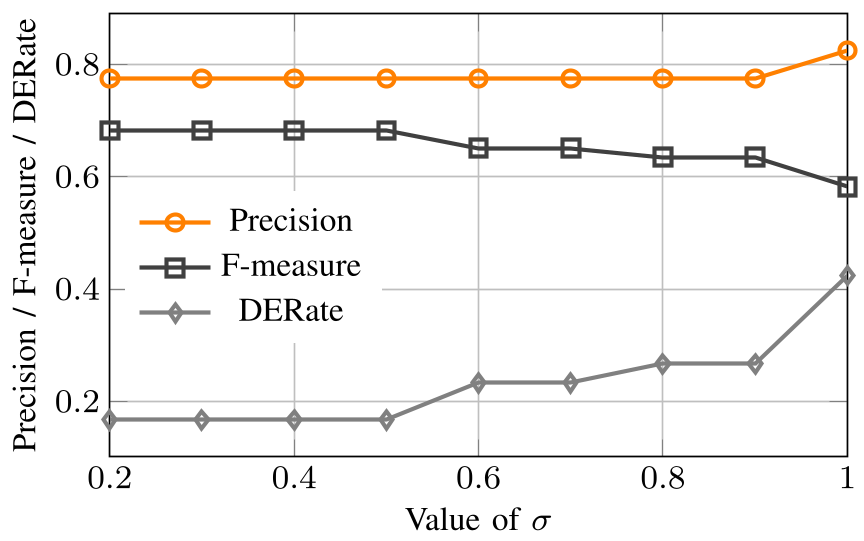 Table: MABED outperforms baselines (ET, TS2, TS3) in F-measure and running time.
The "Fort Hood" Case Study
A striking example is the Fort Hood shooting. MABED detected the burst within the specific 30-minute window it occurred (19:30 GMT). Interestingly, its variant that ignored mentions (-MABED) failed to see the event until two days later when media coverage peaked, proving that social signals are faster and more sensitive than pure keyword counts.
Critical Analysis & Takeaways
The brilliance of MABED lies in its Inductive Bias: it assumes that "impactful events trigger social discussion." This filter naturally discards spam and bot-driven keyword-stuffing that doesn't involve authentic user-to-user mentions.
Limitations:
- The method relies on the "mentioning culture." On platforms where mentions aren't common (like some news-heavy RSS-style feeds), the signal might be weaker.
- It currently focuses on individual words as "seeds," which might struggle with very complex, multi-word event concepts.
Future Outlook: This work demonstrates that social structure is as important as linguistic content. For future AI-driven social listening tools, integrating graph-based social signals into LLM-based summarization could be the next frontier in real-time global awareness.
Main reference: Guille, A., & Favre, C. (2014). Mention-anomaly-based Event Detection and Tracking in Twitter. ASONAM.