
MERL: Beyond Node Pairs—Capturing the Multi-View Essence of Social Relationships
MERL: Multi-View Edge Representation Learning in Social Networks
MERL is a novel multi-view edge representation learning framework designed for social networks. It jointly learns edge embeddings by capturing asymmetric source-destination roles and integrating textual social signals, achieving SOTA performance in link prediction and multilabel classification across multi-view datasets.
TL;DR
In modern social network analysis, treating an edge as a simple "link" between two fixed node vectors is a massive oversimplification. MERL (Multi-View Edge Representation Learning) breaks this limitation by learning role-specific embeddings (Source vs. Destination) across multiple relationship "views" (e.g., Friendship, Work, Education), further refined by the actual content of user conversations. The result is a dramatic boost in link prediction accuracy, particularly in sparse and asymmetric contexts.
The Problem: The Symmetry Trap & Single-View Blindness
Most graph embedding algorithms (like Node2Vec or DeepWalk) are node-centric. To predict an edge between user and , they typically compute a distance metric or a Hadamard product of the two node embeddings. This leads to three critical failures:
- Symmetry Bias: They often can't distinguish between and , even though being a "follower" is different from being a "following."
- Context Loss: Users interact differently across different contexts. Two users might be colleagues but have zero social interaction. Standard models collapse these distinct "views" into a single edge.
- Content Ignorance: They ignore the "vibe" of the relationship—the textual signals in messages that indicate relationship strength and affinity.
Methodology: The MERL Architecture
MERL proposes a sophisticated pipeline to transform raw network data into context-aware edge embeddings.
1. Multi-View Integration
Instead of treating each view in isolation, MERL aggregates edges into a Global Merged Graph to initialize shared node embeddings. This allows sparse views (with few edges) to "borrow" structural information from denser ones.
2. Asymmetric Relational Projections
This is the core innovation. For each view , MERL learns a low-rank matrix . This allows a node to have two distinct personas:
- Source persona:
- Destination persona: The edge existence is then modeled as the dot product of these two projected vectors.
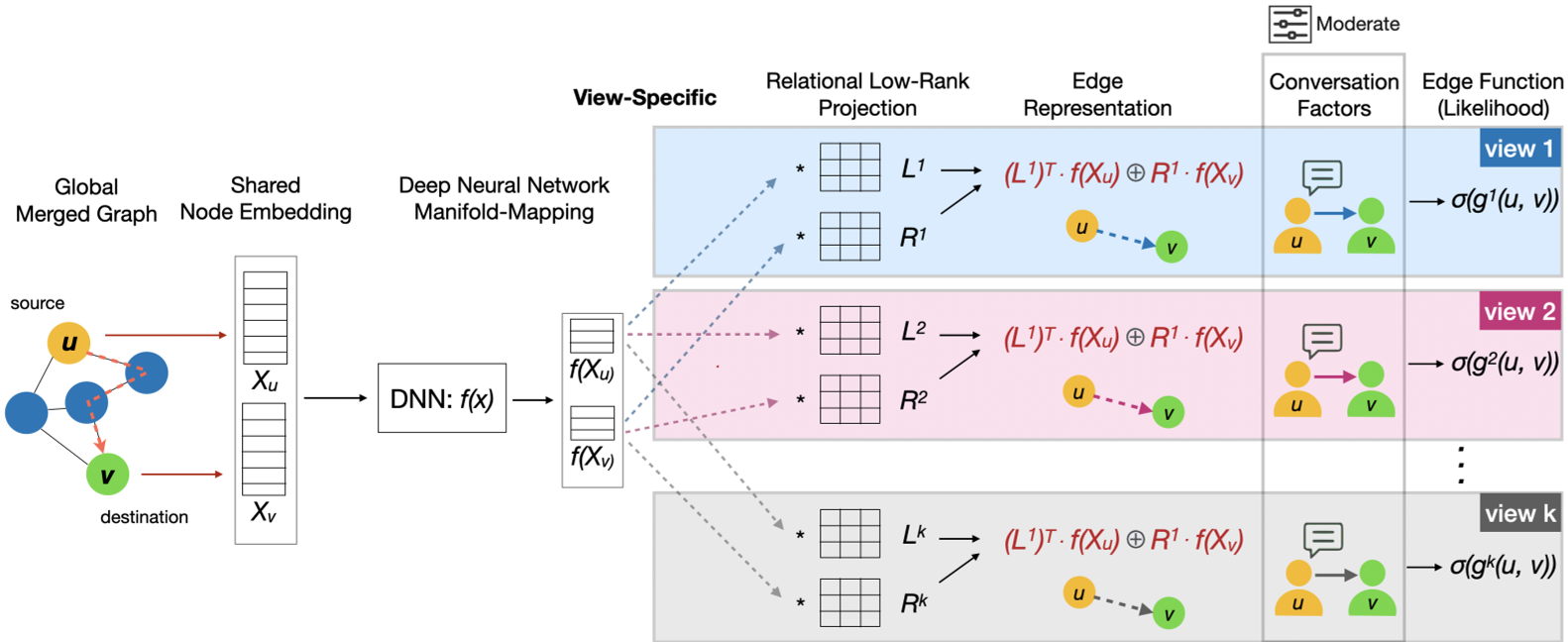 Figure 1: The MERL workflow—from shared node embeddings to view-specific asymmetric projections.
3. Moderating with Natural Language
The model incorporates Conversation Factors:
- (Similarity): Does the vocabulary used between and match the typical vocabulary of that specific view?
- (Frequency): How intense is the interaction? These factors act as weights in the objective function, ensuring the model prioritizes edges backed by strong social signals.
Experimental Triumphs
The authors tested MERL against heavyweights like HeteroEdge, MVE, and Node2Vec on large-scale Facebook and Twitter datasets.
Link Prediction SOTA
MERL demonstrated exceptional performance, particularly on the Twitter dataset where it outperformed the best baseline by nearly 29% in ROC-AUC. Accuracy remained high even as the complexity increased from 6 views to 41 views.
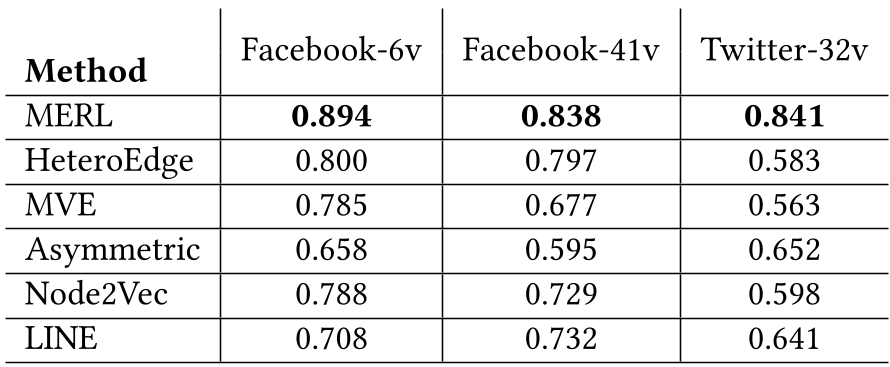 Table 1: Link prediction results (ROC-AUC) across multiple social datasets.
Visualizing "Relationship Clusters"
Using t-SNE, the authors mapped the learned edge embeddings. MERL successfully clustered similar relationships (e.g., Democratic-leaning friends) while maintaining clear separation between disparate interaction types, something traditional node-centric methods failed to do.
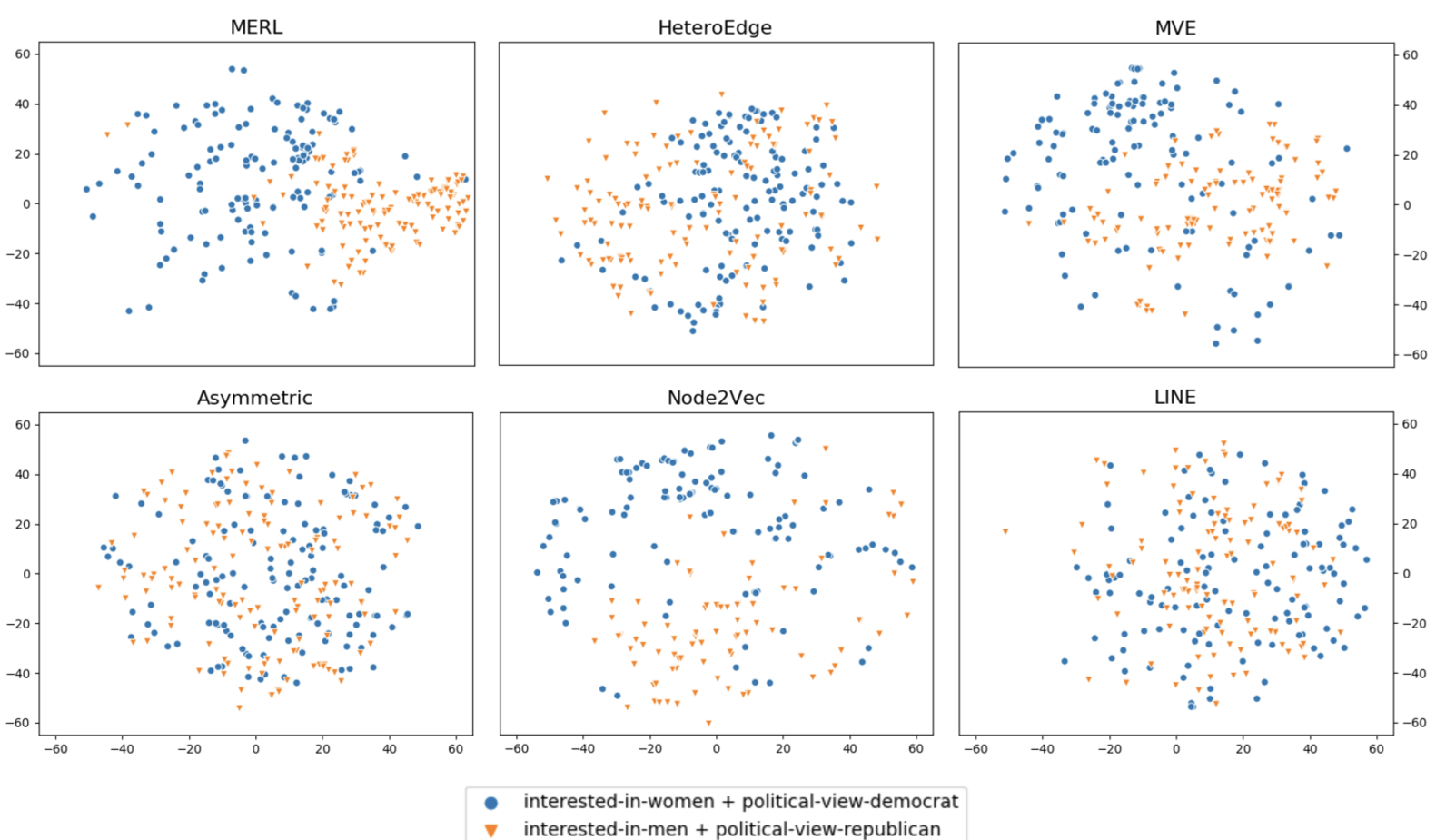 Figure 2: t-SNE visualization showing MERL's superior ability to differentiate relationship types compared to baselines.
Critical Insight: Why it Works
The "Secret Sauce" of MERL is its ability to handle sparsity. In real social networks, specific views (like "Hometown") are extremely sparse. Individual view-based learning fails here. By using a Global Merged Graph for initialization and Conversation Factors for refinement, MERL uses the "rich" data of popular views to illuminate the "dark" corners of sparse views.
Furthermore, the Asymmetric Projection solves the "role-reversal" problem, enabling the model to understand that a user's influence as a source is distinct from their receptivity as a destination.
Conclusion & Future Look
MERL represents a significant shift from node-centric to edge-centric graph learning. Its robustness across dozens of views and its ability to integrate NLP signals make it a powerful candidate for recommendation systems and social influence analysis. Future work could potentially integrate this with Graph Attention Networks (GATs) to dynamically weight the importance of different neighbor views.
Key Takeaways:
- Nodes are roles; edges are the context.
- Asymmetry is a feature, not a bug—model it explicitly.
- Textual metadata is the "ground truth" for relationship strength.