
Beyond a Single Species: Decoding the Microbial Context of Melanoma Immunotherapy
Meta-analytic microbiome target discovery for immune checkpoint inhibitor response in advanced melanoma
This study presents a large-scale meta-analysis of 15 melanoma cohorts (763 samples) to identify gut microbiome biomarkers for Immune Checkpoint Inhibitor (ICI) response. Using a unified pipeline, the authors identified species, metabolic pathways, and Biosynthetic Gene Clusters (BGCs) that predict therapeutic outcomes across different treatment settings.
TL;DR
Researchers have long sought a "universal" gut microbe that predicts success in cancer immunotherapy. By re-analyzing 15 international melanoma cohorts through a standardized meta-analysis pipeline, this study reveals that no such single species exists. Instead, the "responder microbiome" is a moving target that shifts depending on whether a patient receives standard immunotherapy or a combination involving fecal microbiota transplantation (FMT).
The Reproducibility Crisis in Cancer Microbiomics
The promise of the microbiome in oncology is undeniable—specific bacteria can literally "prime" the immune system to attack tumors. However, the field has been plagued by a "reproducibility gap": a microbe hailed as a hero in a Texas cohort often vanishes or becomes a villain in a London study.
The authors argue that this isn't just biological noise; it's a product of technical "Batch Effects" (different DNA kits, sequencing depths) and a failure to account for different treatment contexts. Their mission was to clean the slate, re-process raw data from 763 samples, and find the high-confidence signals that survive across borders.
Methodology: High-Resolution Harmonization
To look past the noise, the study deployed three layers of data extraction:
- Taxonomy: Using MetaPhlAn 4 to map species with unprecedented depth.
- Metabolism: Using HUMAnN 3 to see what chemical "factories" (pathways) the bacteria were running.
- Biosynthetic Gene Clusters (BGCs): Using BGCLens to identify the specialized secondary metabolites (like natural antibiotics) produced by the gut community.
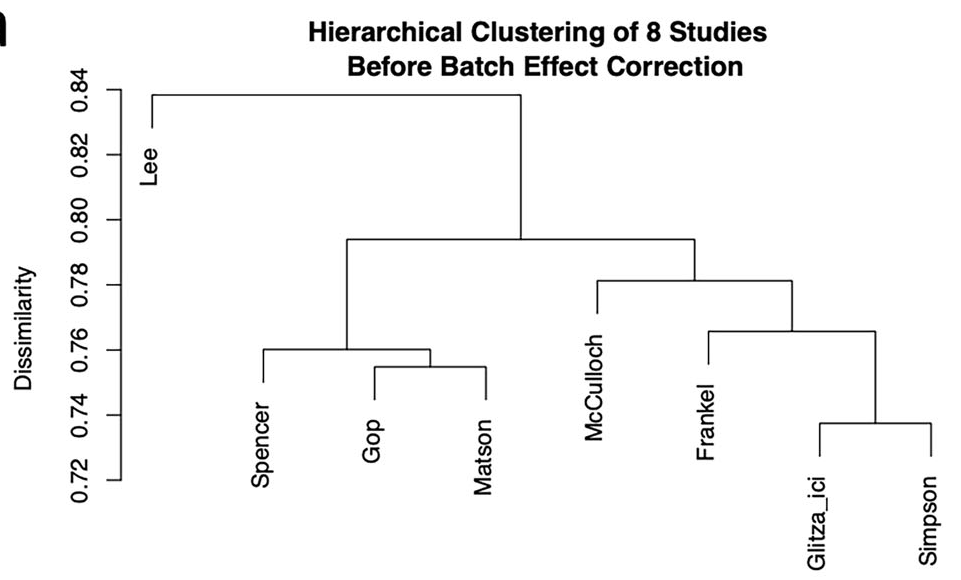 The figure above demonstrates how inter-study dissimilarity was mitigated through batch-effect correction (MMUPHin), reducing systematic bias from 12.1% to 4.2%.
The Context Trap: ICI vs. ICI + FMT
One of the most striking findings of the paper is that the "rules" changes when you add FMT to the mix.
- In ICI-Only patients: Responders are defined by SCFA-producers (butyrate/propionate makers like Roseburia) and an enrichment of amino-acid biosynthesis.
- In ICI + FMT patients: The signature shifts significantly. Suddenly, response is linked to nucleotide salvage and distinct Bacteroides clades.
Curiously, three species—including Pseudoflavonifractor capillosus—actually reversed their roles, favoring non-responders in standard therapy but switching to favor responders after an FMT. This suggests that the ecological "background" determines the clinical impact of individual species.
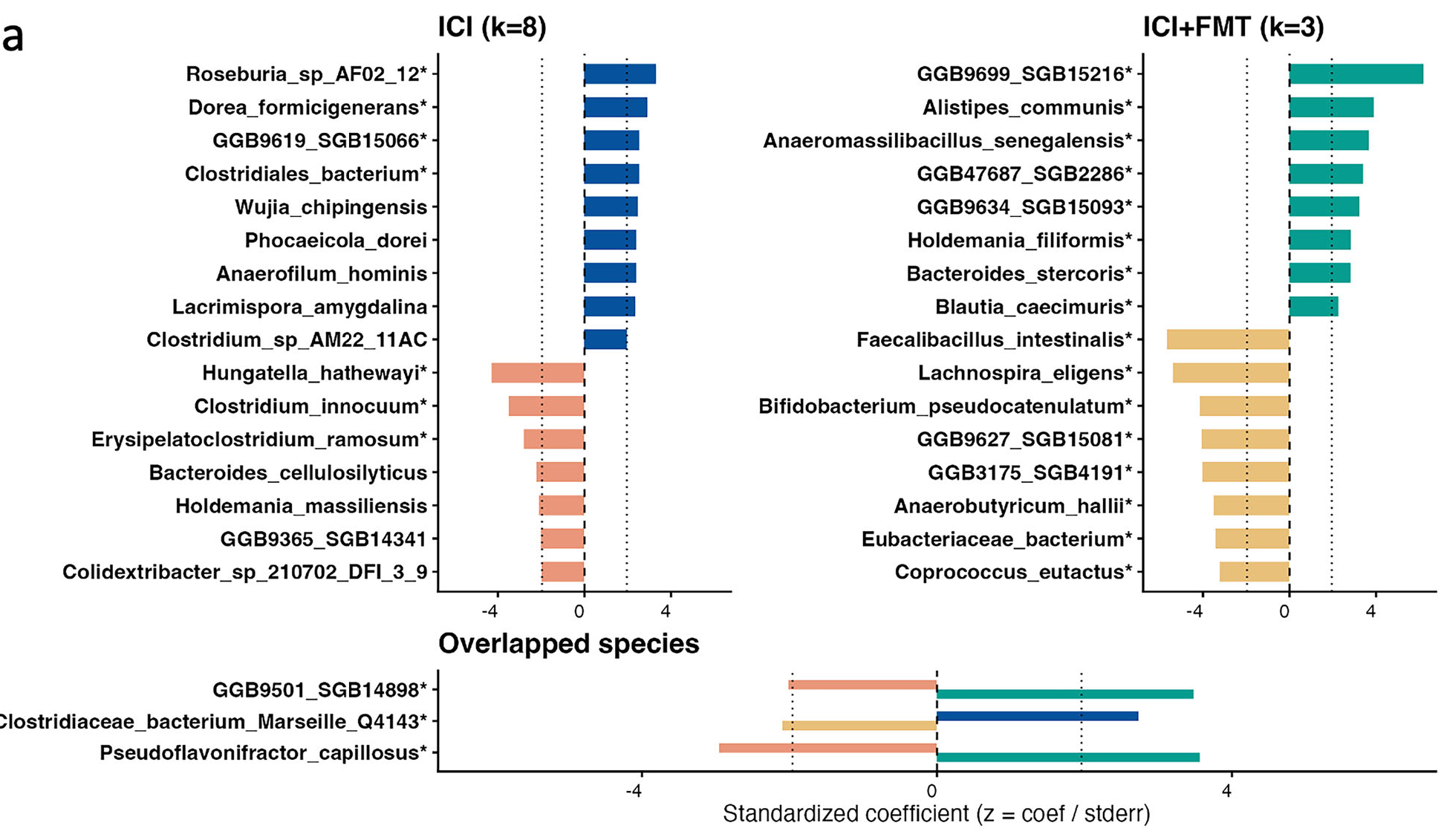 This forest plot highlights the stark differences in responder-associated species between standard ICI and FMT-augmented groups.
Predictive Power: Modest but Stable
The study utilized a "Leave-One-Dataset-Out" (LODO) validation strategy. By training a model on 14 cohorts and testing it on the 15th, they reached an AUC-ROC of approximately 0.60. While this isn't yet precise enough for a diagnostic tool in the clinic, it identifies a "shortlist" of features that are consistently important:
- Surface Molecules: Gene clusters responsible for bacterial capsules and exopolysaccharides are highly predictive, likely because they modulate how the host immune system "sees" the microbiome.
- Metabolic Pipelines: Anabolic programs (building molecules) rather than catabolic ones (breaking them down) seem to characterize the responder state.
 Performance heatmaps show that multi-modal models (combining species, pathways, and BGCs) provide the most stable cross-cohort predictions.
Conclusion and Future Outlook
This meta-analysis serves as a reality check for the field. It confirms that we cannot look for a single "magic bullet" microbe. Instead, we must focus on functional redundancy and treatment-specific ecological niches.
For future clinical trials, the takeaway is clear: the microbiome-informed intervention of tomorrow won't just be a probiotic pill; it will be a personalized strategy that accounts for the patient's specific drug regimen and their existing gut chemistry.