
Beyond Fixed Algorithms: Meta-learning for Educational Data Democracy
Meta-learning: Can It Be Suitable to Automatise the KDD Process for the Educational Domain?
The paper proposes a Meta-learning framework to automate the Knowledge Discovery in Databases (KDD) process specifically for the educational domain. By using algorithm recommenders (built via J48), it maps dataset meta-features to the most effective classification algorithms (NaiveBayes, NNge, JRip, J48) for predicting student performance.
TL;DR
Predicting student performance is a cornerstone of Educational Data Mining (EDM), but there is no "one size fits all" algorithm. This paper demonstrates a Meta-learning framework that automatically recommends the best classification algorithm for a specific course dataset based on its unique "meta-features." By treating the KDD process as a recommendation problem, the authors achieve performance nearly identical to that of human data-mining experts.
The "Data Expert" Bottleneck
Educational platforms like Moodle generate massive amounts of data, yet the people who need insights the most—instructors and academic authorities—are rarely data scientists. Current tools often use a "pre-set" algorithm (like J48). However, the No Free Lunch theorem reminds us that an algorithm that works for a small, blended-learning math course might fail for a massive, virtual cross-curricular seminar. The diversity of educational data (varying scales, noise, and student behaviors) makes manual algorithm selection a major hurdle.
Methodology: High-Level Meta-Features
The core insight of the authors is that the geometry and context of a dataset dictate which classifier will win. They followed a two-stage process:
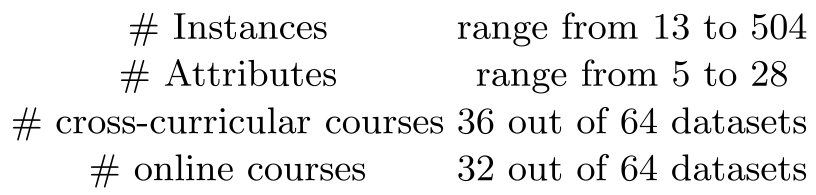
- Meta-Database Construction: They processed 64 datasets from 32 different courses, running four distinct classifiers (NaiveBayes, NNge, JRip, J48) and recording performance.
- Learning to Recommend: They used the extracted features to train a "recommender" (a J48 decision tree) where the input is the dataset's characteristics and the output is the recommended algorithm.
Key Meta-Features
The authors didn't just look at row counts; they utilized complex data geometry:
- Complexity Features (DCoL): Measures like Fisher’s discriminant ratio (F1) and the ratio of intra/inter-class distances (N2).
- Domain Features: Crucially, the "nature" of the course (Cross-curricular vs. Specific) and the "delivery mode" (Online vs. Blended).
How the Recommender Thinks
The authors generated two recommenders: m1 (optimized for global Accuracy) and m2 (optimized for Sensitivity, i.e., finding failing students).
The decision trees revealed a fascinating insight: The "Course Type" is the most important branching factor. This validates that educational domain context is more predictive of algorithm success than raw statistical measures alone.
Results: Can it Beat an Expert?
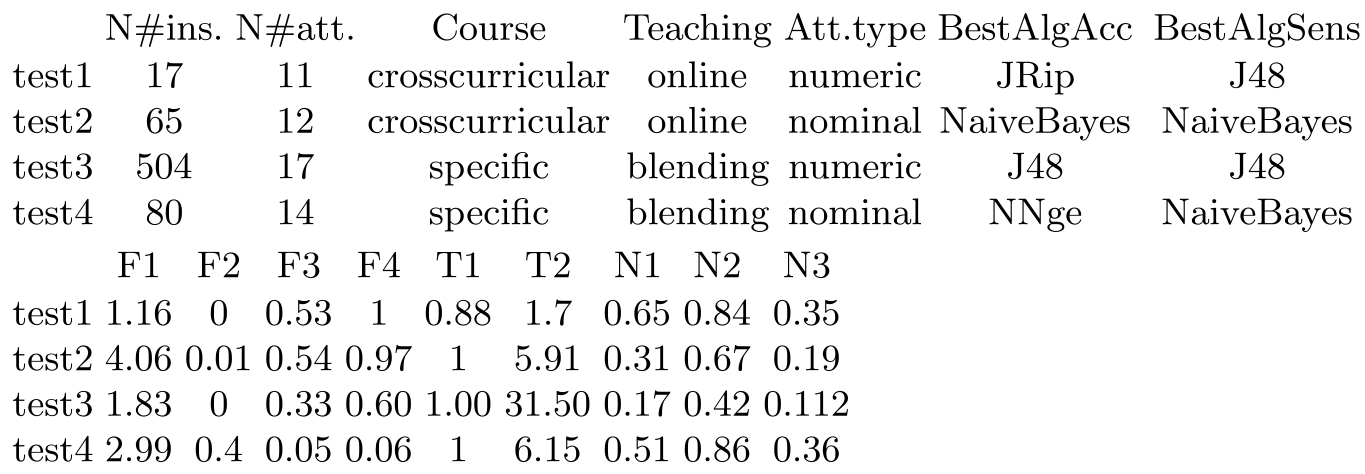
The results were highly promising. In three out of four blind tests, the meta-recommender picked the exact same algorithm an expert would have.
Even more impressive is the "Difference" analysis. When comparing the Recommender’s choice to an expert-tuned model (which includes manual outlier detection and hyperparameter tuning), the performance gap in accuracy was often less than 1%.

Deep Insight & Conclusion
This work marks a significant step toward the democratization of AI in schools. By wrapping this meta-learner into a web service or Moodle plugin, we can provide instructors with "expert-level" predictive models without requiring them to know the difference between a support vector and a decision tree.
Limitations & Future Work:
- The study used a relatively small pool of 64 datasets. Modern Meta-learning often requires hundreds of tasks to generalize perfectly.
- Current recommendations focus on the algorithm, but not yet the hyperparameters.
- Future iterations will likely integrate Automated Outlier Detection into the pipeline to further close the gap with human experts.
In conclusion, meta-learning isn't just a theoretical curiosity; it is a practical tool for making Educational Data Mining accessible, scalable, and robust across the messy reality of modern digital classrooms.