
Breaking the Long Tail: A Semantic Bridge for Heterogeneous Cultural Heritage
A metadata model and mapping approach for facilitating access to heterogeneous cultural heritage assets
The paper introduces the EEXCESS Metadata Model (EEX-O) and a semi-automatic mapping framework designed to aggregate heterogeneous cultural heritage resources. By combining the Europeana Data Model (EDM) and W3C PROV, it enables "on-the-fly" transformation of niche "long-tail" archives into a unified representation for modern web applications.
TL;DR
Cultural heritage data is often buried in specialized "long-tail" repositories. This paper presents the EEXCESS Metadata Model (EEX-O) and an automated mapping approach that uses an intermediate ontology to bridge the gap between niche archives and mainstream web platforms. By combining Europeana Data Model (EDM) and W3C PROV, it allows for real-time, context-aware metadata transformation and enrichment.
Problem & Motivation: The "Long Tail" Challenge
While major portals like Europeana have made significant strides, a vast amount of cultural wealth remains inaccessible in small, thematic collections. These "long-tail" resources suffer from two main issues:
- Heterogeneity: Every museum or archive uses a slightly different metadata schema (e.g., LIDO, Dublin Core, or custom XML).
- Inaccessibility: Traditional search engines don't index these niche databases effectively.
Previous solutions relied on manual mapping or high-maintenance centralized stores. The EEXCESS project argues that we need a way to push this content to users' everyday tools—like browsers or text editors—via "on-the-fly" transformation without the overhead of pre-mapping the entire universe of data.
Methodology: The Architecture of Interoperability
The core of the methodology is a sophisticated mapping chain that separates conceptual meaning from technical implementation.
1. The EEX-O Data Model
The authors didn't reinvent the wheel. Instead, they fused two powerful standards:
- EDM (Europeana Data Model): Handles the "Proxy" mechanism, allowing multiple views of the same object (e.g., a museum's original description vs. an automated AI enrichment).
- W3C PROV: Tracks the "Why" and "How"—providing essential provenance data for automatically enriched records.
2. The Semantic Hub (Meon)
Instead of creating direct mappings between every pair of formats (which is and unscalable), the system uses an Intermediate Concept Ontology (meon).
- Source format Meon Target format.
- This "Hub-and-Spoke" model means adding a new source only requires one mapping to the central hub.
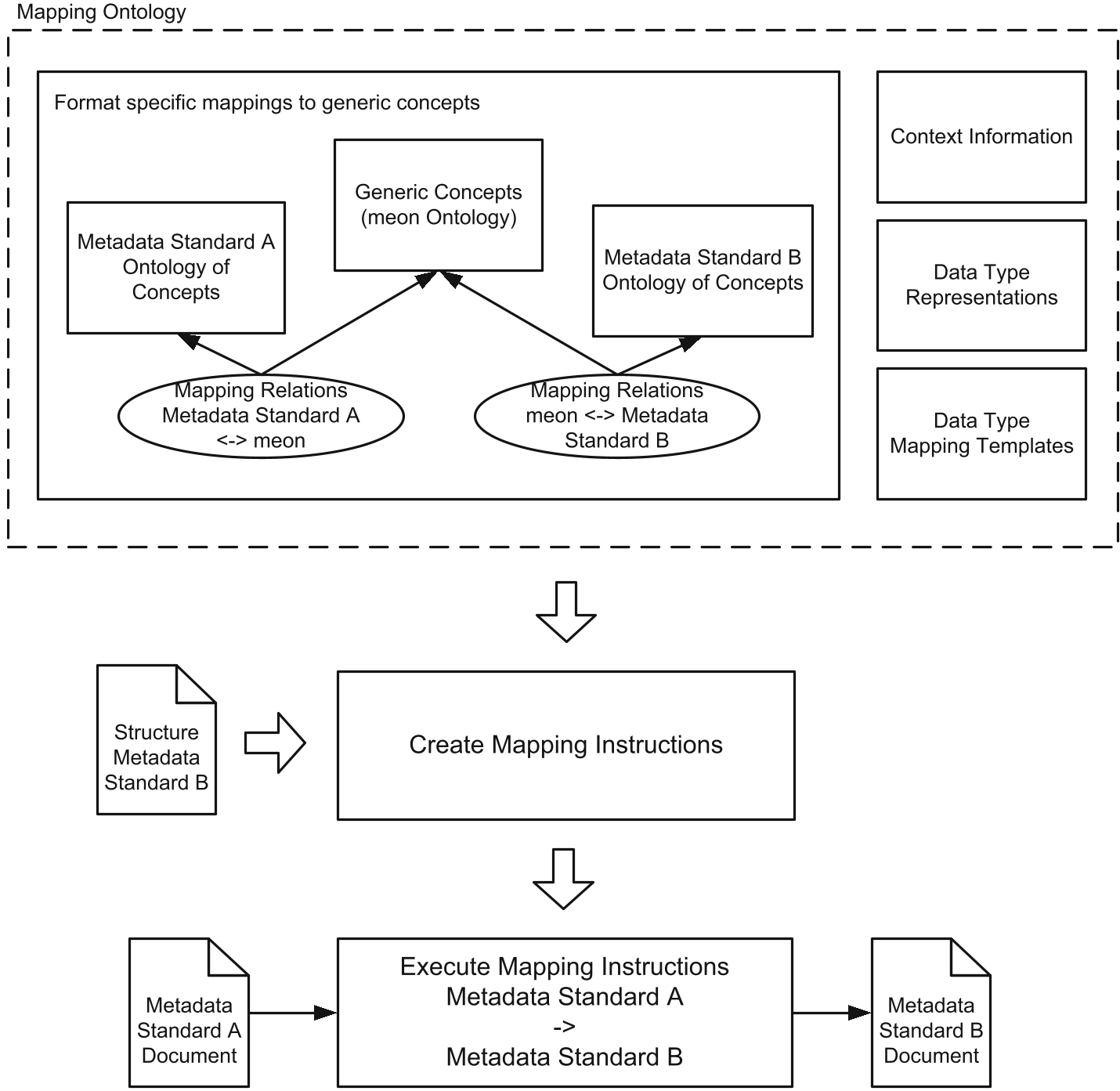 Figure: The mapping ontology chain, from format-specific concepts to generic meon concepts.
3. Contextual XPath Bindings
Translating "Title" to "dc:title" is easy; handling hierarchical XML structures (like collections within sub-collections) is hard. The authors introduced Contextual Bindings to ensure that an identifier for a book isn't confused with an identifier for an author, even if they share the same tag name.
Experiments & Results: Real-World Federated Search
The authors validated their approach by integrating EconBiz (the German National Library for Economics) into the EEXCESS ecosystem.
The Workflow:
- A user writes a blog post using a browser plugin.
- The plugin analyzes the text and queries the recommendation engine.
- The engine federates the query to EconBiz.
- Native XML results are transformed via an XSLT stylesheet (generated automatically by the mapping tool) into the unified EEX-O format.
 Table: Examples of metadata elements mapped from native formats to the unified EEXCESS model.
Through this process, raw metadata was not only harmonized but also enriched with entities from DBpedia and FreeBase, adding broader context (e.g., linking a book about "China" to geographic entities in GeoNames).
Critical Analysis & Conclusion
Takeaways
This paper proves that metadata mapping should be an automated service, not a manual chore. By utilizing an intermediate ontology, the EEXCESS project provides a scalable blueprint for making "long-tail" cultural data a first-class citizen in the modern web.
Limitations & Future Work
- Graph-based Formats: While the system excels at XML, its current reliance on XSLT makes it less native to pure RDF/Graph-based sources without a pre-processing step.
- Semantic Drift: As the "Hub" (meon) grows, maintaining the semantic precision of its generic concepts becomes more challenging.
In the future, the project aims to further refine the "quality" of automated enrichment—ensuring that the metadata added from the cloud is as trustworthy as the original records curated by historians and librarians.