
From Data to Wisdom: A Method Ontology for Automated Network Forensics
Method ontology for intelligent network forensics analysis
The paper introduces a novel Method Ontology for Intelligent Network Forensics Analysis, a heavyweight knowledge representation framework implemented in OWL. It uniquely combines domain-specific concepts with problem-solving methods to automate the reconstruction of complex multi-stage attack scenarios and facilitate expert-level reasoning.
TL;DR
This research moves beyond simple keyword-matching in forensics by introducing a Method Ontology. By encoding not just what an attack is (domain knowledge), but how to investigate it (problem-solving knowledge), the framework enables AI to perform multi-stage attack reconstruction using advanced reasoning (Deductive, Inductive, and Abductive).
The "Manual Bottleneck" in Digital Forensics
Network forensics is traditionally an "after-the-fact" investigation. While we have tools to capture packets (pcap) and generate alerts (Snort), the actual interpretation—connecting a port scan on Tuesday to a root-shell exploit on Wednesday—remains a grueling manual task for human experts.
The authors identify a major gap: existing security ontologies are "lightweight." They act like dictionaries but lack the "instruction manual" for solving problems. Without representing the semantics and logic flow of an investigation, automation is impossible.
Methodology: The Power of Method Ontology
The core innovation is the transition to a Heavyweight Method Ontology. Using Description Logic (OWL), the authors modeled three distinct layers:
- Factual Knowledge: Taxonomy of attacks, assets, and vulnerabilities.
- Competency Questions: 71 structured questions (e.g., "Given impact X, what attacks occurred?") that define the system's goals.
- N-ary Relations: Unlike simple binary links, these allow the system to represent complex "Attacker-Tool-Asset-Severity" relationships simultaneously.
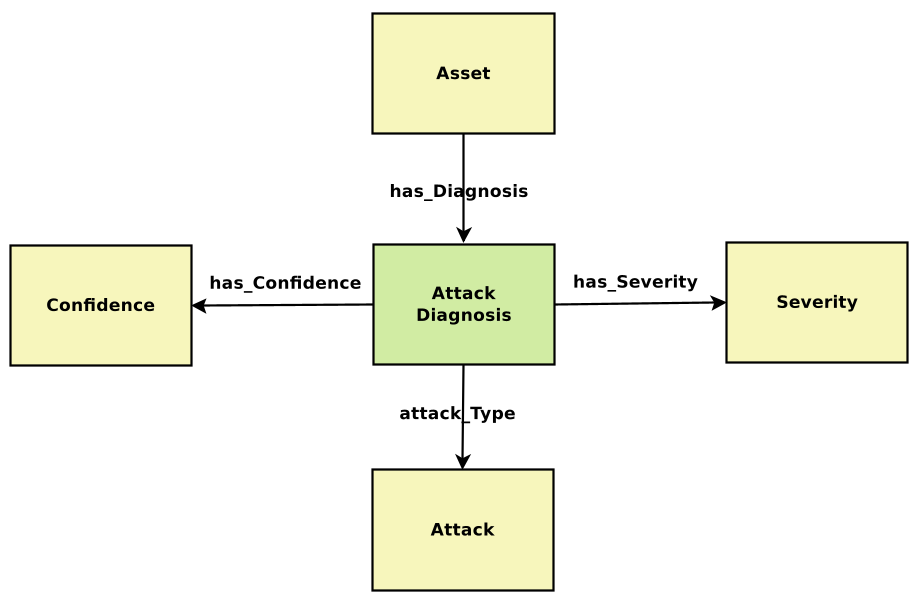 Figure 1: High-level representation of an Attack Diagnosis relation showing how multiple entities interconnect.
Tri-Model Reasoning: The Investigatory Engine
The paper stands out by implementing three types of reasoning that mirror a human detective’s mindset:
- Deductive: Narrowing down facts (e.g., "If it's a Buffer Overflow, it's an Exploitation attack").
- Inductive: Generalizing from cases (e.g., "This specific FTP server bug always allows arbitrary code execution").
- Abductive: Inferring preconditions from consequences. This is crucial for forensics—it allows the system to hypothesize that a "Port Scan" must have occurred even if the NIDS failed to log it, simply by looking at the subsequent exploit targets.
Case Study: Reconstructing a Multi-Stage Attack
The researchers tested the ontology on a real-world 2004 Honeynet attack. The system didn't just list Snort IDs; it built a narrative:
- Identified Reconnaissance (Signature 553/1622).
- Linked it to a Buffer Overflow (Signature 1672).
- Concluded a Privilege Escalation occurred, giving the attacker root access.
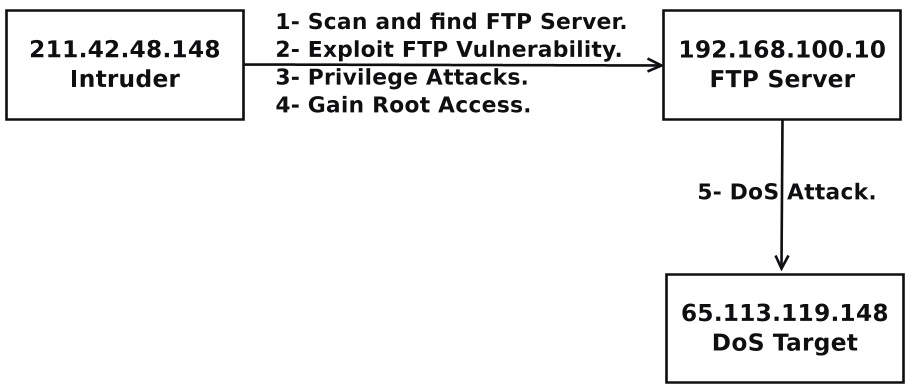 Figure 2: The reconstructed chronological sequence of the attack stages.
Critical Insight & Future Outlook
The heavy lifting in this paper is the Formalization. By defining taxonomic properties (Transitive, Reflexive, Anti-symmetric) for relations, the authors ensure that the inference engine doesn't make logical errors.
However, the Limitation is clear: maintaining an ontology with 11,000+ classes manually is unsustainable. The authors rightly point toward Automated Ontology Construction as the next frontier. As we move into the era of AI-driven SOCs (Security Operation Centers), this work provides the structural "brain" that Large Language Models or Autonomous Agents need to stay grounded in forensic logic.
Final Takeaway
Knowledge is not just a collection of facts; it is the ability to use those facts to solve a puzzle. This "Method Ontology" provides the roadmap for the next generation of intelligent, self-reasoning forensic systems.