
MERML: Boosting Multimodal Emotion Recognition via Joint Metric Learning
Metric Learning Based Multimodal Audio-visual Emotion Recognition
The paper introduces Multimodal Emotion Recognition Metric Learning (MERML), a framework that jointly learns modality-specific Mahalanobis metrics for audio-visual emotion recognition. By optimizing a latent-space representation, it achieves state-of-the-art performance on eNTERFACE (91.5% accuracy) and CREMA-D (66.5% accuracy) datasets.
TL;DR
Recognizing human emotions is inherently multimodal. While previous research struggled with simply "stacking" audio and video data, the Multimodal Emotion Recognition Metric Learning (MERML) framework introduces a way to learn a discriminative latent space. By jointly optimizing how we measure distances in both audio and video channels, MERML hits new SOTA benchmarks (91.5% on eNTERFACE), outperforming even human perception in complex datasets.
The "Concatenation" Trap: Why Current Methods Fail
The central challenge in multimodal learning is that different modalities—like the tone of a voice (audio) and a micro-expression on a face (video)—have vastly different statistical properties and distributions.
Traditional approaches typically use:
- Early Fusion: Concatenating raw feature vectors, which often ignores the unique "importance" of each channel.
- Late Fusion: Averaging the final scores of independent models, which misses the rich, nonlinear correlations between sound and sight.
The authors argue that the missing piece is a learned metric distance. Standard Euclidean distance treats all dimensions equally, but in emotion recognition, some features are "noisier" than others.
Methodology: Engineering a Discriminative Latent Space
The core of MERML is the joint learning of Mahalanobis distance matrices ( and ). Instead of just projecting data, it creates a new "psychological" space where:
- Similar emotions (e.g., two different people being "angry") are pulled together.
- Dissimilar emotions (e.g., "happy" vs. "sad") are pushed apart.
1. The Architecture
The pipeline begins with extracting deep visual features (VGG-Face) and spectral audio features (openSMILE), followed by temporal aggregation using Fisher Vectors.
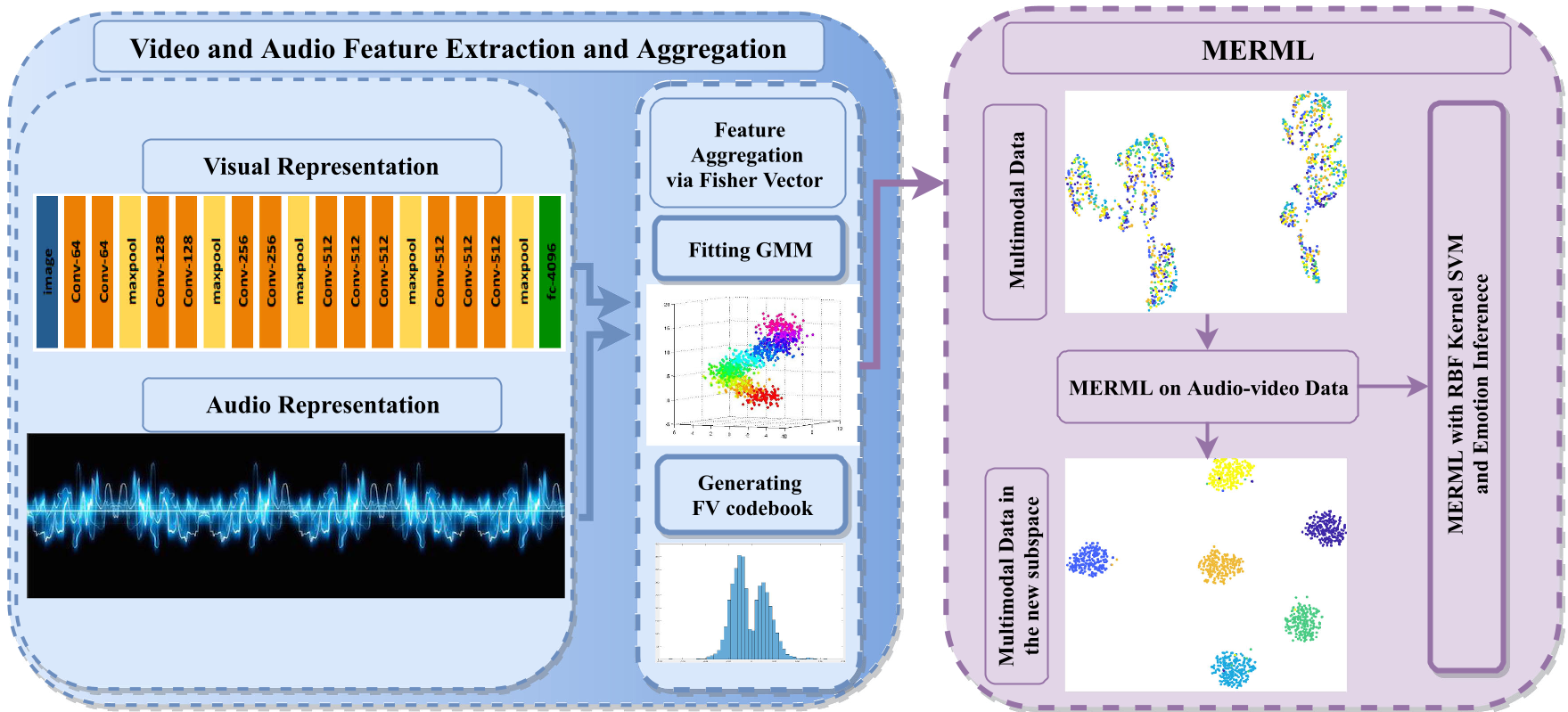 Figure 1: The MERML workflow - from feature extraction to RBF-Kernel SVM classification.
2. The Weighting Mechanism
One of the smartest insights in MERML is the use of a learnable weight . Not all emotions are expressed equally across channels. For instance:
- Anger is often better captured via Audio.
- Happiness is dominated by Video (facial expressions). MERML learns to weigh these modalities dynamically during training.
Experimental Breakthroughs
The authors validated MERML on two major benchmarks: CREMA-D and eNTERFACE.
SOTA Performance
MERML didn't just beat other machines; it surpassed human-level perception. On the CREMA-D dataset, human's binomial majority recognition is roughly 63.6%. MERML achieved 66.5%. On eNTERFACE, it reached a staggering 91.5%, surpassing previous deep-learning-based SOTA (89.4%).
Visualization of Success
Using t-SNE, we can see the "before and after" effect. Before MERML, emotion clusters are a tangled mess. After MERML, the latent space shows clear, structured separation.
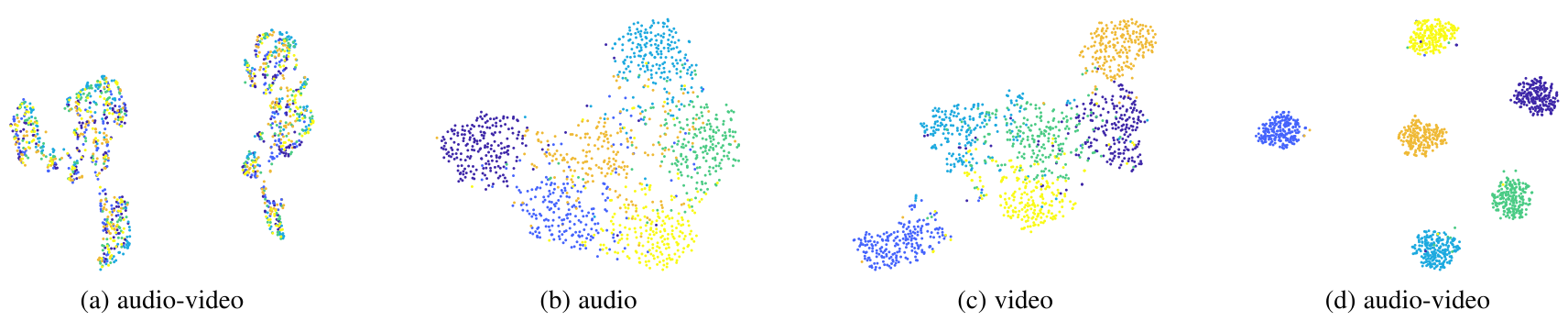 Figure 2: t-SNE embedding showing the original space (a) vs. the highly structured MERML latent space (d).
Results Summary
| Method | CREMA-D Accuracy | eNTERFACE Accuracy |
|---|---|---|
| MERML (Proposed) | 66.5% | 91.5% |
| Human Perception | 63.6% | - |
| Concatenated SVM | 65.2% | 84.7% |
| ITML (Classical) | 60.5% | 77.5% |
Critical Insights: Modality Contribution
The study provides a fascinating look at the "importance" of modalities for specific emotions:
- Category 1 (Audio Dominated): Anger and Sadness.
- Category 2 (Video Dominated): Happiness and Disgust.
- Category 3 (Balanced): Fear and Neutral (requires both to be accurate).
Conclusion
MERML proves that how we measure distance matters. By moving away from rigid Euclidean metrics and toward jointly learned Mahalanobis spaces, we can capture the "harmony" between audio and video. While deep learning is powerful, this work reminds us that robust metric learning and classical classifiers like SVM, when properly integrated, can still outperform massive neural networks in specific, high-stakes domains like Affective Computing.
Future Outlook: The scalability of MERML makes it a prime candidate for integration into real-time HRI (Human-Robot Interaction) systems where latency and explainability are paramount.