
Propagation Contribution: Decoding the Power Dynamics of Information Flow in Social Networks
A Metric for Measuring Members' Contribution to Information Propagation in Social Network Sites
This paper introduces "Propagation Contribution," a novel metric to quantify individual user influence in information dissemination within social networks. Developed using a customized Markov Chain model based on user-to-page and page-to-user transitions, it achieves a ranking system that identifies key information spreaders.
TL;DR
Social networks aren't just collections of users; they are complex ecosystems where content and people interact in a feedback loop. This paper proposes a new metric called Propagation Contribution—a PageRank-inspired stationary distribution model—to identify the "power users" who drive information spread. By analyzing millions of Flickr traces, the researchers prove that information propagation follows a strict power law, where a few individuals act as the primary engines of the entire network.
Problem & Motivation: Beyond Simple Hyperlinks
In the era of Web 2.0, virtual marketing consumes billions in advertising. However, most brands struggle to identify who actually moves the needle. Traditional algorithms like PageRank treat every link as a random jump, but humans don't surf randomly. We follow specific "internal-to-external" paths:
- Intentionality: We browse a user's profile because we like their style.
- Reciprocity: We use people to find content (photos), and content leads us back to new people (photographers).
The authors realized that to measure a user's true value, they needed to model this intentional "surfing" behavior that bridges the gap between people and content.
Methodology: The Two-Step Surf Model
The core innovation lies in the User-Level Web Graph. Instead of a flat page-to-page graph, the authors construct a dual-layer transition matrix.
The Matrix Decomposition
- User-to-Page (X): Represents the ownership relationship. If User A has 10 photos, the probability of being on one of their pages given you are "looking at User A" is 1/10.
- Page-to-User (Z): Represents the navigation link. If a photo on User A's page has a link to User B (e.g., a "favourite" or "friendship" link), this matrix captures that jump.
By multiplying these (), we get a User-to-User transition matrix. The Propagation Contribution (pc) is then found by solving for the stationary distribution:
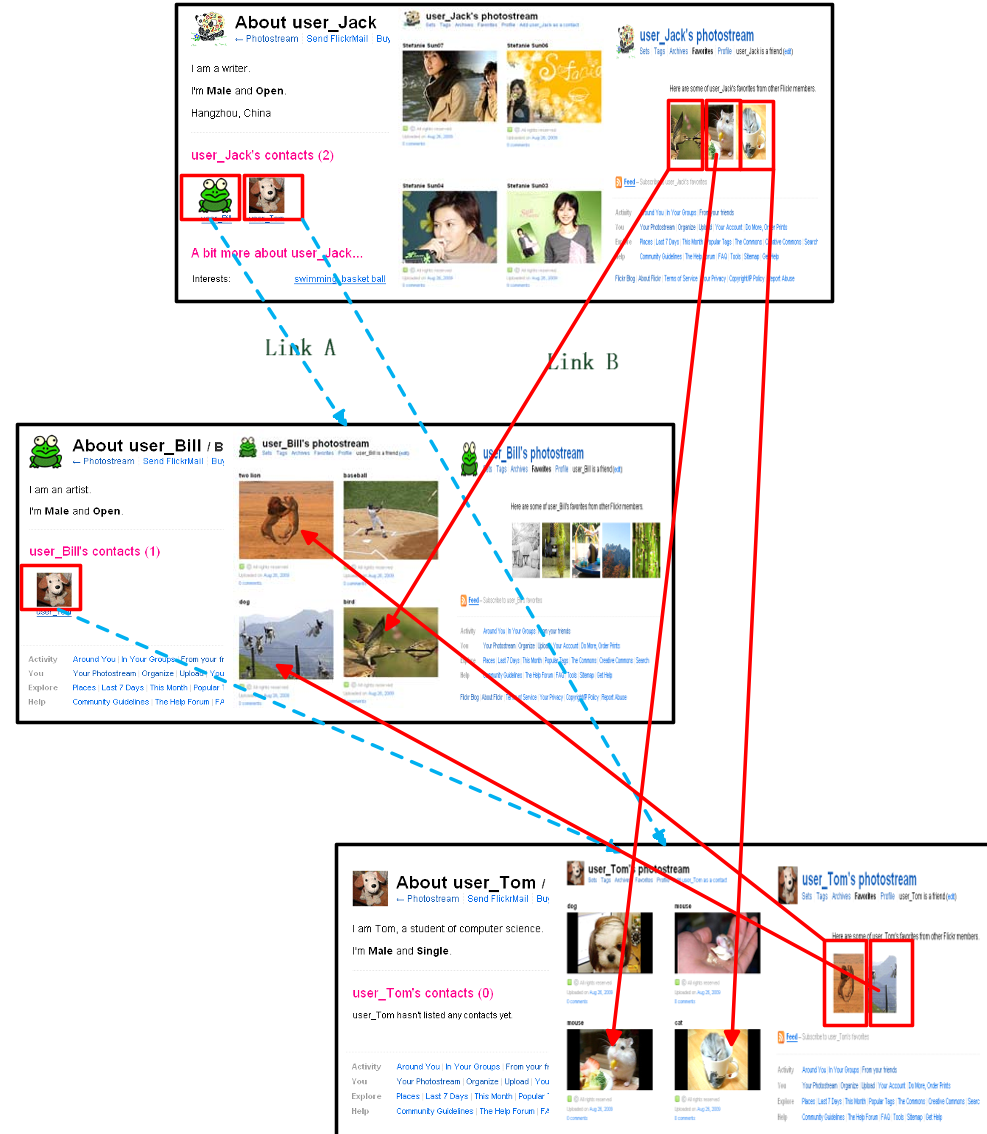 Fig. 1: The tripartite relationship modeling how Jack, Bill, and Tom interact through direct friendship and content-based hyperlinks.
Experiments & Results: The 80/20 Rule on Steroids
The researchers tested this on a massive Flickr dataset from 2006, encompassing 1.6 million users and over 15 million friendship links.
Key Findings:
- Power-Law Distribution: The contribution scores aren't normally distributed. They follow a power law ().
- The "Elite" Few: A tiny fraction of users possesses a disproportionately high Propagation Contribution. These are the "hubs" through which almost all viral content must pass.
- Accuracy: Unlike raw follower counts, this metric accounts for the quality and depth of the links, distinguishing between "famous" users and "influential" spreaders.
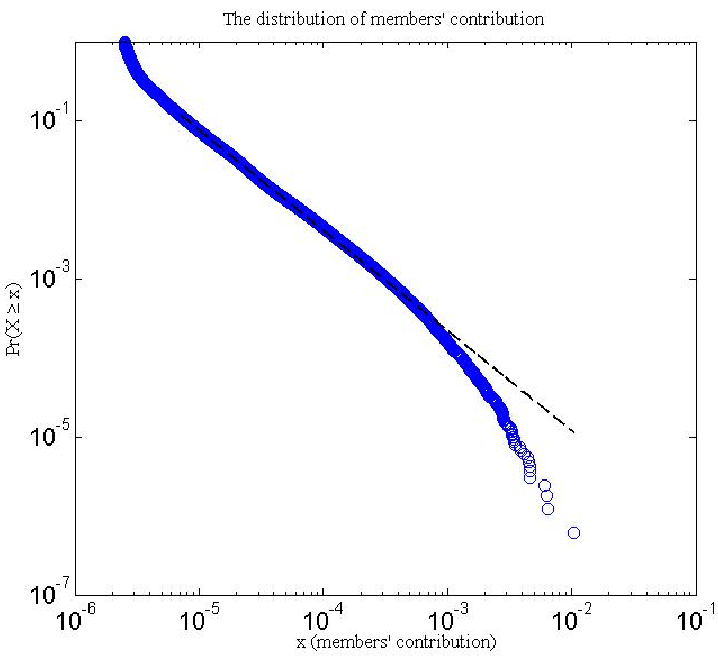 Fig. 2: The distribution of contribution scores, showing the classic long-tail characteristic of social influence.
Critical Analysis & Conclusion
Takeaway
The value of a user in a social network is not just about how many friends they have, but how effectively they bridge the gap between content creation and content discovery. The Propagation Contribution metric provides a mathematically rigorous way to find these bridges.
Limitations
The model assumes a static graph. In modern networks (like X/Twitter or TikTok), the graph changes every second. Furthermore, the model uses a fixed "boredom" factor (), which might vary depending on the platform's UI/UX.
Future Outlook
This work lays the groundwork for influence maximization. Future iterations could integrate "content sentiment" or "topic relevance" into the transition matrices, allowing marketers to find the best spreaders for specific niches rather than just general influencers.