
EmoGrabber: Mapping the Social Pulse through Emotionally-Driven Clustering
Micro-blogging Content Analysis via Emotionally-Driven Clustering
The paper introduces EmoGrabber, a lexicon-based affective analysis framework designed to categorize micro-blogging content (Twitter) into six primary emotions: anger, disgust, fear, joy, sadness, and surprise. By leveraging semantic lexicons and intensity scoring, it shifts the focus from simple binary sentiment (positive/negative) to a multi-dimensional emotional spectrum suitable for capturing the "social pulse."
TL;DR
Researchers have developed EmoGrabber, a framework that moves beyond "Thumbs Up/Down" sentiment analysis to map tweets into six specific emotional categories. By accounting for linguistic nuances like "not" or "very," the system clusters public discourse into an intensity-based emotional landscape, revealing the complex "wisdom of crowds" hidden in 140 characters.
Beyond Binary: Why Positive/Negative Isn't Enough
In the era of micro-blogging, knowing a user is "unhappy" is rarely enough for high-stakes decision-making. A brand needs to know if a customer is angry (high churn risk) or sad (empathy opportunity). Policymakers need to distinguish between fear and disgust during public crises.
The core motivation of this paper is that human emotion is multi-dimensional. Previous SOTA methods often ignored the "valence shifters" (words that flip meaning) and "intentsifiers" (words that scale intensity), leading to a flat and often inaccurate representation of the social pulse.
The EmoGrabber Methodology: From Text to Intensity
The authors approach affective analysis not as a simple classification task, but as a similarity and clustering problem.
1. Semantic Refinement
The framework doesn't just look for keywords. It calculates a Score Intensity (SCI) that adjusts base sentiment scores from SentiWordNet using specific linguistic parameters:
- Intensifiers: "Quite good" vs. "Very good" (Scaling the score).
- Valence Shifters: "Not happy" (Inverting the score: ).
- Emoticons: Mapping symbols like
:-)directly to emotional weights.
2. The Core Algorithm
The relationship between a tweet and a primary emotion is quantified using a weighted similarity measure:
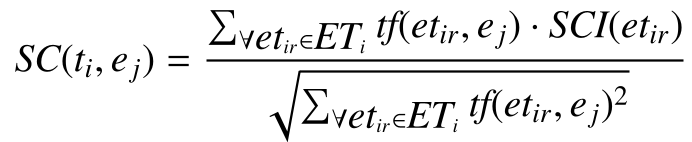
This formula accounts for the frequency of "representative" emotional words while normalizing the vector to keep scores between 0 and 1.
3. Emotion-Driven Clustering
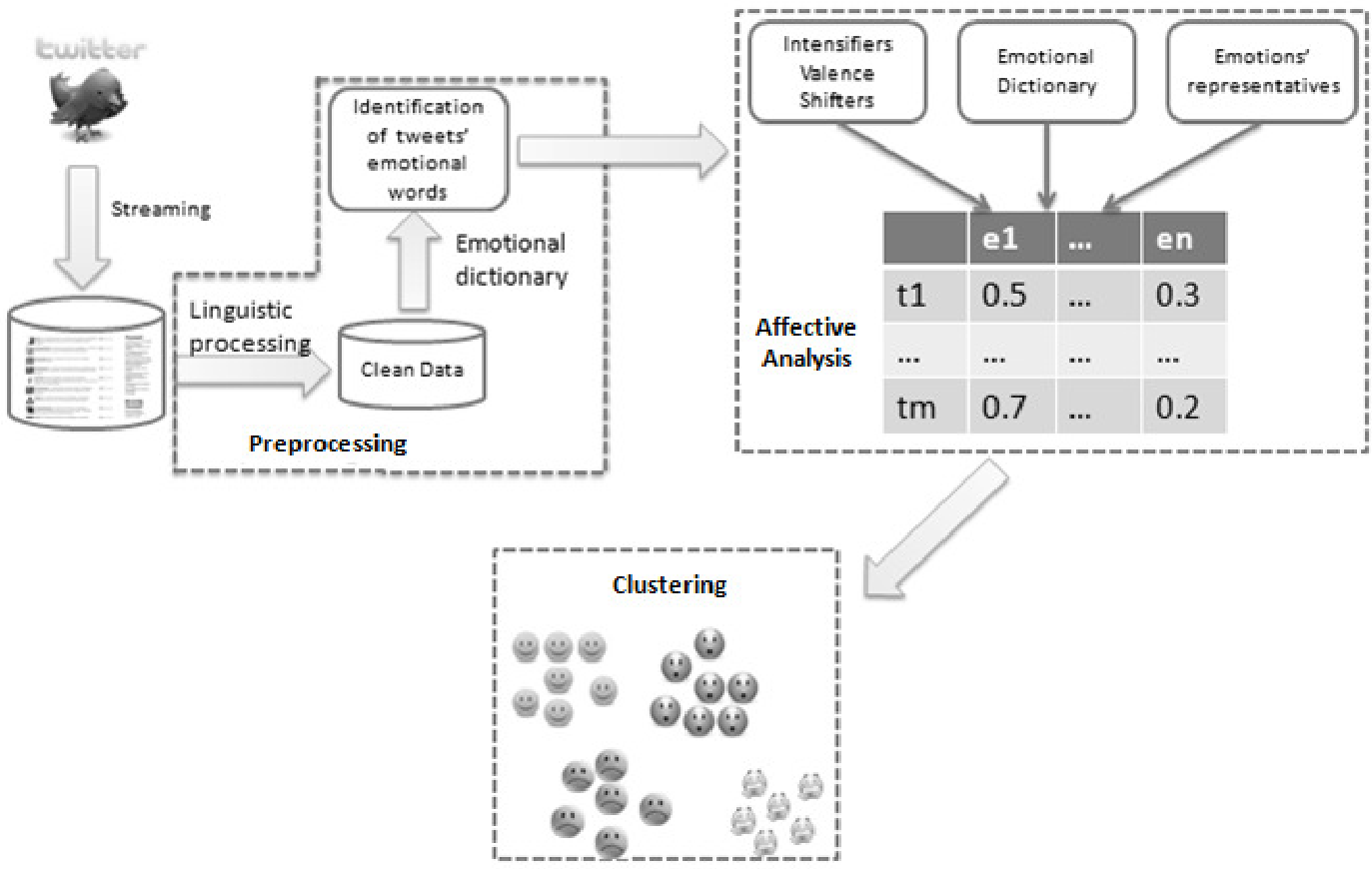
Once every tweet is represented as a 6-dimensional vector (one for each Ekman emotion), the EmoGrabberAlgo uses K-means to find clusters where specific emotions prevail.
Experimental Insights: Validating the Clusters
The researchers tested EmoGrabber on a dataset of 9,500 "Christmas" tweets in London. The results were telling:
- Mutual Exclusivity: Clusters high in negative emotions (Anger, Disgust) showed significantly lower levels of positive emotions (Joy).
- Psychological Validity: Factor analysis showed that Joy and Surprise often appeared together, as did Anger and Disgust, confirming that the algorithm was capturing real-world psychological correlations.
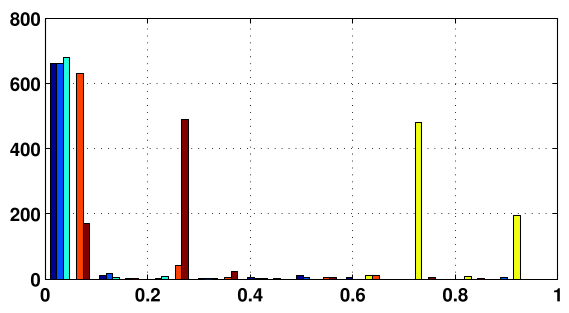 (a) Cluster dominated by Anger shows low Joy levels; (d) Cluster dominated by Joy mirrors low negative intensity.
Visualizing the Social Heatmap
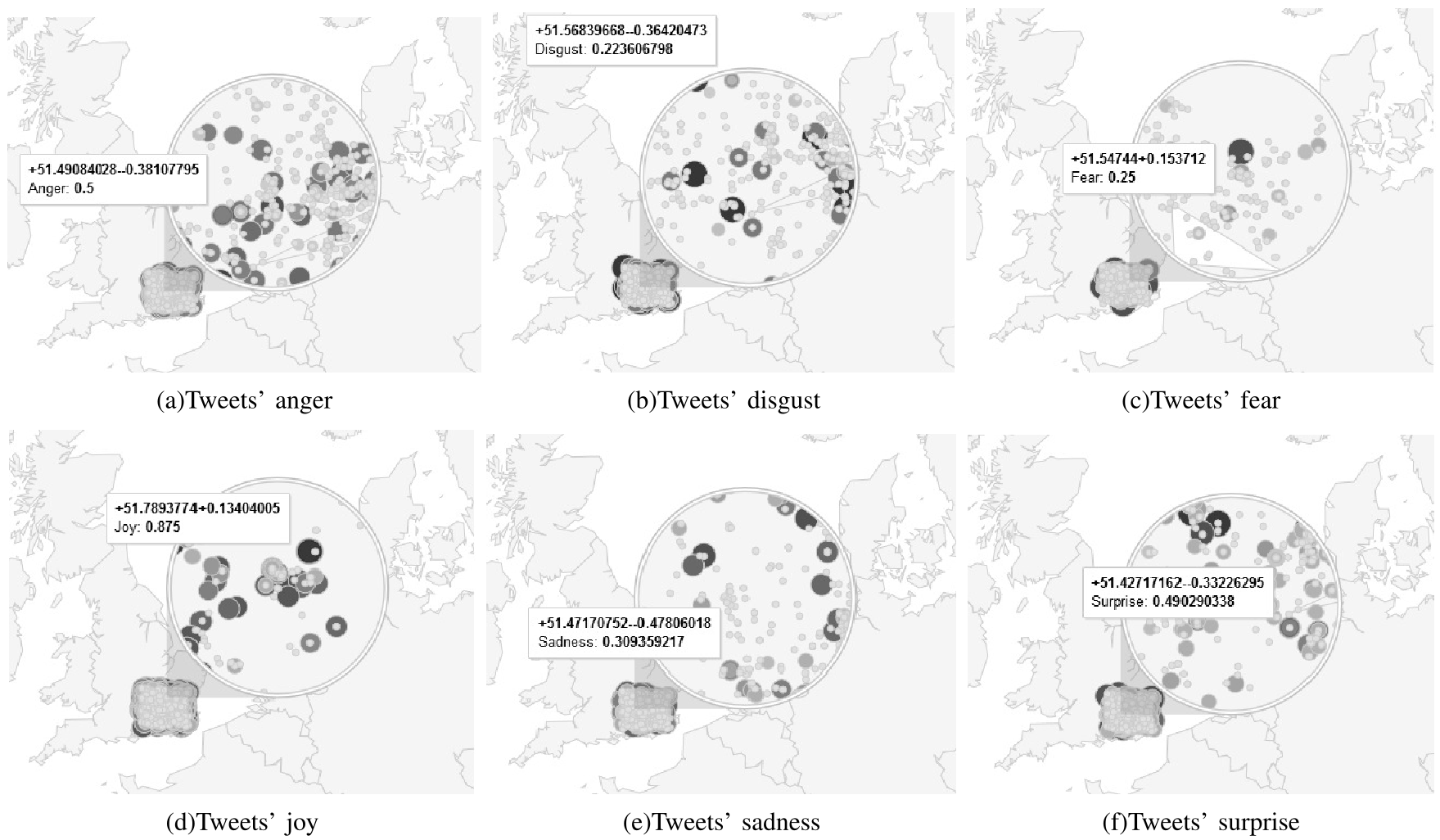
One of the most innovative outputs of this work is the EmoGrabber Visualizer. By mapping emotional intensity to geographic coordinates, the tool creates a "heat map" of human feeling. A city mayor, for instance, could see a "fear spike" in a specific neighborhood during an event and deploy social services or "freeing fear" policies accordingly.
Critical Perspective & Future Work
While the lexicon-based approach is computationally efficient (linear complexity ) and highly scalable, it does have limitations:
- Sarcasm: Lexicon-based methods traditionally struggle with "I love being stuck in traffic," which may be incorrectly flagged as "Joy."
- Context: The current model treats words somewhat in isolation.
The authors aim to incorporate more advanced linguistic parameters in future iterations (potentially moving toward semantic deep learning) to refine how representative words are mapped to emotional states.
Conclusion
EmoGrabber proves that even with the constraints of micro-blogging, we can extract deep, multidimensional emotional insights. By moving from Sentiment to Affect, the framework provides a more authentic mirror of the public's heart and mind.