
Decoding Public Pulse: Multi-Dimensional Emotion Analysis via Ren-CECps
13524_Microblogging hot events emotion analysis based on Ren-CECps.
This paper presents a sentiment analysis framework for Chinese microblogging hot events using the Ren-CECps emotion corpus. By leveraging polynomial kernel methods and an 8-dimensional emotion space model, the study quantifies public emotional shifts during events like the "Beijing Heavy Fog" and state visits.
TL;DR
This study tackles the complexity of Chinese microblogging sentiment by moving beyond simple "positive vs. negative" labels. Using the Ren-CECps corpus and Polynomial Kernel Methods, the researchers successfully mapped eight distinct emotional dimensions across major social events, providing a more granular view of public opinion on platforms like Sina Weibo.
Background & Motivation
Since its inception, Sina Weibo has become a critical barometer for public sentiment in China. However, analyzing this data is notoriously difficult due to:
- Fragmentation: Thoughts are condensed into 140 characters or fewer.
- Emotional Ambiguity: A single post often contains multiple, sometimes conflicting, emotions.
- Linguistic Evolution: Cyber-slang and colloquialisms evolve faster than traditional dictionaries (like HOWNET) can keep up.
The authors argue that to truly understand "Hot Events," we need a system that recognizes the nuances of Expectation, Anxiety, and Love simultaneously, rather than flattening them into a single polarity score.
Methodology: The Ren-CECps Advantage
The core of this research is Ren-CECps (Chinese Emotion Corpus), a platform containing nearly 1,500 documents manually annotated at the document, paragraph, and sentence levels.
The Emotion Space Model
The researchers represent the emotion of any given text as a vector: Where each represents the intensity (0.0 to 1.0) of one of the eight basic emotions: Expect, Joy, Love, Surprise, Anxiety, Sorrow, Angry, and Hate.
Kernel-Based Recognition
To handle the non-linear relationship between discrete words and abstract emotions, the study employs Polynomial Kernel Methods. This maps the text into a higher-dimensional space where linear learning algorithms can effectively classify multi-labeled emotional states.
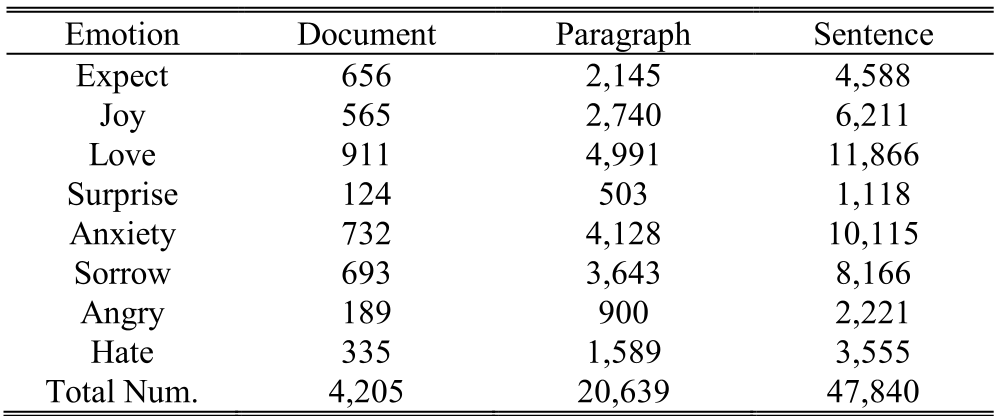 Table II: Distribution of basic emotional words across different levels in Ren-CECps.
Case Studies and Experimental Results
The paper analyzes two major events from 2013: the "Beijing Heavy Fog" and "Xi Jinping's State Visit."
1. Beijing Heavy Fog (Anxiety & Localized Sentiment)
The system detected a sharp peak in frequency on January 22, 2013, correlating exactly with a "Yellow Fog Warning." The dominant emotions were unsurprisingly negative, centered around health concerns and visibility.
2. State Visit (The "First Lady" Effect)
Analysis of the "Xi-Peng" visit revealed a fascinating shift. While the President garnered initial attention, Public interest in Peng Liyuan spiked later due to her promotion of domestic fashion brands (e.g., Pehchaolin).
- Finding: The "Expect" emotion occupied the majority of the sentiment distribution, reflecting public hope for a modernized Chinese global image.
- Regional Differences: Southern regions (Shanghai, Guangdong) showed more durable and fashion-conscious interest compared to the traditionally conservative Northern regions.
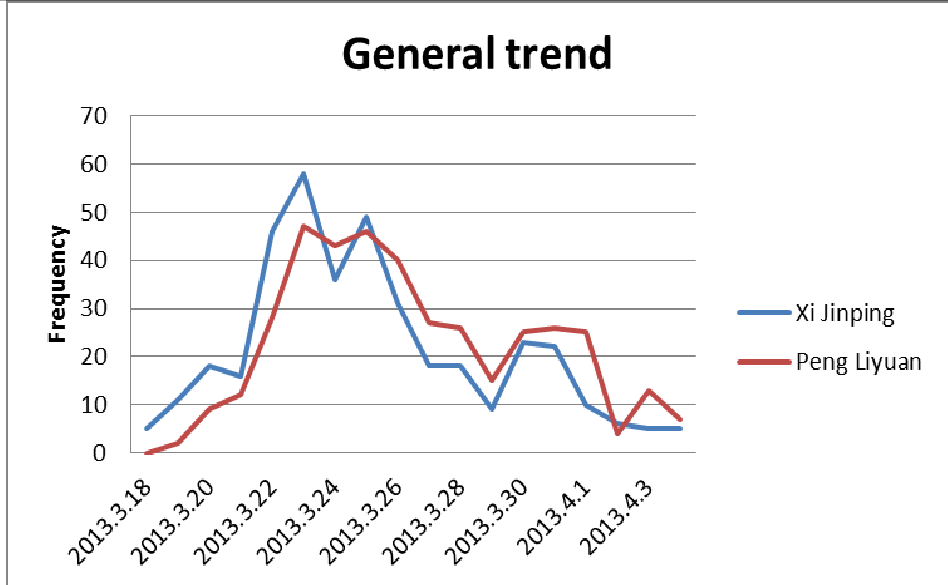 Table VI: National attention trends and emotion distribution showing the rise of "Expect" and "Love" emotions during the State Visit.
Critical Analysis & Takeaways
The strength of this work lies in its lexical depth. By comparing Ren-CECps to HOWNET, the authors proved that their corpus contains twice as many emotion-relevant words actually used in modern web text.
Limitations:
- Real-time Processing: The current API-based collection used in the study is retrospective, not real-time.
- Intensity Nuance: While the model identifies which emotions are present, it still struggles with calculating the exact "intensity" of negative emotions in highly sarcastic or fragmented contexts.
Future Outlook
The authors envision moving this technology into Speech Robotics, where real-time emotional intensity calculation will allow robots to interact with humans more naturally. As Chinese NLP continues to evolve, the transition from kernel methods to deep learning (LLMs) will likely build upon the foundational linguistic mapping established by Ren-CECps.