
MicroTrails: Cracking the Code of Worker Behavior on Crowdsourcing Platforms
MicroTrails: comparing hypotheses about task selection on a crowdsourcing platform
The paper introduces MicroTrails, a framework to objectively compare hypotheses regarding how workers select tasks on crowdsourcing platforms like Microworkers. Using the Bayesian approach HypTrails, the authors rank various factors such as employer reputation, task similarity, and monetary incentives based on their ability to explain observed user transition data from 39,100 workers.
TL;DR
Understanding how workers navigate the thousands of tasks on platforms like Microworkers or Amazon Mechanical Turk (mTurk) is crucial for optimizing workflows. This paper moves beyond biased surveys by using HypTrails, a Bayesian framework, to objectively rank hypotheses against millions of real-world task transitions. The verdict? Workers value employer reputation and task familiarity far more than the size of the paycheck.
Background: Beyond the Survey Bias
Why does a worker choose one image-tagging task over a sentiment analysis task? Previous literature was a mess of contradictions: some studies claimed money is king, others pointed to intrinsic interest or task simplicity. The problem was the data source—subjective surveys are prone to recall bias and small sample sizes.
The authors of MicroTrails argue that the truth lies in the data logs. By treating a worker's sequence of tasks as a "trail," we can use statistical inference to see which underlying logic best explains the path they took.
Methodology: Human Trails as Markov Chains
The researchers transformed years of Microworkers data into a series of transitions between "campaigns." They utilized HypTrails, which allows scientists to express a "hunch" (a hypothesis) as a mathematical prior (Dirichlet distribution) and then check how well that hunch aligns with the actual evidence (the data).
Key Hypotheses Tested:
- Availability: Users only pick what is currently active (a necessary baseline).
- Employer Loyalty: Users stick with employers they trust.
- Category Focus: Users prefer to stay within a niche (e.g., only doing "Transcription").
- Semantic Similarity: Users look for tasks with similar descriptions/titles.
- Extrinsic Rewards: Users chase the highest pay per hour.
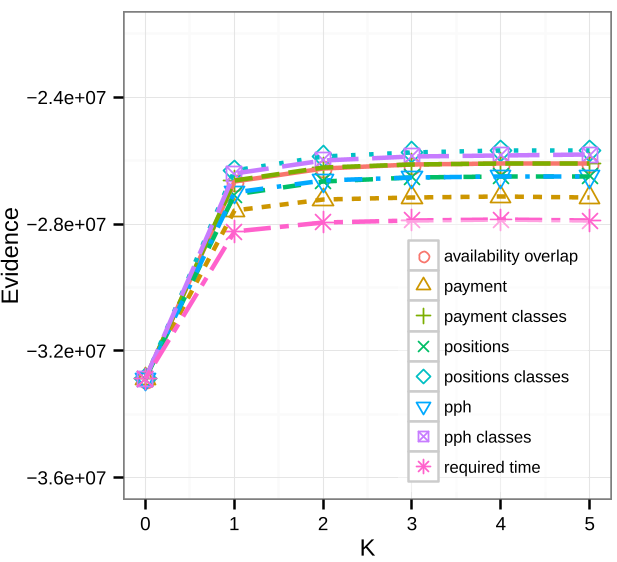 Figure: The ranking of hypotheses. Higher evidence values indicate a better explanation of reality.
The Core Insight: Reputation Over Money
The methodology revealed a clear hierarchy of influence:
- The Power of the Employer: The "Same Employer" hypothesis was one of the strongest. Workers likely develop a relationship with employers who rate fairly and pay promptly.
- Semantic Over Categories: Using TF-IDF vectors to compare task descriptions was more effective than using the platform's broad categories. This suggests workers look for specific task mechanics (e.g., "Finding URLs") rather than broad labels like "SEO."
- The "Pay" Paradox: Surprisingly, hypotheses based on high monetary rewards or high pay-per-hour performed poorly. While money matters, it is not the primary driver of the next task choice. Workers often prefer a "known" low-paying task from a trusted employer over a "risky" high-paying task from an unknown one.
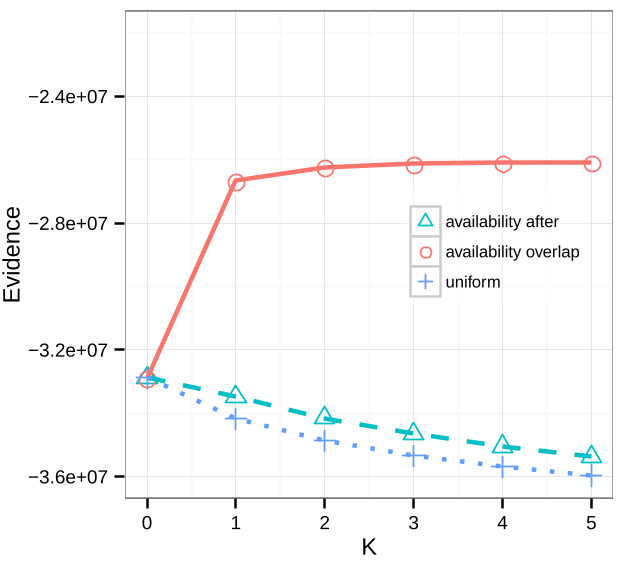 Figure: Consistency in staying with the same employer and category provides significantly higher evidence than simple monetary factors.
Critical Analysis & Future Outlook
Takeaway for Platforms: Task recommendation systems should not just blast "High Paying" jobs to everyone. Instead, they should emphasize:
- Work History: Show tasks from employers the worker has successfully worked for before.
- Semantic Matching: Use NLP to find tasks that match the specific description of what the user is currently doing.
Limitations: The study focused on US workers to avoid geographical restrictions. However, global crowdsourcing is a diverse beast. Cultural differences (e.g., workers in developing vs. developed nations) might shift the weight from "Reputation" to "Money." Furthermore, the HypTrails model currently struggles with states (campaigns) that disappear once they are finished, requiring a "local availability" approximation.
Conclusion
MicroTrails provides a rigorous, Bayesian lens through which we can finally see the "Human in the Loop." It proves that in the digital labor market, just like the traditional one, trust and familiarity are the invisible hands guiding the crowd.