
Milgram-Routing: Navigating the Hidden Dimensions of Social Interests
Milgram-routing in social networks
This paper introduces an evolutionary model for social networks called "Affiliation Networks" that explains Milgram's "six degrees of separation" through an underlying navigable "interest space." By integrating person-to-person friendships with topic-based affiliations, the authors provide the first theoretical and experimental framework where local greedy routing effectively discovers short paths in a dynamic, power-law social graph.
TL;DR
Why did Stanley Milgram’s letters actually reach their targets across the US in just six hops? While mathematicians have long cited "small-world" graphs, they often missed the human element: we don't route by distance, we route by interests. This paper provides an evolutionary model of social networks that proves short paths are not just present, but mathematically discoverable using a "hierarchy of interests."
The Missing Link: Why Geography Isn't Enough
Previous research into the "Small World" phenomenon largely focused on geographical proximity—routing a message to the friend who lives closest to the target. However, in Milgram’s original experiment, participants used cues like profession and status. A person in Nebraska might send a letter to a friend in Massachusetts not just because of the state, but because the friend is also a "stockbroker."
The authors argue that social networks are "Affiliation Networks"—bipartite graphs where people are connected to interests. The social graph we see is a "folding" of this interest space.
Methodology: The Geometry of Interests
The paper introduces a dynamic model where the network evolves through:
- Node Arrival: New people and interests enter the system.
- Prototype Copying: A new person mimics the interest profile of an existing "prototype" (a mentor or friend).
- Preferential Attachment: A few "weak ties" are formed randomly to popular nodes, representing social status and random acquaintances.
The Interest Prototype Graph
The core innovation is the Prototype Graph. By tracking who was a prototype for whom, the model creates a metric space of "closeness" between topics.
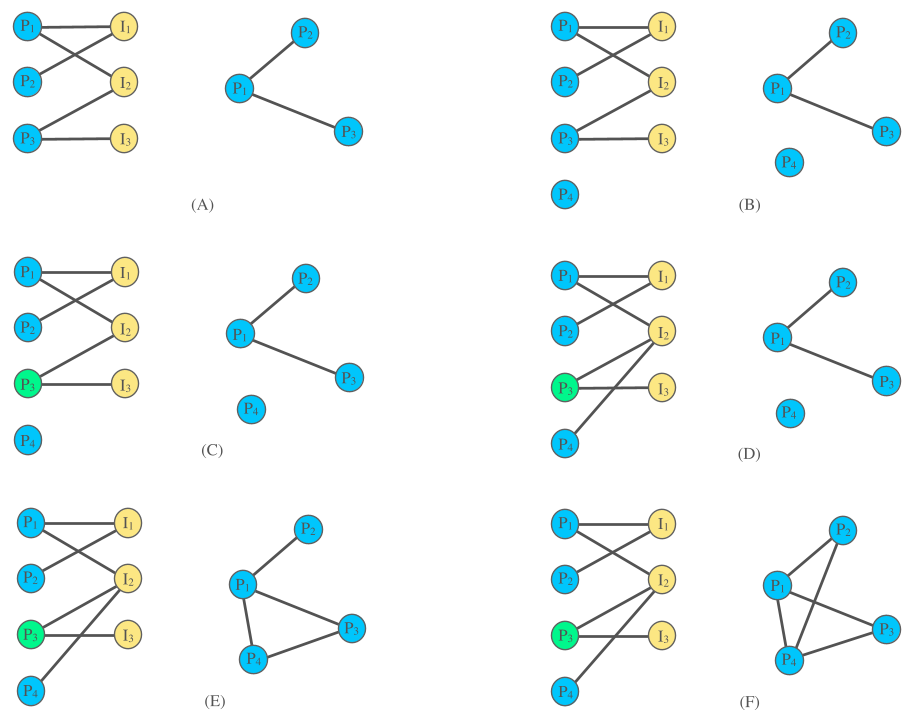 Figure 1: The insertion of a new person P4, who selects P3 as a prototype, copies their interests, and then adds preferential attachment edges.
Proving Navigability
The authors prove that a Local Routing Algorithm—one that simply picks the neighbor most "similar" to the target in the interest space—is highly efficient:
- Universal Search: It finds paths of steps for any two nodes.
- Status-Driven Search: If the target is "popular" (high degree), the path length drops to constant time O(1).
- The Power of Weak Ties: The few random edges (preferential attachment) act as bridges between dense interest communities, preventing the search from getting stuck in local interest "cul-de-sacs."
Experimental Validation: The DBLP Study
The researchers tested this on the DBLP co-authorship graph. They turned paper titles into a "space of concepts" using unigrams and bigrams.
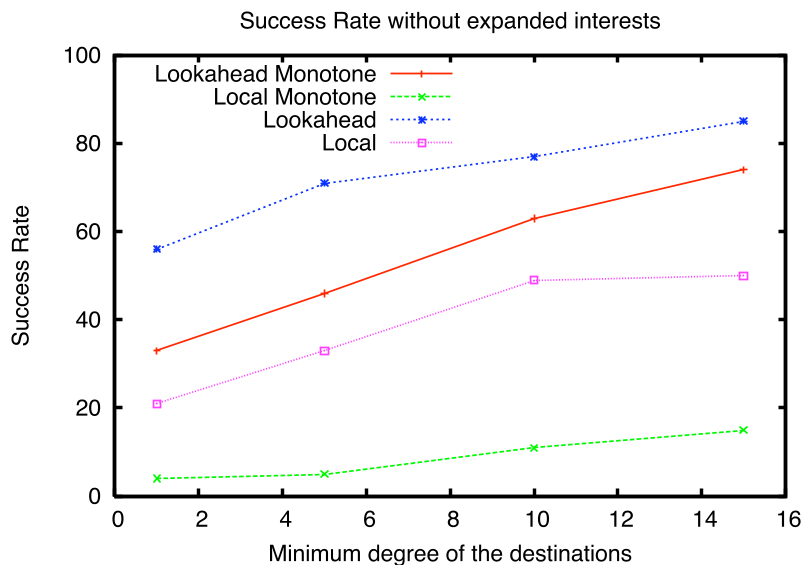 Figure 3: Success rates of routing algorithms. Notice how adding "Lookahead" (knowing friends-of-friends) and "Expanded Interests" significantly boosts success toward 100%.
The results were striking:
- Success via Concepts: Routing based solely on title keywords successfully delivered 21% of messages—unprecedented for such a simple digital replica.
- The Lookahead Boost: When nodes could see just one step further (knowing their friends' friends), success rates jumped to 57%.
- High-Degree Targets: When targeting well-connected authors (degree > 15), the success rate hit 97%.
Critical Insight: Social Status Matters
The paper confirms a sociological intuition: Milgram's experiment worked partly because his targets weren't random recluses; they were often socially visible professionals. In mathematical terms, the "volume" of hubs in a social network dominates the graph, making them natural magnets for local routing algorithms.
Conclusion
This work shifts the small-world narrative from "we are all connected" to "we can all find each other." By proving that an interest-based hierarchy makes a network navigable, the authors provide a blueprint for understanding everything from how rumors spread to how recommendation engines should explore "latent" user interests. The limitation remains the "attrition" of human subjects, but in a purely digital world, the "six degrees" are more discoverable than ever.