
MindBook: Reimagining Depression Therapy through a "Safe" Social Network
Mind Book – A Social Network Trainer for Children with Depression
MindBook is a simulated therapeutic social network designed for children with depression, based on the MATCH-ADTC clinical protocol. It utilizes a Facebook-like interface to deliver cognitive behavioral therapy (CBT) through games, videos, and interactive tools, successfully improving users' emotional self-reporting during pilot studies.
TL;DR
MinBook is a therapeutic serious game that mimics the look and feel of Facebook to teach children coping mechanisms for depression. By integrating the evidence-based MATCH-ADTC protocol into a virtual social environment, it helps children practice positive self-expression and emotional regulation in a controlled, rewarding space.
Background & Motivation: Why a Social Network?
Mental health issues affect one in ten children, yet many never receive treatment due to a lack of specialists or the perceived "stigma" of therapy. While social networks are the digital playground for today's youth, they can be dangerous for those with depression, often exacerbating feelings of exclusion.
The authors' insight was to flip the script: What if we used the addictive, familiar structure of a social network to deliver therapy instead of anxiety?
Methodology: The MATCH-ADTC Digitization
MindBook isn't just a website; it’s a structured clinical intervention. It adopts the Modular Approach to Therapy for Children (MATCH-ADTC), breaking down complex CBT strategies into digestible digital modules.
The system uses a five-session guided journey:
- Mood Tracking: Users start every session with the "Feelings Weather" (a scale from thundery to sunshine).
- The Toolbox: Modules like Cognitive Coping (BLUE) and Problem Solving (STEPS) are taught via videos and interactive games.
- Positive Feedback Loop: The system simulates "friends" who provide positive feedback when the user engages in healthy self-expression.
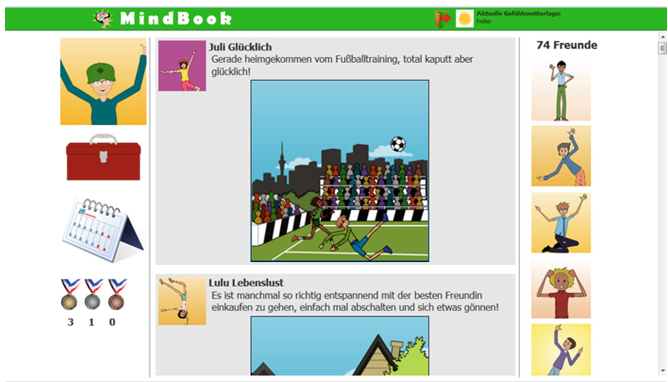 The main page of MindBook, designed to mirror the familiarity of Facebook to lower the barrier to entry.
The "Feelings Weather" Algorithm
To tailor the experience, MindBook calculates a "feelings baseline" () using the formula: This baseline dynamically influences the UI—for example, the profile header image grays out or brightens based on the user's longitudinal mood data.
Experiments & Results
The researchers conducted two studies focusing on psychological effect and usability.
Key Findings:
- Engagement: Children spent progressively more time in the system with each session, suggesting high retention and interest.
- Mood Improvement: A significant portion of children recorded a "better feelings weather" at the end of the usage compared to their starting point.
- Usability: While most children (80-100%) handled basic navigation and data input easily, younger groups (ages 6-10) struggled more with mouse-heavy tasks like "Drag and Drop" compared to touch-native interactions.
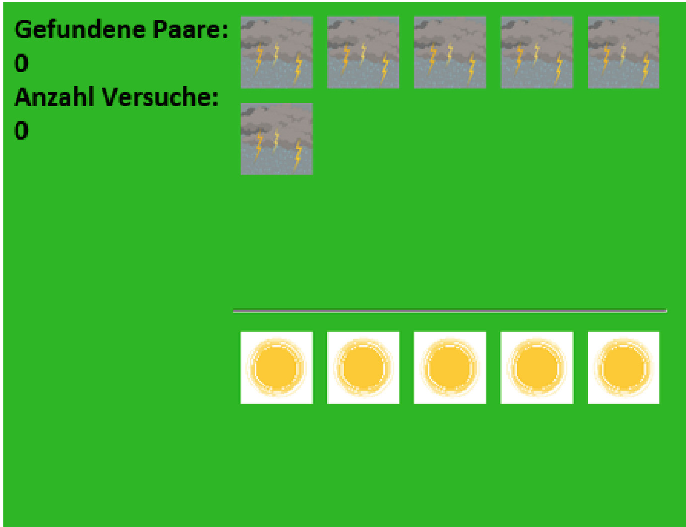 Example of interactive modules: (a) Video decision-making and (b) Memory games to replace negative thoughts.
Critical Insight & Conclusion
The brilliance of MindBook lies in its Inductive Bias—it assumes that children will be more honest and engaged in a space that feels like "play" rather than "clinical work."
Limitations
- Small Sample Size: While the results are promising, larger clinical trials are needed to prove long-term efficacy.
- Platform Transition: The study noted that younger children are more accustomed to touchscreens than the PC-based mouse interactions used in the trial.
Takeaway
MindBook provides a blueprint for "Therapeutic Social Networks." By bridging the gap between Serious Games and Clinical Psychology, it offers a scalable way to deliver mental health tools to children who might otherwise fall through the cracks of the traditional healthcare system.
Future Work
The authors suggest that future iterations should focus on mobile-first designs and perhaps integrate real-time peer tutoring where children can support one another in a moderated, safe environment.