
Mind Your SMSes: Why Your 2FA Security Depends as Much on Grammar as Encryption
Mind Your SMSes: Mitigating Social Engineering in Second Factor Authentication
The paper investigates the "Verification Code Forwarding Attack" (VCFA), a social engineering method used to bypass SMS-based two-factor authentication (2FA). It proposes a science-based redesign of 2FA verification messages, demonstrating that optimized messaging can reduce attack success rates from 50% to roughly 8%.
TL;DR
Despite the technical robustness of Two-Factor Authentication (2FA), the human element remains a massive vulnerability. This research proves that a simple "Verification Code Forwarding Attack" (VCFA) can deceive 50% of users. However, by redesigning the SMS message to include a specific, proactive warning before the code, researchers were able to crush that success rate down to a mere 8%.
Context: This work is a seminal study in "Usable Security," shifting the focus from the strength of the 128-bit encryption to the logic of the 160-character SMS.
The "Easy" Way to Hack Google: Social Engineering
The technical community often views SMS-2FA as a "solved" problem. An out-of-band code is sent, the user enters it, and identity is verified. But what happens when the attacker controls the narrative?
The authors identified the Verification Code Forwarding Attack (VCFA). The workflow is deceptively simple:
- The attacker triggers a legitimate password reset for the victim's account.
- The victim receives a real code from Google.
- The attacker immediately sends a fake SMS: "We detected abuse on your account. Reply with the code you just received to cancel the hack."
Because the victim just received a code, the attacker's story feels credible. The user "helps" by handing over the keys to their digital life.
Methodology: Engineering the "Abuse-Proof" Message
The researchers didn't just guess what would work. They utilized a structured framework based on four core principles for security warnings:
- Abuse-proof: The warning shouldn't be usable by the attacker (e.g., asking a user to call a number which the attacker could then spoof).
- Worry-free: It shouldn't cause unnecessary panic, as "false alarm fatigue" leads users to ignore future warnings.
- Actionable: It must tell the user exactly what to do (or not do).
- Concise: It must fit within the 160-character SMS limit and be jargon-free.
The Experiment Setup
The team tested various "Attack Stories" (Compliance, Service, and Security) against different "Verification Messages."

Key Results: Position and Phrasing Matter
The most shocking finding wasn't just what the message said, but where it said it.
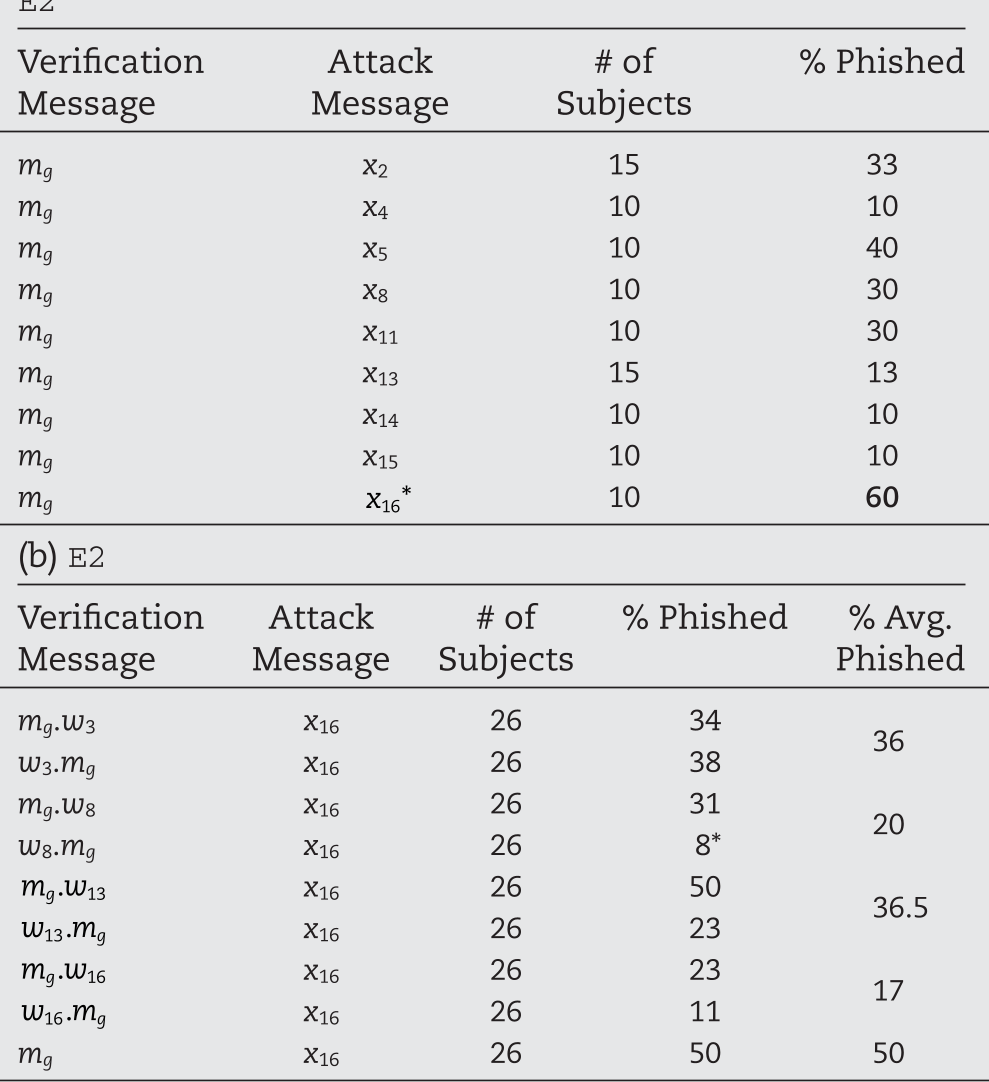
- The Power of Primacy: Placing the warning before the code (e.g., "Please ignore... Your code is...") was significantly more effective than placing it after. Once a user sees the 6-digit number, their brain often stops reading the rest of the text.
- The Winner: The message
"Please ignore this message if you did not request a code. Your Google verification code is XXXXXX"reduced the success of the best attack from 50% to 8%.
Critical Insight: The "No-Action" Action
A unique challenge in VCFA is that the "correct" response for the user is doing absolutely nothing. Humans are psychologically wired to act when they perceive a threat (the "Fight or Flight" response). By telling the user to "Please ignore this message," the researchers successfully validated that a passive instruction can be a powerful security tool—if it arrives precisely when the hazard is detected.
Conclusion & Future Outlook
While SMS-2FA is being phased out in favor of App-based authenticators (like Google Authenticator or WebAuthn), millions of users still rely on SMS. This paper serves as a vital reminder for developers: The UI is a security protocol.
Limitations: The study notes that attackers could iterate their social engineering tactics or even disrupt services to make the 2FA request more credible. However, the fundamental takeaway stands—improving the semantic clarity of security communications is the most cost-effective way to protect the masses.
Takeaway for Devs: If you are sending OTPs (One-Time Passwords), don't just send the code. Lead with a warning. Your users' security depends on it.