
Scaling Laws for Reasoning: Why Giant Models Might Be Overkill
Finding the Minimal Parameter Budget for Implicit Reasoning: A Data Complexity Driven Scaling Law for Language Models
This paper investigates the minimal parameter budget required for "implicit reasoning" in Language Models (LMs) by pretraining them on synthetic knowledge graphs. The authors identify a scaling law linking the optimal model size to "Graph Search Entropy," demonstrating that an optimally sized LM can reliably support approximately 0.008 bits of reasoning-relevant information per parameter.
TL;DR
Is a 70B parameter model necessary to solve a logical puzzle, or are we just using a sledgehammer to crack a nut? New research reveals that implicit reasoning—the ability to connect A to C via B without being told how—is governed by a specific scaling law tied to Graph Search Entropy. Surprisingly, an optimally sized model only needs 1 parameter for every 0.008 bits of reasoning complexity, and bigger isn't always better.
The "More is Better" Fallacy
In the era of GPT-4 and Llama-3, the industry has lived by the mantra of Kaplan’s scaling laws: more compute, more data, and more parameters lead to lower loss. However, these laws primarily track memorization and prediction, not necessarily the logic of reasoning.
The authors of this paper noticed a strange phenomenon: during prolonged training for reasoning tasks, large models often exhibit a U-shaped curve. They don't just plateau; their reasoning performance on unseen data actually degrades compared to smaller, "optimally sized" counterparts. This suggests that for any given set of facts, there exists a "Minimal Parameter Budget" that is sufficient for reasoning.
Methodology: Mapping Logic to Entropy
To isolate reasoning from the noise of natural language, the researchers used Knowledge Graphs (KGs). They assigned random IDs to entities (e.g., Entity_1254) to ensure the model couldn't "cheat" using semantic similarities.
The Core Metric: Graph Search Entropy
The major contribution here is the definition of Graph Search Entropy (). Think of this as a measure of how "confusing" the paths are in a maze of facts. If a model needs to infer that A is the grandfather of C, it must navigate the entropy of all possible relations branching from A and B.
The authors proved that the -optimal model size—the smallest model that achieves near-top performance—is proportional to this entropy:
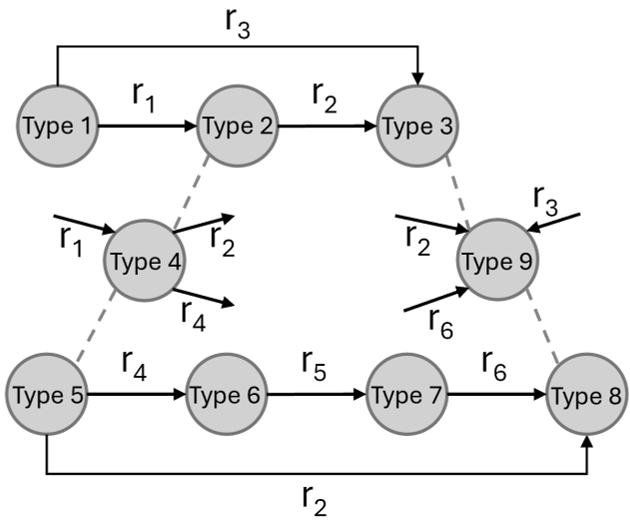 Figure 1: Synthetic nodes and logical rules used to build controlled reasoning environments.
Experimental Proof: The 0.008 Bit Rule
By ablating various graph properties (number of entities, rules, and triples), the team found a relentless linear correlation between the complexity of the graph and the size of the model needed to solve it.
- The SOTA Threshold: While previous studies suggested models can store 2 bits of fact per parameter, this paper shows they can only handle ~0.008 bits of reasoning per parameter.
- The Overfitting Trap: As seen in Figure 1 of the paper, once a model exceeds the optimal size for a specific dataset complexity, its test loss begins to climb (the U-shape), particularly when random IDs are used.
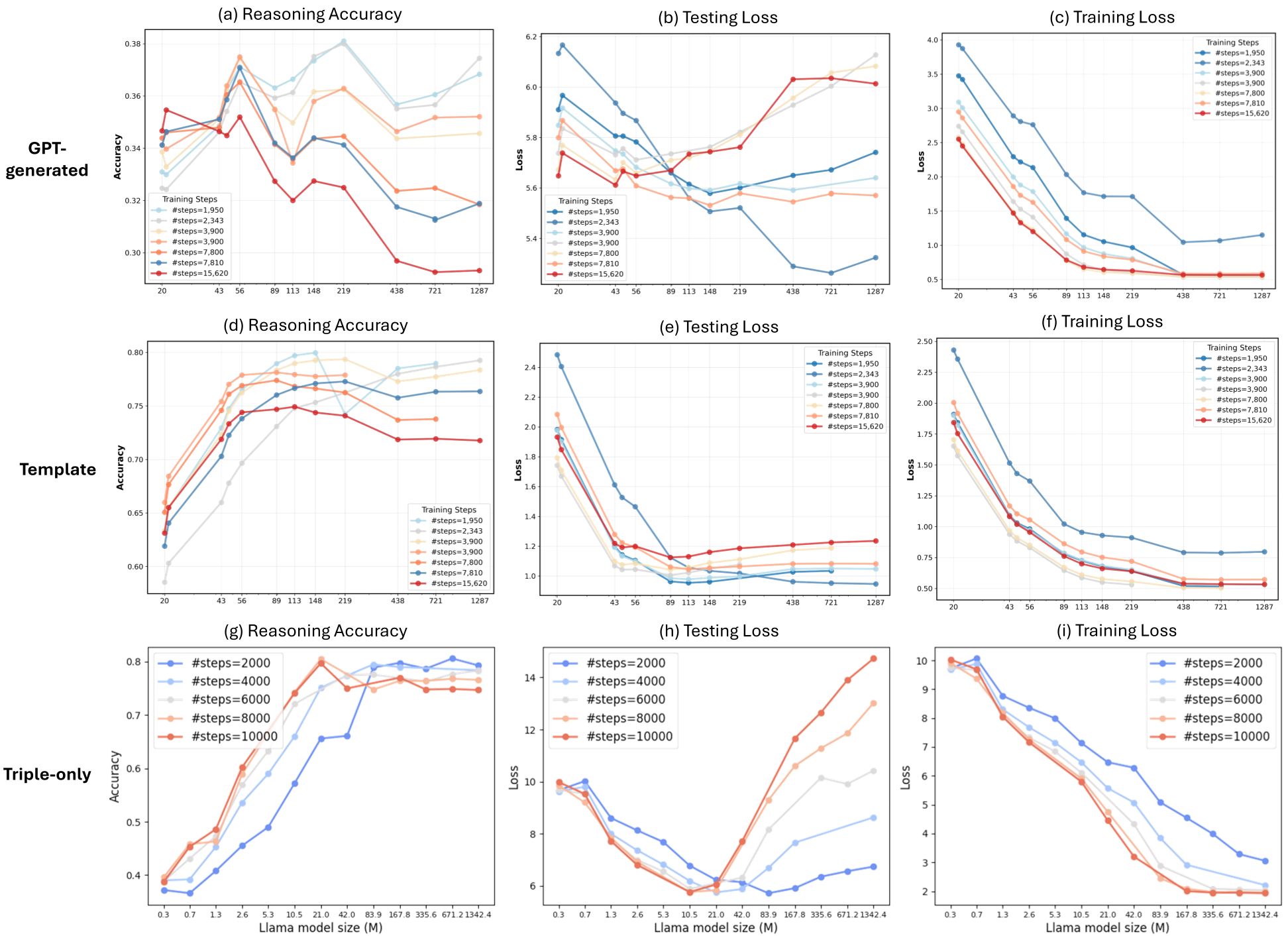 Figure 2: The U-shaped test loss curve. Note how smaller models often outperform larger ones on reasoning tasks when given sufficient training steps.
Critical Insight: The Future of Efficient AI
This research repositions reasoning as a capacity-limited phenomenon. It implies that our current approach of scaling models to trillions of parameters might be a brute-force solution to a problem that could be solved more elegantly.
Limitations & Outlook
While the study provides a rigorous mathematical framework, it currently relies on random IDs and synthetic graphs. In real-world natural language, "semantic sharing" (knowing that 'Father' and 'Dad' are related) allows for further compression, meaning real models might be even more efficient than this 0.008 bit/param limit suggests.
The next frontier? Testing if Non-Transformer architectures like Mamba or other State-Space Models (SSMs) follow the same entropy-driven scaling law, or if they offer a better "reasoning density" per parameter.
Conclusion
The "Minimal Parameter Budget" isn't just a theoretical curiosity; it's a target for the next generation of specialized, efficient LMs. By matching model size to the entropy of the task, we can build AI that reasons better with less.