
Robustness via Game Theory: Mastering the Fractional Minimax Theorem
A Minimax Theorem with Applications to Machine Learning, Signal Processing, and Finance
This paper presents a definitive minimax theorem for fractional functions of the form , establishing the existence of a saddle point under relaxed convex constraints. The authors provide a computationally efficient method based on convex optimization to solve robust maximization problems across Machine Learning, Signal Processing, and Finance.
TL;DR
Seung-Jean Kim and Stephen Boyd (Stanford) introduce a robust mathematical framework for fractional objectives common in engineering. By treating uncertainty as an adversarial "game," they provide a convex optimization method to find solutions that remain optimal even when your data model is wrong.
Context & Positioning
In the landscape of optimization, we often seek to maximize ratios: Signal-to-Noise (SNR), Sharpe Ratio (Return/Risk), or Fisher Discriminant (Between-class/Within-class). While standard solutions like are elegant, they are fragile. This paper bridges the gap between Sion's Minimax Theorem and practical Robust Optimization, providing a recipe for "bulletproof" decision-making.
The Core Intuition: The Adversarial Game
The paper focuses on the function: Imagine a game between a Designer (choosing ) and Nature (choosing the mean and covariance from an uncertainty set ).
- The Designer wants to maximize the ratio to ensure performance.
- Nature acts as an adversary, picking the worst possible and to minimize it.
The authors prove that under specific conditions (convexity of and , and a positive-drift condition), a saddle point exists. This means the order of "max-min" doesn't matter—the game has a stable equilibrium.
Methodology: From Logic to Computation
The brilliance of Theorem 1 lies in its transformability. Instead of solving a complex fractional game directly, the authors show it is equivalent to a manageable convex problem:
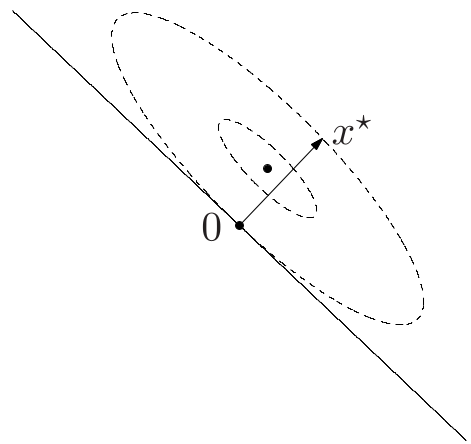 Fig 1: A geometric view of the optimal robust hyperplane. The solution finds an ellipsoid that is "hardest to separate" from the origin, ensuring safety against the worst-case statistical shift.
Real-World Applications
1. Robust Fisher Discriminant (ML)
In classification, if your class means shift, a standard boundary fails. Robust FLDA tilts the decision boundary to account for the "direction of maximum uncertainty" in the class distributions.
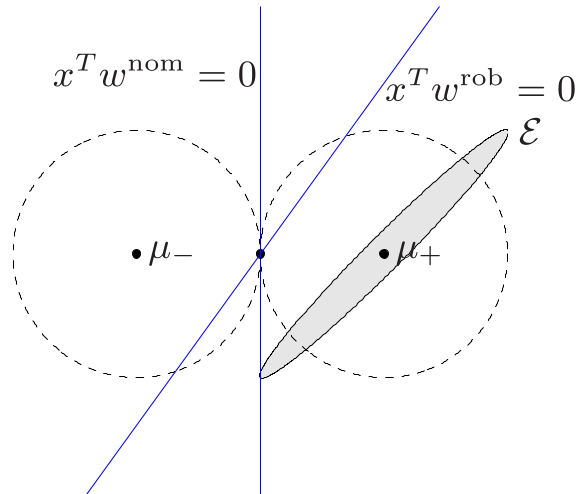 Fig 2: Comparison between nominal and robust boundaries. Note how the robust boundary (solid line) adjusts its angle to stay clear of the uncertainty ellipse ().
2. Robust Portfolio Selection (Finance)
Typical "Mean-Variance" optimization often results in "corner portfolios" that bet heavily on assets with high estimated returns. If those estimates are slightly off, the portfolio crashes.
- Nominal Sharpe Ratio: 0.74 (at best), but drops to 0.22 under uncertainty.
- Robust Sharpe Ratio: 0.57 (more conservative), but stays at 0.36 under uncertainty.
- Gain: A 63% improvement in worst-case risk-adjusted returns.
Critical Insight & Conclusion
The "Boyd approach" consistently emphasizes turning hard, intuitive problems into convex forms that can be solved reliably with interior-point methods.
Limitations: The paper notes this specific theorem doesn't easily extend to the Rayleigh Quotient () where is high-rank. It is specifically optimized for "vector-over-matrix-norm" style problems.
Takeaway: If your system relies on a ratio (like SNR or SR) and your data is noisy, stop using the nominal solution. Use the Minimax formulation—it’s the difference between a system that works in a lab and one that works in the wild.