
DIARIZE: Solving the Economic Puzzle of Rural 5G Connectivity via UAVs and Solar Rings
Minimum Cost Design of Cellular Networks in Rural Areas With UAVs, Optical Rings, Solar Panels, and Batteries
The paper proposes an optimization framework and a heuristic algorithm named DIARIZE for the minimum cost design of cellular networks in rural areas. It integrates UAV-mounted Base Stations, ground sites powered by Solar Panels (SPs) and batteries, and an optical fiber ring to provide cost-effective and self-sustainable connectivity.
Executive Summary
TL;DR: This paper introduces an innovative framework for the minimum-cost design of rural cellular networks. By replacing fixed infrastructure with UAV-mounted Base Stations (BSs) and powering them through localized "Solar-Battery" ground sites interconnected via optical fiber rings, the authors demonstrate a path to slash installation costs (CAPEX) by over 40%.
Context: This work occupies a unique spot in the academic landscape—it transitions from the theoretical "management" of UAVs to a hard-core engineering and economic problem: How do we actually build the physical network from scratch at the lowest possible price?
Problem & Motivation: The Rural Connectivity Divide
Why are billions still offline in rural areas? The math doesn't add up for telcos:
- Grid Absence: Bringing electricity to remote sites is prohibitively expensive.
- Sparsity: Fixed towers are underutilized in low-population density zones.
- Backhaul Costs: Laying fiber in a star topology is too costly.
The authors' insight is to treat the network as a dynamic system: use UAVs to provide coverage only where and when needed, and use a ring topology (more survivable and efficient) for backhaul, entirely powered by Renewable Energy Sources (RES).
Methodology: The OPT RURAL DESIGN Framework
The core of the paper is a mathematical optimization model that balances multiple conflicting goals: finding the minimum number of sites, the right amount of solar panels/batteries to prevent failure during nights/winters, and ensuring every area is covered while UAVs are recharging.
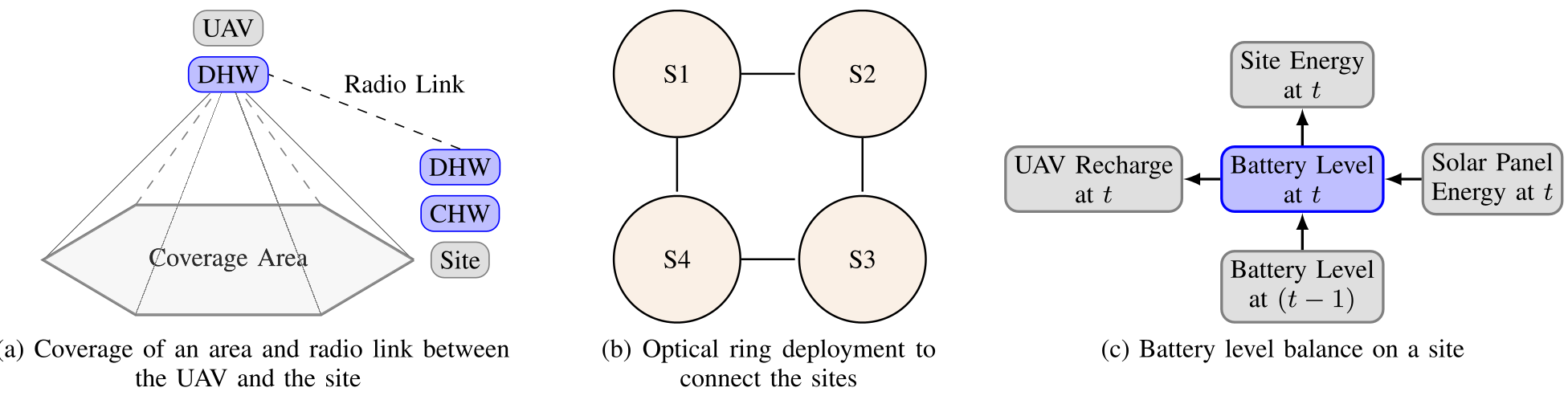
Architectural Breakdown
The system follows a Functional Split approach:
- UAVs: Carry low-level BS functionalities (flying radio).
- Ground Sites: Host high-level BS functionalities, SPs, batteries, and optical interfaces.
- The Ring: A fiber ring connects these sites to the core network.
Moving from Theory to Practice: The DIARIZE Algorithm
Since solving the optimal ILP is NP-complete and can take hours for large maps, the authors created DIARIZE (Design Algorithm for Rural Zones). It works by:
- Clustering: Using k-medoids to find potential site "hubs."
- Pruning: Discarding hubs that can't provide 100% coverage.
- Brute-Force Dimensioning: Testing thousands of SP/Battery combinations for each site to ensure "zero-failure" power levels.
Experiments & Results
The authors tested their model against a REF DESIGN (Traditional Fixed BSs).
Performance Comparison
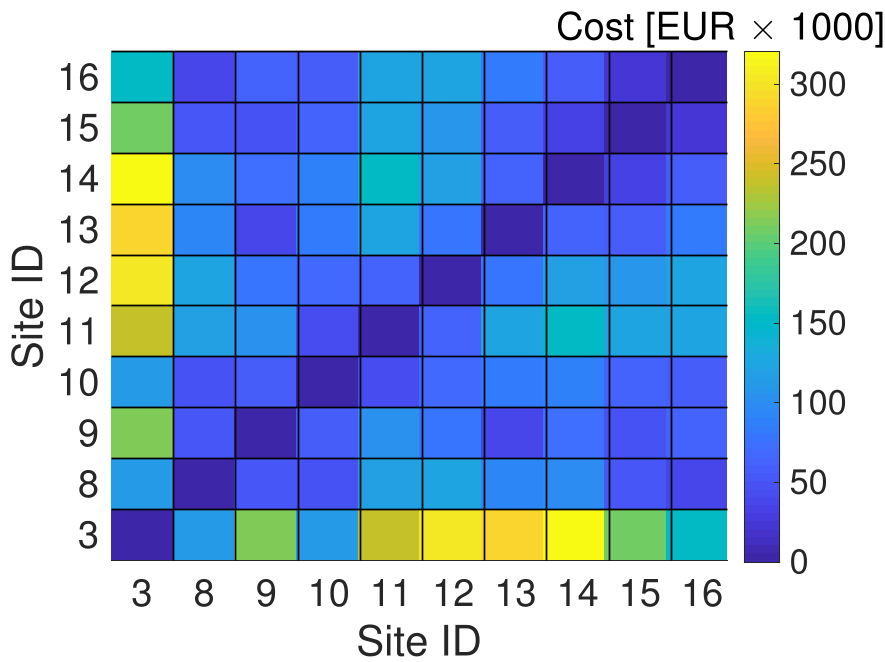
- Cost Efficiency: In the "Frascati Small" scenario, the UAV solution cost €400k vs. the legacy €700k.
- Algorithm Fidelity: DIARIZE achieved almost the same cost as the optimal (Cplex) solver but in a fraction of the time.
Energy Dynamics
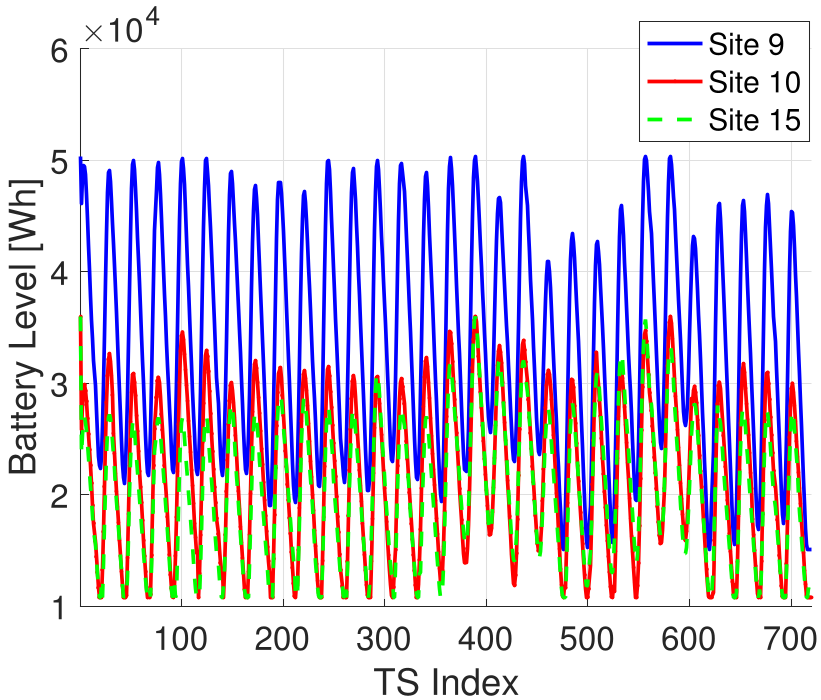
One of the most impressive parts of the study is the battery-level analysis. The model accounts for the diurnal cycle—batteries drain at night while powering ground hardware and recharging UAVs, and replenish during the day.
Critical Analysis & Conclusion
Takeaway
The paper proves that a hybrid UAV-Optical-Solar approach is technically and economically feasible for rural zones. The 35%-42% cost saving is the difference between a project being "too expensive" to "commercially viable."
Limitations
- Weather Dependency: The model relies on historical sunlight data; extreme weather events (e.g., a 7-day storm) might require larger battery buffers or backup generators.
- Interference: While coverage is addressed, the paper leaves the spectral management and inter-cell interference (the "Quality of Service" for individual users) for future work.
Future Outlook
This work lays the groundwork for Autonomous Rural 5G Pools, where self-optimizing sites and UAVs could provide a "network-in-a-box" solution for developing nations or disaster relief.