
C-IC Model: Minimizing Seed Costs in the Battle for Social Influence
Minimum cost seed set for competitive social influence
The paper introduces the Competitive-Independent Cascade (C-IC) model and the Minimum Cost Seed Set (MinSeed) problem to optimize viral marketing in competitive social networks. It proposes a greedy algorithm and a scalable heuristic called LSS-Greedy to achieve a desired influence threshold with minimum seed costs while outperforming prior SOTA methods in both efficiency and approximation guarantees.
TL;DR
In the competitive arena of social networks, being first matters. This paper presents the Competitive-Independent Cascade (C-IC) model, the first to formally integrate "timeliness" and "overlapping seeds" into influence propagation. By proving that influence in this competitive landscape remains submodular, the authors provide a greedy algorithm with a superior approximation ratio and a scalable heuristic, LSS-Greedy, that handles massive networks in seconds.
Background: Beyond Simple Influence Maximization
Most viral marketing research asks: "How much influence can I get with seeds?" However, real companies often ask the inverse: "How little can I spend to reach 10,000 people?" This is the MinSeed problem. Previous attempts at solving this were either computationally explosive or provided weak theoretical guarantees with large additive errors. Furthermore, they ignored the "first-mover advantage"—the psychological reality that the first piece of information to reach a user is the most impactful.
The C-IC Model: Timeliness and Competition
The C-IC model introduces two vital nuances:
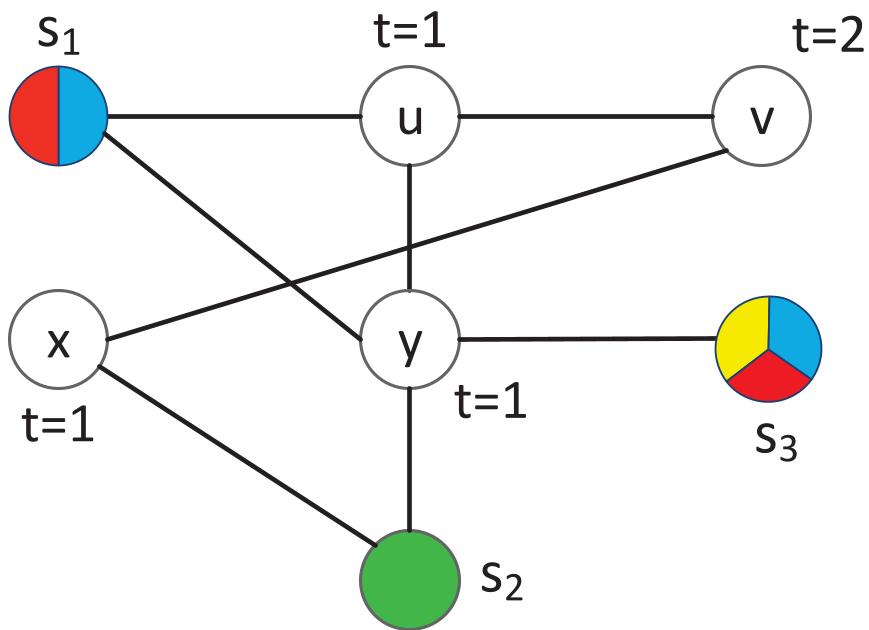
- Overlapping Seeds: Unlike prior models that assumed disjoint seed sets, C-IC allows a single node to act as a seed for multiple competing influences.
- The Priority Principle: When multiple influences reach a node via different paths, the node's final decision is influenced by the set of messages that arrived at the earliest time step.
Submodularity: The Mathematical "Safety Net"
The authors' most significant theoretical contribution is proving that the influence spread in this complex competitive environment is still monotone increasing and submodular. This is crucial because it guarantees that a simple greedy choice—picking the "best bang for buck" node at each step—will stay within a predictable distance of the optimal solution.
Methodology: From Theory to Scalable Algorithms
Calculating exact influence spread is #P-hard. On a graph with millions of nodes, standard Monte Carlo simulations take hours. To solve this, the authors propose:
- Generalized Greedy Analysis: A new approximation ratio that tightens the bounds for any submodular minimization problem.
- LSS-Greedy (Linear-Combination Single-Hop Spread): Instead of simulating the whole cascade, LSS looks at a "single-hop" expansion using linear combinations of edge weights. This reduces complexity from exponential/stochastic time to linear time.
Empirical Results: Speed vs. Quality
The researchers tested their approach against real-world datasets like GR-QC (Physics collaborations) and Enron (Email networks).
- Efficiency: On the WikiVote dataset, the LSS-Greedy algorithm finished in 0.32 seconds, while the standard Greedy approach took over 12 seconds.
- Cost Minimization: Despite the speedup, the cost (number of seeds) found by LSS-Greedy remained remarkably close to the exhaustive greedy version.
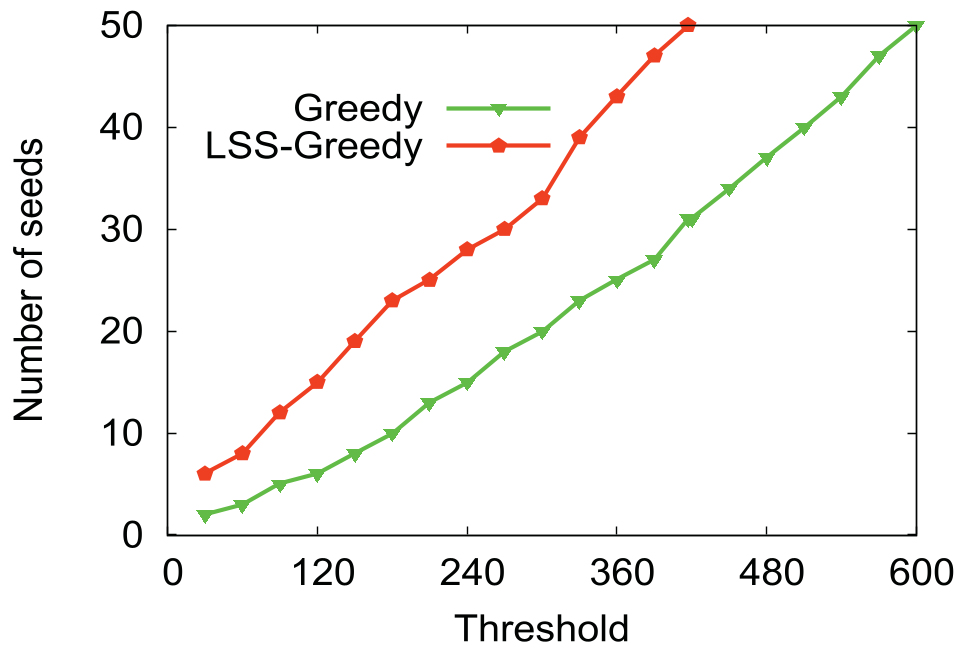 Fig 2: Comparing LSS-Greedy vs. Simple Greedy. Note how LSS-Greedy tracks the performance of the more expensive algorithm closely while being significantly faster.
Critical Insight & Future Outlook
The beauty of this work lies in its "Physical Intuition." By acknowledging that the network is dynamic and competitive, the authors move closer to behavioral reality without losing mathematical tractability.
Takeaways for Practitioners:
- Don't just maximize; minimize. If you have a target reach, use MinSeed logic to save budget.
- Focus on the first hop. The LSS approximation suggests that capturing high-degree nodes and their immediate neighbors is a highly effective proxy for long-term cascade potential.
Limitations: The model currently assumes edge weights (probabilities) are known. In practice, estimating these from noisy social media data remains a significant hurdle. Future work could integrate "Learning from Demonstration" to estimate these parameters on the fly.
Conclusion
This paper sets a new standard for seed minimization by providing the "state-of-the-art best ratio" and an algorithm that makes competitive influence analysis feasible for large-scale enterprise applications.