
Mining Direct Marketing Data: Rough Sets vs. Ensembles in the Quest for Internet Accessibility Prediction
Mining Direct Marketing Data by Ensembles of Weak Learners and Rough Set Methods
This paper explores predicting Internet accessibility in Poland using direct marketing data from the Nationwide Products and Services Questionnaire (NPSQ). The authors implement and compare ensembles of weak learners (Bagging, AdaBoost) and the ModLEM algorithm based on Rough Set Theory, achieving significant improvements over random classifiers in a highly imbalanced dataset.
TL;DR
Predicting consumer behavior is the "Holy Grail" of direct marketing. This study tackles the challenge of predicting Internet accessibility in Poland by leveraging the Nationwide Products and Services Questionnaire (NPSQ). By comparing Ensembles of Weak Learners (Bagging, AdaBoost) with Rough Set-based Rule Induction (ModLEM), the researchers demonstrate how to extract signal from a noisy, imbalanced dataset of over 200,000 records.
Background & Motivation
In direct marketing, the cost of a "False Positive" (sending promotion to someone who won't respond) is high. Acxiom Poland sought to "translate" survey data from 15% of households to the remaining population.
The researchers identified a unique Unit of Analysis: a specific age category within a specific building. This granularity is high enough to be actionable but broad enough to use official registry data (PESEL). However, this leads to Data Inconsistency: different people in the same building/age bracket might have different Internet access, creating "noise" that traditional deterministic models struggle to resolve.
Methodology: The Battle of Paradigms
The paper pits two distinct philosophies against each other:
1. Ensembles of Weak Learners
These methods rely on the "Wisdom of the Crowd." By training multiple simple models (like Decision Stumps or C4.5 trees) and aggregating their votes, the ensemble reduces variance and improves robustness against noise.
- Bagging: Parallel training on random subsets.
- AdaBoost: Sequential training where each new model focuses on the mistakes of the previous one.
2. Rough Set Methods (ModLEM)
Rough Set Theory is specifically designed to handle inconsistency. It categorizes data into:
- Lower Approximation: Objects that "certainly" belong to a class.
- Upper Approximation: Objects that "possibly" belong to a class.
The ModLEM algorithm uses a sequential covering strategy to induce rules that represent these approximations, aiming to provide a more nuanced logical structure than standard decision trees.
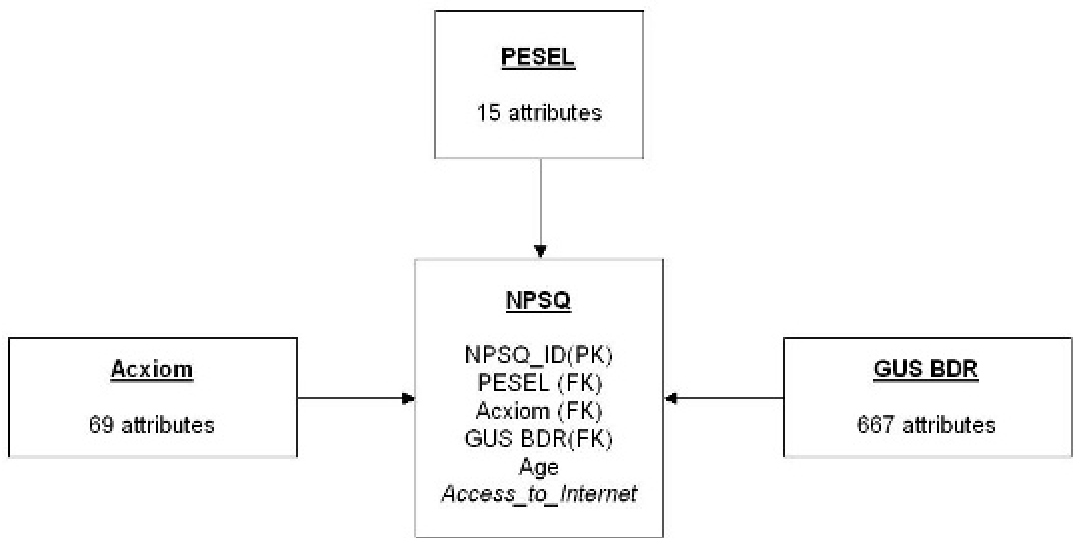 The Figure above illustrates the data integration schema, transforming raw survey data into a star schema suitable for high-performance mining.
Experimental Challenges: A Lesson in Data Hygiene
One of the most candid parts of this paper is the discussion of a "mistake." Initial results were spectacular (Precision ~40%), but the authors discovered that 17% of records were duplicates. When these duplicates were split between training and testing sets, the model was essentially "cheating" by remembering specific households.
After fixing this, the performance dropped, which reflects the true difficulty of the task. The problem is "hard" because the Information Gain for most attributes is near zero.
Results & Insights
The final evaluation showed that Bagging with Linear Support Vector Machines (SVM) and AdaBoost with Decision Stumps were the top performers.
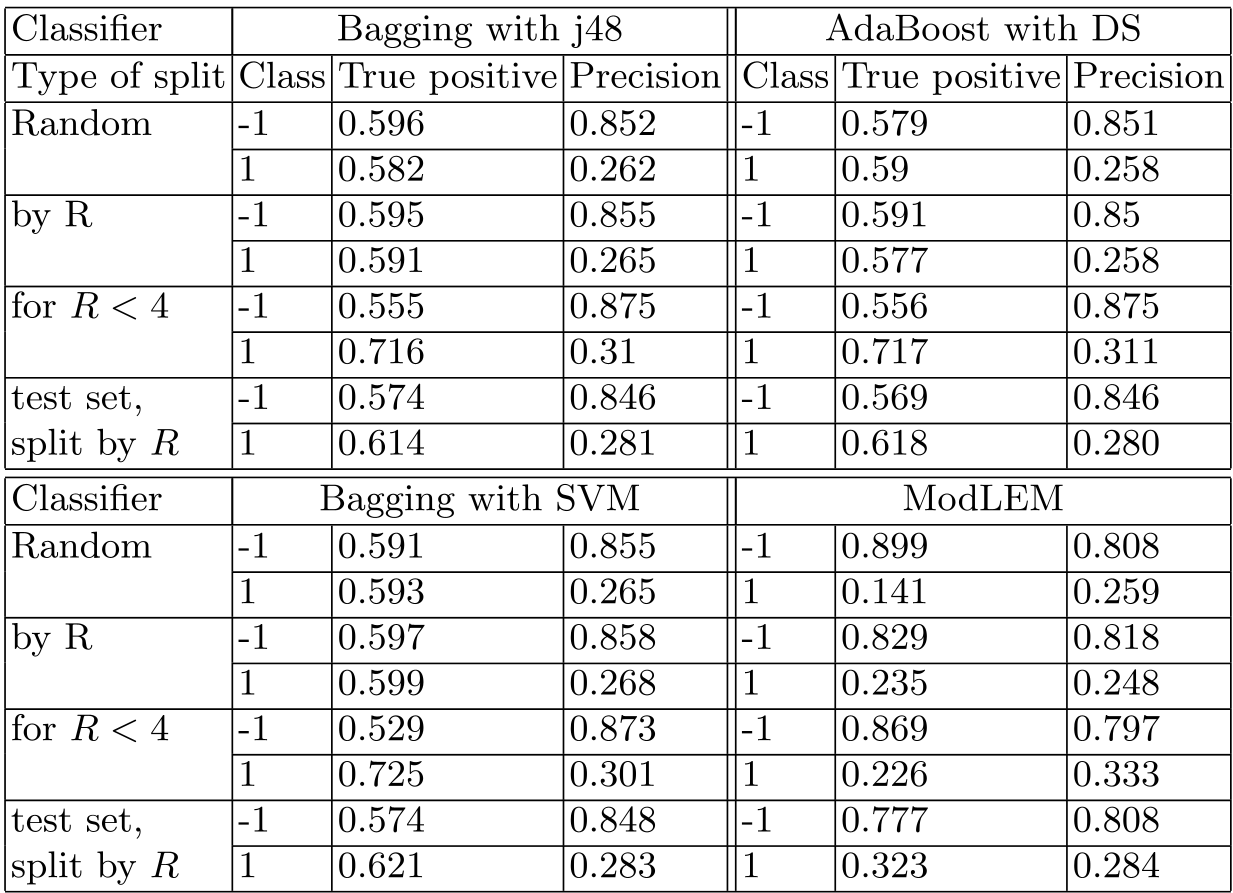 Key results comparison showing true positive and precision rates across various classifiers on fixed data.
- Precision Improvement: Compared to a random classifier (20% precision), the ensemble methods achieved ~28%. While a 8% absolute jump might seem small, in direct marketing at scale, this represents a massive increase in ROI.
- ModLEM Performance: Interestingly, ModLEM struggled more with the highly imbalanced "fixed" data. The authors suggest that a more sophisticated strategy for handling the "areas of inconsistency" (the boundary region in Rough Sets) is needed.
Critical Analysis & Takeaways
The paper confirms that for large-scale, high-dimensional marketing data, Ensemble methods are often the "off-the-shelf" winners due to their inherent ability to handle variance. However, the Rough Set approach offers better interpretability through logical rules, which is valuable for business strategists who want to know why a certain building category is being targeted.
Key Takeaways:
- Data Partitioning (The 'R' Variable): Splitting data by building size (Variable R) helped in focusing the models, especially for smaller buildings where behavior is more predictable.
- Imbalance is the Enemy: Standard classifiers need cost-sensitive adaptations to avoid simply predicting the majority class.
- Experimental Integrity: The paper serves as a warning to all data scientists: always check for data leakage and duplicates before celebrating a high-precision score.