
Mining Environmental Data: A New Frontier for Disease Transmission Prediction
Mining environmental data for prediction of transmission patterns of communicable diseases
This paper proposes an integrated data mining framework to predict transmission patterns of communicable diseases by correlating meteorological, environmental, and pollution datasets. It introduces an expert system architecture designed to handle real-time scientific data streams to provide proactive health decision support.
TL;DR
Climate change is fundamentally altering the map of infectious diseases. This paper introduces a proactive monitoring system that leverages Scientific Data Mining and Wireless Sensor Networks to correlate environmental shifts with disease transmission patterns. By moving beyond static datasets to real-time stream processing, the authors aim to provide a decision-support engine that anticipates outbreaks before they reach new geographic regions.
Background & Motivation: The Climate-Health Link
Climate change rarely acts in isolation. Fluctuations in temperature, rainfall, and air quality interact with underlying social vulnerabilities to extend transmission seasons for vector-borne and water-borne diseases.
The authors identify a major systemic gap: Data Isolation.
- Meteorological departments track humidity and pressure.
- Pollution boards monitor particulates (SPM, RSPM).
- Health centers record infection rates.
The core insight of this research is that these variables are deeply interconnected. To predict a disease outbreak, one must look at the "behavioral patterns" of the environment as a whole rather than tracking disease statistics in a vacuum.
Methodology: Scientific Data Mining & Stream Processing
Unlike market-driven data mining (which focuses on consumer behavior), Scientific Data Mining deals with precise, continuous, and often noisy physical data.
1. The Expert System Architecture
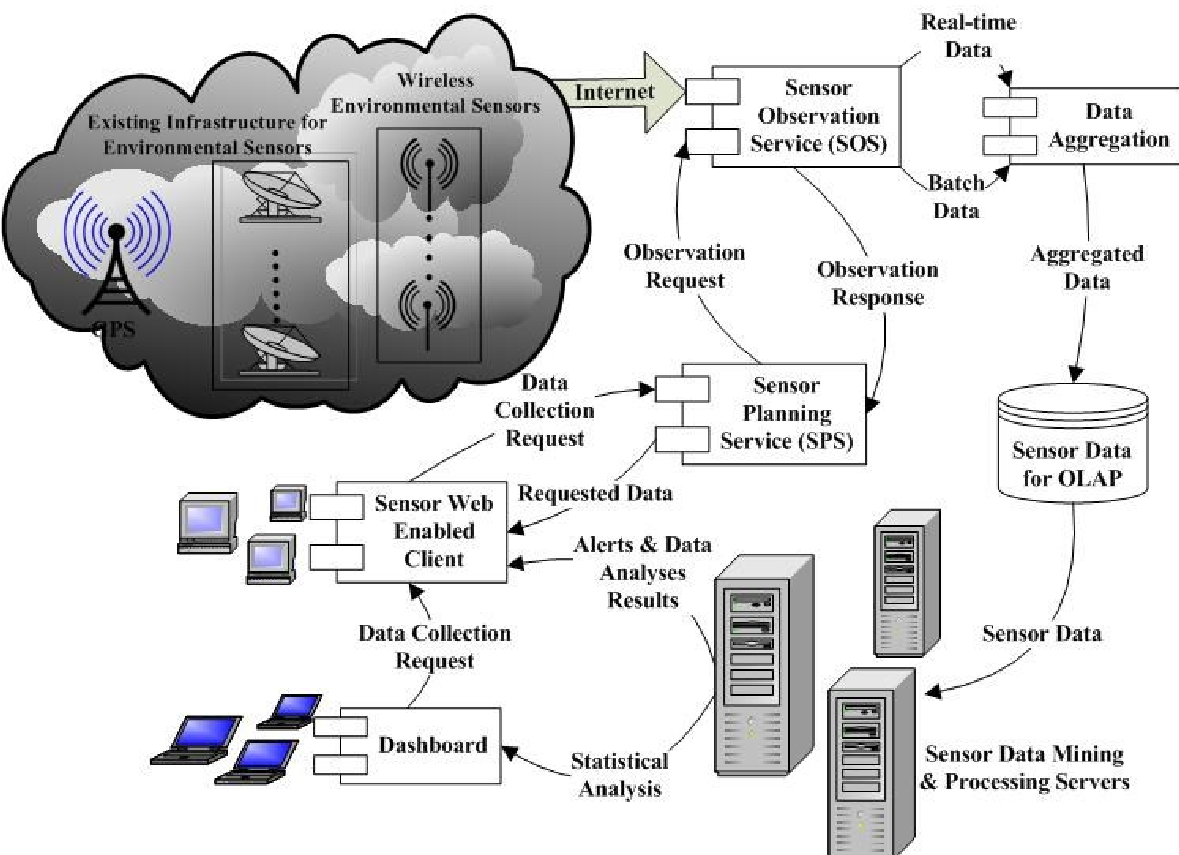
The proposed system functions as an inference engine. It ingests data from three primary streams:
- Meteorological: Dry/Wet bulb temperatures, vapor pressure, and wind speed.
- Pollution: SO2, NOx, and Respirable Suspended Particulate Matter (RSPM).
- Environmental: pH levels, Biochemical Oxygen Demand (BOD), and Fecal Coliform in water.
2. Overcoming Data Stream Challenges
The authors highlight three "V"s of big data streams: Volume, Velocity, and Volatility. To handle these, the paper suggests:
- Load Shedding and Aggregation: Dropping or summarizing data elements to fit memory constraints.
- Addressing Concept Drift: Since environmental patterns change over time (e.g., a sudden monsoon shift), the mining models must update themselves autonomously.
- Algorithm Output Granularity: Using control parameters to manage the rate of results generated by the mining engine.
Experiments & Analytical Focus
The research moves beyond simple correlation to Pattern Mining.
- Sequential Pattern Mining: Finding statistically relevant sequences in sensor data that consistently precede an increase in disease cases.
- Frequent Item-sets: Identifying clusters of environmental conditions (e.g., high humidity + specific temperature range + high BOD) that create a "perfect storm" for vector breeding.
By analyzing parameters like Dew Point and Vapour Pressure alongside Suspended Particulate Matter (SPM), the system can generate hypotheses regarding disease introduction into previously unaffected regions.
Critical Insight: Why This Matters
The shift from "fact extraction" to "hypothesis generation" is the paper's most significant contribution. In complex biological systems, we often lack a "General Theory of Everything." Data mining acts as a bridge, deriving empirical models through induction that can serve as practical tools for public health officers.
Limitations
- On-board Analysis: The paper notes the massive computational cost of transferring raw sensor data to a central hub, suggesting that future iterations might need "edge computing" (on-board analysis at the source).
- Concept Synchronization: If the data preprocessing model updates but the predictive model doesn't, the system risks becoming obsolete.
Conclusion
This work positions data mining not just as a tool for business intelligence, but as a critical infrastructure for public health. By correlating the "breath" of the environment with the "pulse" of disease transmission, we can transform health systems from reactive entities into proactive, adaptive shields against the impacts of climate change.