
Mining the Wisdom of Crowds: Automated Fuzzy Ontology Generation from Wikipedia
Mining Fuzzy Domain Ontology Based on Concept Vector from Wikipedia Category Network
The paper proposes a novel framework for mining Fuzzy Domain Ontologies from the Wikipedia Category Network (WCN). By introducing a concept vector extraction method and a specific weighting algorithm, it characterizes the semantic relatedness between terms and domains to automate the construction of knowledge structures for tasks like expert-finding.
TL;DR
Building domain ontologies is notoriously tedious and often outdated by the time they are finished. This paper introduces a method to automatically "mine" these structures from the Wikipedia Category Network (WCN). By treating Wikipedia categories as fuzzy concepts and calculating path-based relatedness, the authors achieved a 29.2% accuracy boost in document classification over previous SOTA fuzzy methods.
Background: The Problem with Rigid Knowledge
In an era of rapidly evolving information, static ontologies (like early versions of WordNet) act as bottlenecks. Domains often overlap—"Machine Learning" is part of "Computer Science" but also "Statistics." Traditional rigid hierarchies can't handle this "fuzzy" reality. Moreover, Wikipedia’s category structure is a messy, cyclic graph, making it difficult to traverse using standard tree-based algorithms.
Methodology: From Wikipedia to Fuzzy Vectors
The researchers proposed a structural pipeline to transform the chaotic Wikipedia graph into a usable fuzzy ontology.
1. The Architecture
The system maps terms to Wikipedia pages, then to categories, and finally calculates a Concept Vector. This vector represents how strongly a term "belongs" to a specific domain based on its path distance to "Concept Representatives" (ancestor categories).
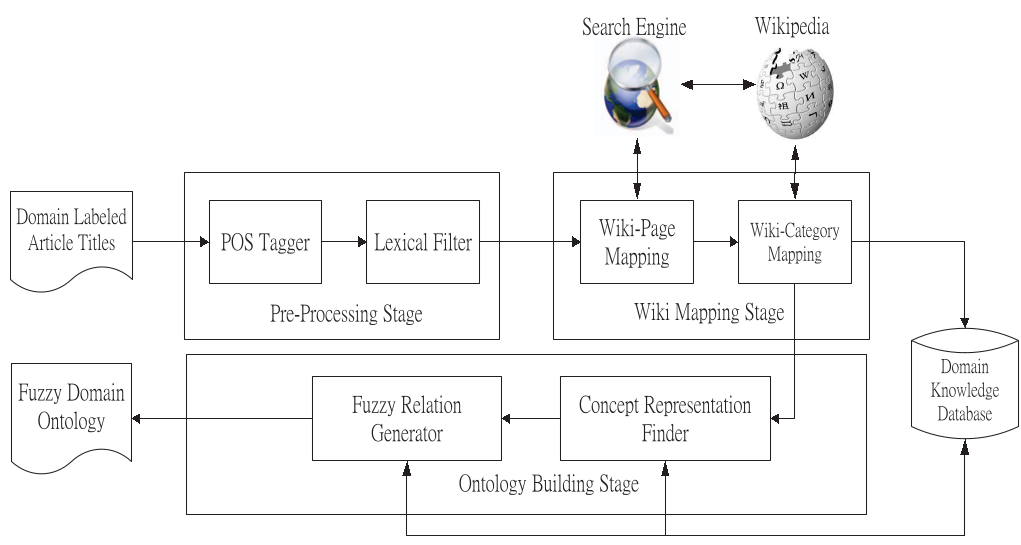 Figure 1: The three-stage workflow: Pre-processing, Wiki Mapping, and the Core Ontology Building Stage.
2. The Fuzzy Secret Sauce:
The core innovation lies in the fuzzy relation (Wikipedia Category to Concept). Instead of a binary "is-a" relationship, they use an exponential decay function based on path length : This acknowledges that while a category might have multiple paths to a concept, shorter paths indicate stronger semantic relevance.
Experiments and Insights
The authors tuned two critical hyperparameters:
- Concept Count: They found that using 10 concept representations per domain strikes the best balance between accuracy and computational cost.
- Weight Parameter (): This controls how much weight is passed to parent categories. They discovered that is the "Goldilocks" zone—high enough to capture general context, but low enough to maintain concrete domain specificity.
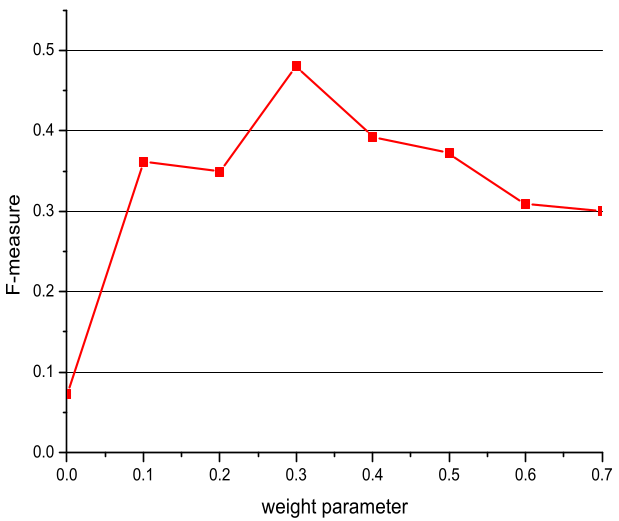 Figure 2: Tuning the alpha parameter; provides the optimal F-measure.
Results vs. SOTA
When compared against the FRG-BMI (Balanced Mutual Information) approach on the Reuters-21578 dataset, the proposed method showed a staggering improvement. In specific categories like 'ACQ', the F-measure soared by nearly 70%, proving that structural network data is often more powerful than pure statistical co-occurrence.
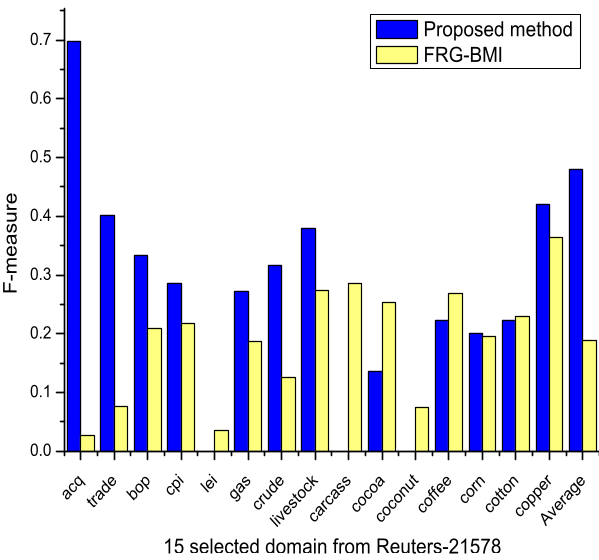 Figure 3: Massive gains over the FRG-BMI baseline across multiple Reuters topics.
Critical Analysis & Conclusion
Takeaway
This work demonstrates that the Wikipedia Category Network is a goldmine for automated ontology engineering. By applying fuzzy logic to path lengths, the authors successfully modeled the "shades of gray" inherent in human knowledge.
Limitations & Future Work
While the method is robust, it relies heavily on the Category Network. The authors note that the next frontier is mining Page Context (the actual text within Wikipedia articles) to refine these fuzzy relations further. Additionally, reducing the time complexity of the graph traversal remains a priority for real-time applications in expert-finding systems.