
Beyond Crisp Logic: Mapping the Nuances of Knowledge with Fuzzy Domain Ontologies
Mining Fuzzy Domain Ontology from Textual Databases
The paper introduces a novel fuzzy domain ontology mining algorithm that automatically extracts concepts and taxonomic relations from textual databases. By integrating lexico-syntactic patterns with a custom "Balanced Mutual Information" (BMI) metric, the method constructs fuzzy ontologies that capture the inherent uncertainty in language, achieving significant gains in semantic Information Retrieval (IR).
TL;DR
Knowledge is rarely black and white. While traditional "crisp" ontologies categorize data into rigid hierarchies, this paper presents a fully automated system to mine Fuzzy Domain Ontologies. By leveraging Balanced Mutual Information (BMI) and fuzzy set theory, the authors transform raw text into a nuanced map of concepts, resulting in a staggering 58.3% improvement in Information Retrieval performance.
Context & Motivation: The Rigidity of Current Systems
In the quest for a "Semantic Web," ontologies act as the structural backbone that allows machines to understand human concepts. However, most existing frameworks treat relationships as binary: either a term belongs to a concept, or it doesn't.
The authors argue that this "crisp" approach is fundamentally flawed for two reasons:
- Labor Intensity: Manually building ontologies for every domain is impossible.
- Uncertainty: Language is probabilistic. A term like "merger" might be highly relevant to "corporate finance" but only tangentially to "legal proceedings."
The Core Innovation: Balanced Mutual Information (BMI)
The paper’s most significant technical contribution is the BMI membership function. Traditional Mutual Information (MI) only looks at how often two terms appear together. The BMI approach considers four scenarios:
- Term A and Term B both appear (Positive evidence).
- Neither Term A nor Term B appear (Negative evidence).
- Term A appears but B does not (Inhibiting evidence).
- Term B appears but A does not (Inhibiting evidence).
By balancing these factors with a weight , the system can filter out "noise" and better estimate the membership of a term within a linguistic concept.
The FuzzyOntoMine Algorithm
The process follows a clean, logical pipeline:
- Preprocessing: POS tagging and stemming.
- Context Extraction: A sliding window (5-10 words) captures local statistical dependencies.
- Fuzzy Concept Building: Groups terms into concepts using BMI.
- Subsumption Discovery: Determines "Is-A" relationships (e.g., is "Laptop" a sub-class of "Computer"?) using fuzzy conjunction operators.
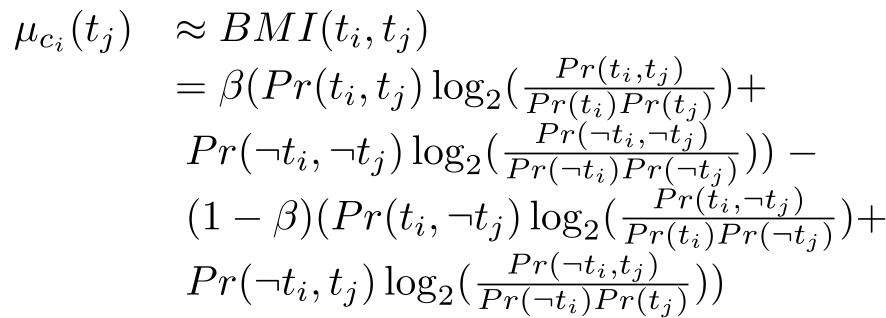 (Note: This BMI formula represents the mathematical heart of the system, calculating membership through weighted positive and negative associations.)
Experimental Results: Proving the Value
The authors didn't just build a model; they tested it in a high-stakes Routing Task using the Reuters-21578 benchmark.
Performance Gains
Using the mined fuzzy ontology for Query Expansion (automatically adding related terms to a user's search) led to a massive boost in recall and F-measure.
| Topic | F-measure (With Ontology) | F-measure (No Ontology) |
|---|---|---|
| Average | 0.188 | 0.119 |
| Carcass | 0.286 | 0.155 |
| Copper | 0.364 | 0.182 |
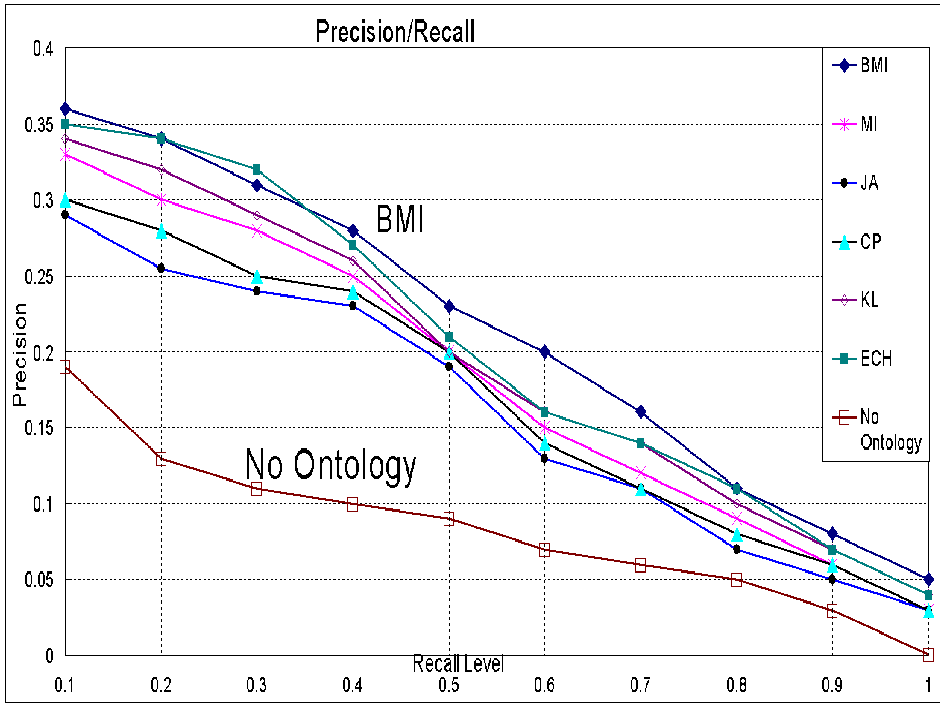 In the Precision-Recall curve above, the BMI-based fuzzy ontology (highest curve) significantly outperforms standard statistical methods and the baseline retrieval system.
Critical Insight: Why Does It Work?
The success of this method lies in its Inductive Bias. By using a sliding window and lexico-syntactic filters (like Noun-Noun patterns), the algorithm focuses on "meaningful" co-occurrences rather than coincidental ones. Furthermore, the use of WordNet for smoothing helps the model account for synonyms that might not even appear in the specific training corpus, making the ontology more robust to variations in human writing.
Summary and Future Outlook
This work demonstrates that fuzzy logic is not just a theoretical curiosity but a practical tool for scaling the Semantic Web.
- Takeaway: Effective AI must embrace uncertainty.
- Limitations: The reliance on pre-defined lexico-syntactic patterns means it might miss non-traditional linguistic structures.
- Future: Integrating this fuzzy mining with Deep Learning (specifically Embeddings) could potentially create even more dynamic and self-evolving knowledge graphs.